Most people pay for an internet connection and use maybe 10 to 20 percent of the bandwidth they are paying for at any given moment. The rest sits idle. Selling internet traffic is simply a way to monetize that idle capacity by letting a third-party service route requests through your IP address while you are not using it yourself.
The mechanism is straightforward. A bandwidth-sharing program installs a small background application on your device. That application registers your IP address in a proxy network. Companies that need residential or mobile IP addresses to collect publicly available data, verify ads, or check localized search results pay to send their requests through that network. A portion of that payment goes back to you. You share bandwidth you would otherwise waste, the client gets a legitimate residential IP, and the platform takes a cut for handling the infrastructure and compliance.
This is different from operating your own proxy business and selling proxy access directly. In that model, you handle everything yourself: the server, the billing, the customer support. Bandwidth-sharing platforms like ByteLixir handle all of that. You just install the app and let it run.
The IP addresses produced this way are called residential proxies, because they come from real consumer internet connections rather than from data centers. Residential proxies are more trusted by target websites than datacenter IPs, which is exactly why businesses are willing to pay for them. A data analytics company scraping product prices across ten thousand retail pages needs IP addresses that look like ordinary shoppers, not server blocks. Your home connection provides exactly that.
Who Actually Buys This Traffic and Why?
Understanding the demand side helps you evaluate whether joining a network makes sense. The buyers are overwhelmingly businesses running automated data collection at scale. An e-commerce company checking competitor prices across 50 markets needs thousands of residential IP addresses to do that without getting blocked. A travel aggregator verifying airfare accuracy region by region needs the same thing. An ad-tech firm confirming that its display campaigns appear correctly in Germany, Brazil, and South Korea cannot do that from a single office IP.
These companies do not want to recruit and manage millions of individual users directly. Instead they license access to a bandwidth-sharing network that has already done the recruitment, built the software, and handled compliance. That network is the intermediary between you and those business clients. ByteLixir operates as exactly this kind of intermediary, and it currently serves more than 500,000 users worldwide.
Demand is not uniform. High-income, low-density locations in Western Europe, North America, and parts of Asia command more per gigabyte because businesses targeting those markets need local IPs. A residential address in suburban Ohio is worth more to a US-focused retailer than an address in a smaller market. This geographic factor is one of the main variables that determines your actual earnings, and it is worth understanding before you set expectations.
What ByteLixir Is and How It Fits Into This Picture
ByteLixir (https://bytelixir.com/) is a bandwidth-sharing platform that lets ordinary users earn passive income by contributing their internet connection to a proxy network. The platform has over 500,000 users worldwide and holds a 4.76 rating on TrustPilot based on verified user reviews. The premise is simple: sign up, download the app, keep it running in the background, and collect payments for the traffic your device shares.
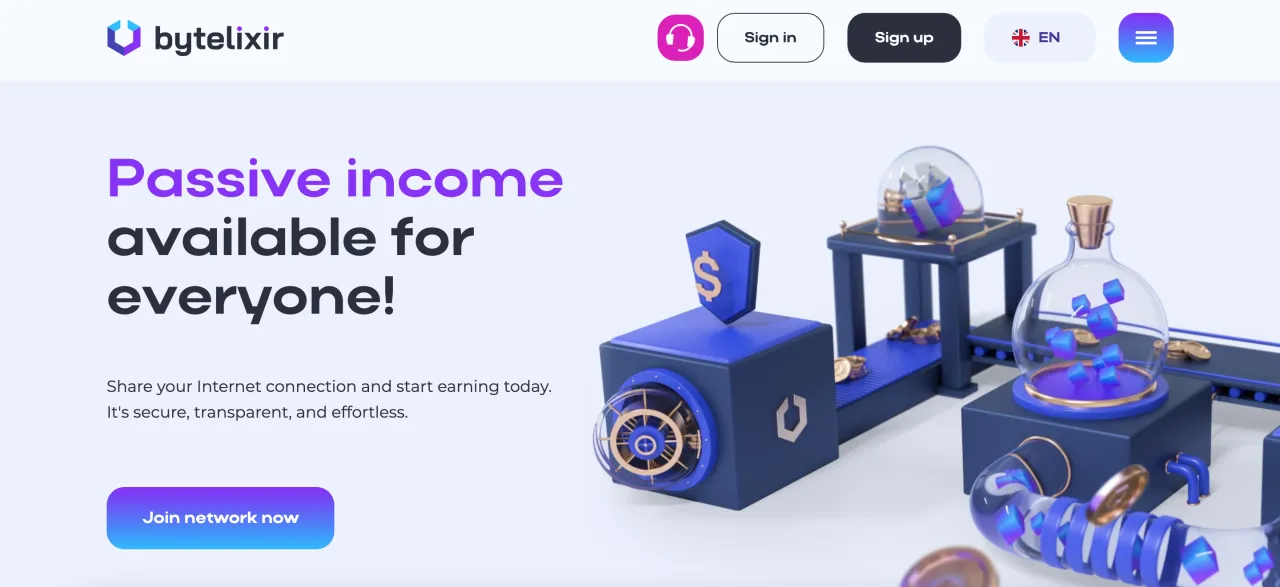
The platform is honest about what happens to your traffic. ByteLixir works primarily with data analytics companies that collect publicly available information. That means the requests traveling through your connection are going to public websites, not to anything private or restricted. The platform enforces strict KYC and AML policies on every partner company before granting network access, and its monitoring systems detect and block violations in real time. It is also verified by antivirus, which matters because running any background application deserves scrutiny before installation.
From a user perspective, the whole point is that you do very little. There is no configuration of proxy endpoints, no managing customer accounts, no dealing with abuse complaints. ByteLixir abstracts all of that away. Your job is to keep the app running.
Who Should Actually Consider This
Bandwidth-sharing is genuinely suitable for a fairly broad range of people, but it is not for everyone. Here is an honest breakdown.
- Home users with uncapped broadband: If your ISP charges a flat monthly rate and you do not have a data cap, sharing bandwidth costs you nothing extra. This is the ideal scenario.
- People with multiple devices on different IP addresses: ByteLixir pays more when you contribute more unique IPs. A household with a desktop, a laptop, and a smartphone on separate connections can meaningfully increase earnings compared to running the app on a single device.
- Small office or home office operators: An always-on PC or a spare Raspberry Pi left running overnight accumulates hours of shared bandwidth without any active effort.
- Users in high-demand geolocations: Earnings depend heavily on where you are located. ByteLixir's demand map shows real-time demand by country, and some regions command significantly higher rates than others.
- Mobile users on unlimited cellular plans: ByteLixir supports mobile and cellular network sharing. Mobile IPs are among the most valuable in the proxy market because they carry 4G and 5G carrier assignments that are almost impossible to block without collateral damage. If you have an unlimited mobile plan, this is worth exploring separately from your home connection.
People who should be more cautious include anyone on a metered connection where excess usage costs money, anyone whose ISP terms of service explicitly prohibit reselling or sharing bandwidth, and anyone in a country where demand is consistently very low. The earnings in low-demand regions may not be worth the background resource usage.
What Determines How Much You Earn
ByteLixir is transparent about the factors that drive earnings, and they are worth understanding in detail rather than just glancing at an average number.
Geolocation is the single biggest variable. Proxy buyers pay different rates for different countries because the demand for IPs in those locations varies. A US residential IP in 2026 commands a premium because American e-commerce, streaming platforms, and ad networks are heavily targeted by analytics companies. Western European IPs are also in strong demand. IPs from regions with fewer active scraping targets earn less, not because the platform values them less, but because fewer buyers are requesting traffic through those locations. ByteLixir shows a demand map on its homepage that color-codes locations from very high demand to very low demand, which gives you a realistic expectation before you sign up.
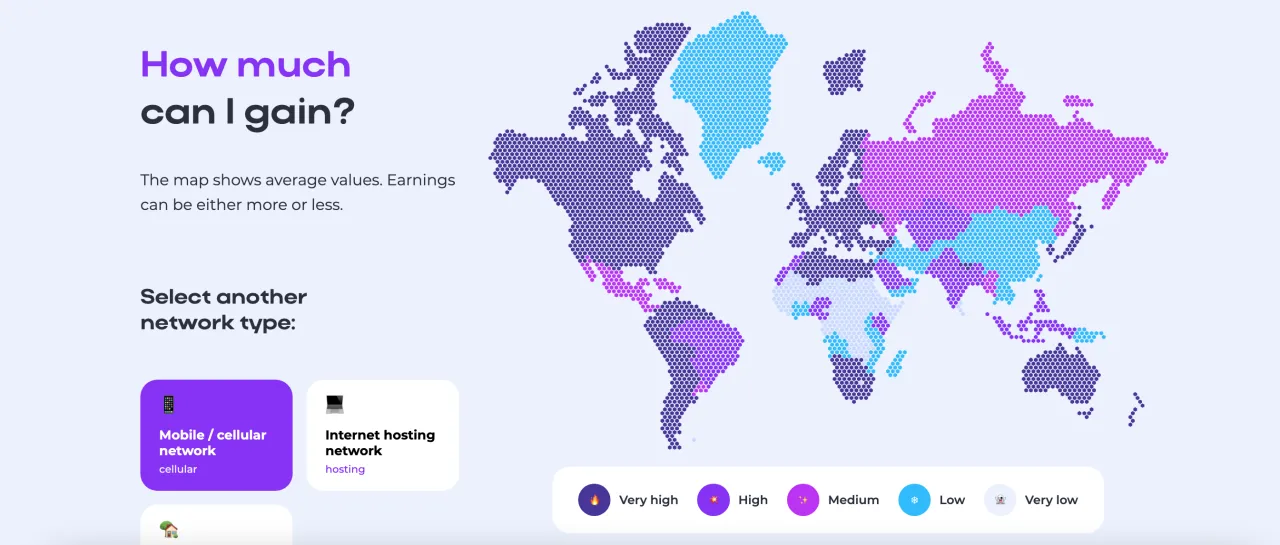
Connection speed is the second major factor. ByteLixir recommends a minimum of 50 Mbps. Below that threshold, the app can still run, but faster connections handle more concurrent requests, which translates directly into more traffic sold and more money earned. If you are on a 10 Mbps DSL line, your ceiling is lower than someone on a 500 Mbps fiber connection.
Number of unique IP addresses is the third lever. The platform pays per IP, not per device in a flat sense. Two devices on the same router share one public IP and effectively count as one node. Two devices on separate connections, whether two different home networks or a home connection plus a mobile data connection, contribute two IPs and double that portion of your earnings. This is why the platform explicitly recommends installing the app on multiple devices connected to different IP addresses.
Connection uptime is the fourth variable. The app earns when it is running. A machine that stays online 24 hours a day earns more than one that is only on during business hours. This seems obvious, but the practical implication is that earnings are proportional to uptime in a fairly linear way. A device running 12 hours a day earns roughly half what it would earn running continuously.
Network type also plays a role. Mobile cellular connections, home broadband connections, and hosting connections are priced differently because the proxy buyers value them differently. Mobile IPs are the most valuable because they carry genuine carrier attribution. Home residential connections are second. Hosting IPs, meaning connections routed through internet hosting providers, are less valuable because they are closer to datacenter IPs in the eyes of target websites.
Earnings Estimate: A Practical Calculation
ByteLixir states that earnings vary and recommends waiting one to two months of active participation before evaluating performance. That is sensible advice. However, it is possible to work out a rough estimate using what the platform discloses and what is publicly known about the bandwidth-sharing market.
A single home residential IP in a high-demand country such as the United States, the United Kingdom, or Germany, running continuously on a connection above 50 Mbps, typically generates between $5 and $20 per month through platforms in this space. ByteLixir's own published guide references a path to $100 or more monthly, which implies that reaching that number requires multiple IPs across devices rather than a single installation.
A realistic scenario for a motivated user might look like this. You install the app on a home PC connected to your broadband (IP 1), on a personal smartphone using a separate mobile data connection (IP 2), and on a spare laptop that stays plugged in overnight (this shares IP 1 with the desktop unless the laptop uses a separate mobile hotspot). With two distinct IPs in a moderate-demand country, a reasonable expectation is $8 to $25 per month combined. In a high-demand country with three or four distinct IPs and good uptime, the $50 to $100 range becomes realistic. Exceeding $100 monthly usually means running the app on many devices across multiple high-demand IPs simultaneously, which some users achieve by running it on a small home server cluster or several family members' devices.
These numbers are not guarantees. ByteLixir is explicit that the demand map shows average values and that actual earnings can be higher or lower. The figures above are consistent with what the bandwidth-sharing category generally delivers. Do not expect to replace a salary. Do expect to offset a portion of your monthly internet bill with no ongoing effort.
Security and Legal Considerations
The most common concern people raise about bandwidth-sharing is whether it is safe and legal. Both are fair questions that deserve a direct answer rather than marketing reassurance.
On the legal side, sharing bandwidth through a platform that routes traffic to publicly available websites is legal in the vast majority of jurisdictions. You are not providing access to private systems or enabling any kind of intrusion. The analogy is closer to renting out a parking space than to anything more sensitive. ByteLixir enforces KYC and AML policies on the companies using its network, which means the platform is not simply selling anonymous access to anyone with a credit card. Only verified, vetted business partners can route traffic through the network.
The more practical legal consideration is your ISP's terms of service. Some internet service providers include clauses that prohibit commercial use of a residential connection. It is worth reading your contract before you start, because this varies by provider and country. Most ISPs do not actively monitor for or enforce these clauses against small-scale bandwidth sharing, but it is a variable worth knowing about.
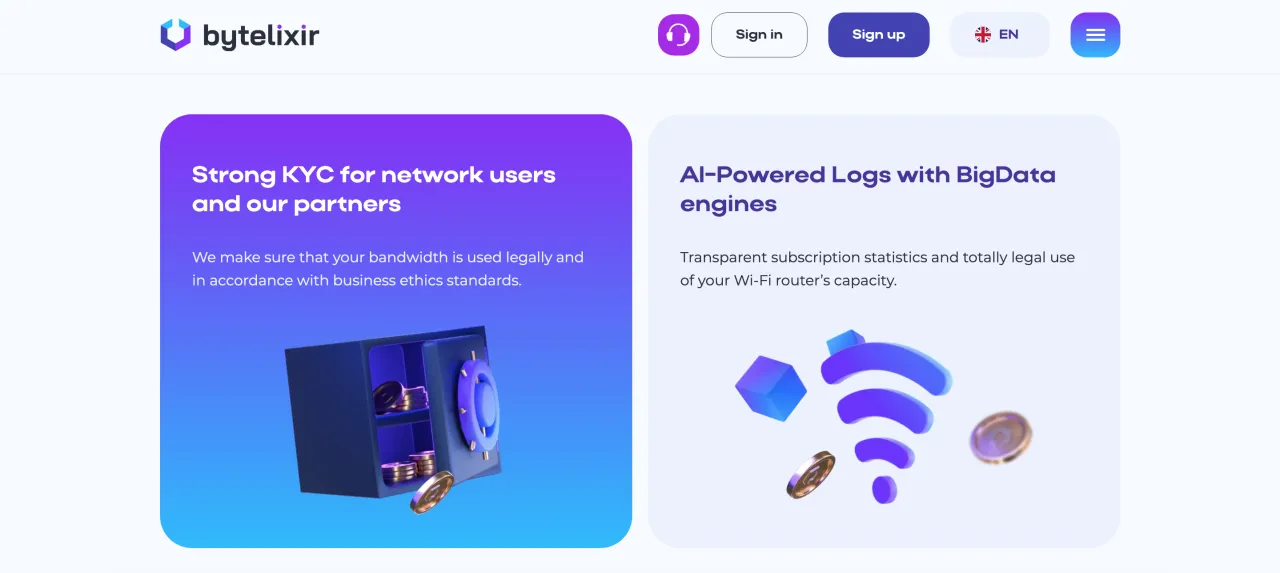
On the security side, ByteLixir states that its AI-powered monitoring systems log all traffic and block violations in real time. The app is verified by antivirus. The platform uses BigData engines for transparent subscription statistics. None of this makes the platform immune to every conceivable risk, but it places ByteLixir well above the category of anonymous, unaudited bandwidth-sharing schemes that have existed in this space. The fact that the platform enforces strong KYC on network users and partners is the most meaningful security signal, because it means the platform has commercial and legal reasons to keep traffic clean.
One thing to be clear about: you are sharing your IP address with the network. Requests that travel through your IP will be associated with your IP in the logs of whatever website they visit. If a partner company violates ByteLixir's terms and uses your IP for something problematic before the monitoring catches it, that activity temporarily appears to originate from your address. The monitoring layer is designed to prevent this, but it is worth understanding the mechanism. This is not unique to ByteLixir, it applies to every bandwidth-sharing platform in the market.
How to Get Started with ByteLixir: A Step-by-Step Walkthrough
The process is genuinely simple, but it is worth walking through each step so there are no surprises.
Step 1: Create an Account
Go to the ByteLixir website https://bytelixir.com/ and click "Sign up". The registration requires an email address. During registration, enter the referral code 5ENXKEMGYKE3 to receive a $1 welcome bonus on your account. After confirming your email, you will have access to the dashboard. There is no payment required to sign up and no KYC required from users joining to share bandwidth, only from the business partners using the network.
Step 2: Download and Install the App
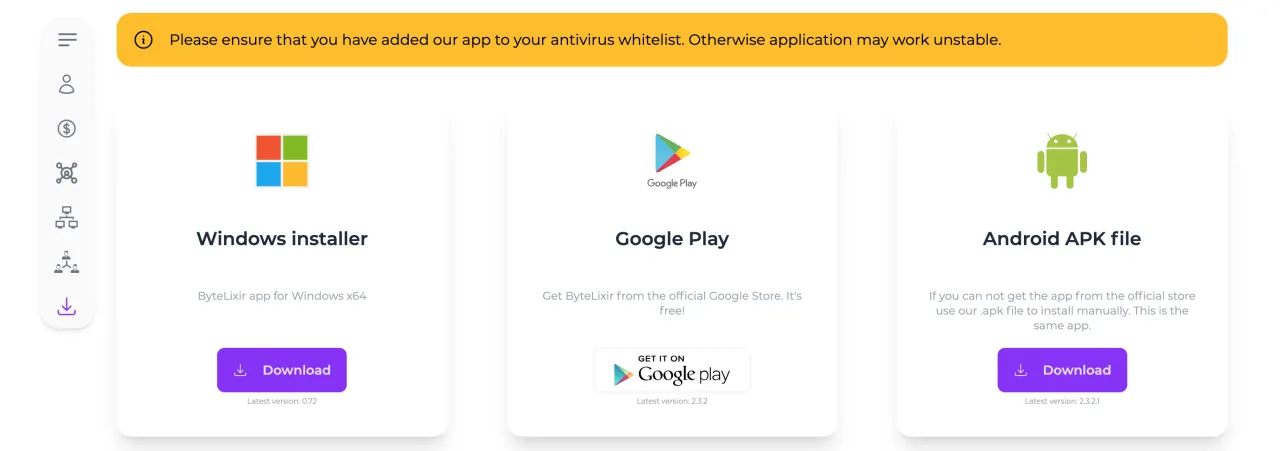
ByteLixir provides a client application for your device. Download it from the dashboard. Installation is straightforward on standard operating systems. One user noted in a review that there is currently no Docker or Raspberry Pi build, which is a limitation for users who want to run it on lightweight Linux environments. If you are planning to run it on a Pi, check the current list of supported platforms before purchasing hardware specifically for this purpose.
Step 3: Sign In and Launch
Open the app and sign in with the same email address you used to register. Once signed in, start the sharing process. The app will begin routing traffic through your connection. You do not need to configure anything else. The app runs in the background and you can continue using your computer normally.
Step 4: Monitor Earnings in the Dashboard
The dashboard shows your earnings and traffic statistics. ByteLixir uses AI-powered logging with BigData engines, so the statistics are updated regularly and reflect actual traffic volumes passing through your node. Give the system one to two months before drawing conclusions about your earning rate, because demand fluctuates and the first days may not represent a typical average.
Step 5: Withdraw Earnings
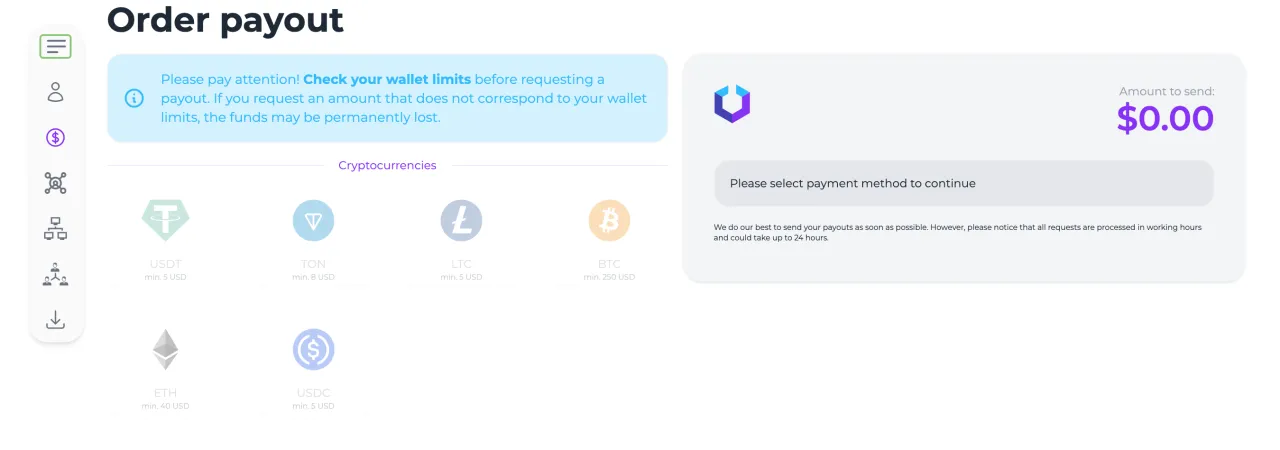
Once your balance reaches the minimum payout threshold, you can request a withdrawal. Several users have noted that withdrawals process almost instantly once initiated. One point worth flagging: ByteLixir raised its minimum payout amount at some point, which means you now need to accumulate more before withdrawing. This does not affect total earnings, but it does affect cash flow frequency. Budget for a longer accumulation period between withdrawals.
Step 6: Scale Up with Additional Devices
If you want to increase earnings, install the app on additional devices connected to different IP addresses. A home PC, a smartphone on mobile data, and a spare tablet each on a different connection represent three distinct IPs. Each additional IP adds an independent earning stream. The scaling is linear: more IPs in higher-demand locations means proportionally higher income.
How ByteLixir Compares to Running Your Own Proxy Operation
Some people who research this topic land on it because they are interested in proxies more broadly, and it is worth explaining how bandwidth sharing differs from operating a proxy business directly.
Running your own proxy operation means acquiring IP addresses, setting up proxy server software (such as 3proxy or Squid), handling authentication, building a billing system, marketing to buyers, and managing abuse reports. The earning potential is higher per IP because you keep the full margin rather than a platform cut. But the complexity is also much higher. You are running a business, not a passive income stream.
ByteLixir is the opposite trade-off. You earn less per IP because the platform takes its share for handling all the infrastructure, compliance, and customer relationships. But the time investment after initial setup is essentially zero. For most people, the passive model makes more sense unless they have the technical background and the time to operate a full proxy business.
There is also a risk difference. With your own proxy operation, abuse of your IPs is your problem to manage. With ByteLixir, the platform's monitoring layer and partner vetting handle that responsibility. The platform has stronger incentive to keep the network clean than an individual operator does, because its entire business model depends on maintaining quality and legal standing with partner companies.
A Simple Code Example: Monitoring Your ByteLixir Node Status
If you run multiple devices and want a programmatic way to check whether the ByteLixir client is active on each machine, the following Python script uses the psutil library (a cross-platform process and system monitoring tool) combined with the requests library (an HTTP client for Python) to verify the process is running and log a heartbeat. This is not a ByteLixir API integration, it is a local monitoring wrapper for your own node management.
import psutil
import time
import logging
from datetime import datetime

# Configure structured logging so output is readable in log aggregators
logging.basicConfig(
 level=logging.INFO,
 format="%(asctime)s [%(levelname)s] %(message)s"
)

PROCESS_NAME = "bytelixir" # Adjust if the executable name differs on your OS
CHECK_INTERVAL_SECONDS = 300 # Check every 5 minutes
MAX_RETRIES = 3


def is_client_running(process_name: str) -> bool:
 """
 Iterate over running processes and look for the ByteLixir client by name.
 psutil.process_iter is safer than shell commands because it does not
 spawn a subprocess and works consistently across Windows, macOS, and Linux.
 """
 for proc in psutil.process_iter(["name", "status"]):
 try:
 if process_name.lower() in proc.info["name"].lower():
 if proc.info["status"] != psutil.STATUS_ZOMBIE:
 return True
 except (psutil.NoSuchProcess, psutil.AccessDenied):
 # Process may have terminated between iteration steps; skip it
 continue
 return False


def check_with_retries(process_name: str, retries: int) -> bool:
 """
 Run the process check up to `retries` times with a short backoff.
 A single negative result can be a transient read error, not a real outage.
 """
 for attempt in range(1, retries + 1):
 if is_client_running(process_name):
 return True
 logging.warning(
 "Client not detected on attempt %d of %d. Retrying in 10s.",
 attempt, retries
 )
 time.sleep(10)
 return False


def monitor_loop():
 logging.info("ByteLixir node monitor started.")
 while True:
 timestamp = datetime.utcnow().isoformat()
 running = check_with_retries(PROCESS_NAME, MAX_RETRIES)
 if running:
 logging.info("[%s] Client is active. Node is sharing traffic.", timestamp)
 else:
 logging.error(
 "[%s] Client is NOT running after %d attempts. "
 "Manual restart required.",
 timestamp, MAX_RETRIES
 )
 # Insert your alerting logic here, e.g. send an email or a
 # webhook to Slack so you know immediately when a node goes offline.
 time.sleep(CHECK_INTERVAL_SECONDS)


if __name__ == "__main__":
 monitor_loop()
To run this, install the dependencies first with pip install psutil requests, then execute python monitor.py. On a machine where you want this to run persistently alongside the ByteLixir client, you can register it as a systemd service on Linux or a scheduled task on Windows. The retry logic matters because a brief system hiccup can cause a single process scan to miss an otherwise healthy process. Three retries with a ten-second gap between them is a reasonable balance between sensitivity and false alarms.
Is This Safe for Your Home Network?
The legitimate concern here is what traffic is actually passing through your connection. ByteLixir addresses this directly. The platform restricts what partners can do with the network, focuses use on publicly available data collection, and runs real-time monitoring that blocks violations before they complete. Partners are vetted through KYC and AML procedures before gaining access. You are not running an open relay. The traffic is monitored, filtered, and logged.
From a practical standpoint, the application uses a fraction of your available bandwidth. Your own browsing, streaming, and gaming are unaffected. The client runs at low priority and is designed specifically to avoid interfering with your normal internet use. On a 100 Mbps connection, the background traffic contribution is generally imperceptible during regular use.
There is one category of risk worth being honest about. Any service that routes external traffic through your IP does mean that IP address will appear in the logs of whatever websites the partner clients are visiting. This is inherent to the residential proxy model and not specific to ByteLixir. For most home users doing standard browsing, this has no practical consequence. For someone with unusual reasons to keep their IP address history clean, it is worth factoring in.
A Realistic View of the Passive Income Category
Bandwidth-sharing sits in a broader category of passive income tools that includes staking cryptocurrency, renting storage space, and similar schemes. The honest reality is that none of these replace meaningful income on their own for the average user. What they do is generate a small but genuine return on resources that would otherwise go unused.
ByteLixir's positioning is accurate when it says this is about offsetting your internet bill rather than funding a lifestyle. A user in a high-demand country running the app on two or three devices might earn $20 to $60 per month after a few months of stable operation. That is real money that requires no ongoing work. It is not transformative, but it is also not nothing.
The 500,000 user count that ByteLixir reports, combined with the 4.76 TrustPilot score, suggests the platform operates reliably enough that a large number of people have found it worth keeping installed. The most common complaints in user reviews are about payout thresholds being raised and slow accumulation rather than about payments failing or the platform behaving dishonestly. Those are frustrations about rate of return, not about integrity, which is the more important variable when deciding whether to trust a platform with a background process on your machine.
If you have idle bandwidth, a device that stays powered on, and a few minutes to complete setup, ByteLixir is a straightforward way to put that idle capacity to work. The ceiling depends on your location and how many IPs you contribute. The floor is a small but consistent addition to your monthly budget for doing essentially nothing after the first install.
FAQ
- Is it legal to sell your internet bandwidth?
- In most jurisdictions, including the United States, yes, as long as the platform routes traffic only to publicly available websites. The practical limit is your ISP contract: some providers prohibit commercial use of a residential connection, so read your terms before you install anything.
- Is selling your internet bandwidth safe?
- Requests from the platform's clients leave through your IP address and appear in the logs of the sites they visit. ByteLixir vets every partner company with KYC and AML checks, monitors traffic and blocks violations in real time, and its app is verified by antivirus. That lowers the risk but does not remove it: if a partner breaks the rules before monitoring catches it, the activity briefly looks like it came from your address.
- How much can you earn by selling bandwidth?
- One home IP in a high-demand country such as the US, the UK or Germany, online around the clock on a connection above 50 Mbps, typically brings $5 to $20 a month. Two or three devices on different IP addresses can reach $20 to $60 after a few months. Going past $100 a month takes many IPs in high-demand locations. ByteLixir itself suggests judging results only after one to two months.
- Is it worth selling unused internet bandwidth?
- It is worth it if you pay a flat monthly rate with no data cap and a device stays on most of the day: the income offsets part of your internet bill for no ongoing effort. It is not worth it on a metered or capped connection, in a country with low demand, or if your ISP contract forbids sharing the connection.
- What should I check before installing a bandwidth-sharing app?
- Your ISP terms and data cap, whether the platform verifies the companies that buy the traffic, what kind of traffic it allows, the minimum payout (ByteLixir has raised it in the past), the devices it supports (there is no Docker or Raspberry Pi build yet) and the demand map for your country.
- Will sharing bandwidth slow down my internet?
- In normal use you should not notice it. The client runs at low priority and takes a fraction of the connection, and on 100 Mbps the background traffic is generally imperceptible. ByteLixir recommends at least 50 Mbps. Slower lines still work but handle fewer requests and earn less.
- Who buys the bandwidth people share?
- Companies that collect public data at scale: e-commerce firms checking competitor prices, travel aggregators verifying fares by region, ad-tech firms checking how campaigns render in other countries, and data analytics companies collecting publicly available information. They need residential IPs that look like ordinary users, which is what a home connection provides.