Pricing
- ISP Proxies
- Dedicated Datacenter Proxies
- Unlimited Residential Proxies
- Static Residential Proxies
- Dedicated Mobile Proxies
- Rotation Residential Proxies
Specifications

ProxyShard in our rankings
Proxy Type
- Mobile Proxies
- Residential Proxies
- ISP Proxies
- Datacenter Proxies
- Dedicated Datacenter Proxies
- Unlimited Residential Proxies
- Static Residential Proxies
- Dedicated Mobile Proxies
- Rotation Residential Proxies
Available Countries
- Ukraine
- France
- Germany
- Ireland
- Italy
- Netherlands
- Poland
- Portugal
- Spain
- United States
- Canada
- Indonesia
- Moldova
- Ukraine
- Austria
- Belgium
- Bulgaria
- Croatia
- Czech Republic
- Denmark
- Estonia
- Finland
- France
- Germany
- Greece
- Hungary
- Ireland
- Italy
- Latvia
- Lithuania
- Netherlands
- Poland
- Portugal
- Romania
- Slovakia
- Slovenia
- Spain
- Sweden
- United Kingdom
- Australia
- United States
- Canada
- China
- India
- Saudi Arabia
- United Arab Emirates
- Israel
- Japan
- Korea
- Norway
- Thailand
- Switzerland
- Turkey
- Serbia
- Kazakhstan
- Vietnam
- Philippines
- Indonesia
- Malaysia
- Mexico
- Brazil
- Argentina
- Azerbaijan
- Algeria
- Andorra
- Armenia
- South Africa
- Bangladesh
- Belarus
- Bosnia and Herzegovina
- Vatican
- Venezuela
- Georgia
- Dominican Republic
- Egypt
- Jordan
- Iraq
- Iceland
- Cambodia
- Hong Kong
- Colombia
- Costa Rica
- Kyrgyzstan
- Luxembourg
- Moldova
- Monaco
- Nigeria
- New Zealand
- Pakistan
- Singapore
- Tajikistan
- Taiwan
- Uzbekistan
- Montenegro
- Ecuador
- Albania
- Bahamas
- Bahrain
- Bolivia
- Cameroon
- Chile
- Cuba
- Cyprus
- Ethiopia
- Guatemala
- Jamaica
- Kenya
- Lebanon
- Liberia
- Libya
- Macedonia
- Madagascar
- Maldives
- Malta
- Mongolia
- Morocco
- Nepal
- Paraguay
- Peru
- Qatar
- Seychelles
- Sri Lanka
- Tanzania
- Tunisia
- Turkmenistan
- Uruguay
- Zambia
- Afghanistan
- Angola
- Aruba
- Benin
- Bhutan
- Botswana
- Brunei Darussalam
- Burkina Faso
- Congo
- Côte d'Ivoire
- Curacao
- El Salvador
- Fiji
- Gabon
- Ghana
- Guadeloupe
- Guyana
- Honduras
- Kuwait
- Macao
- Mali
- Mauritius
- Mozambique
- Myanmar
- Namibia
- Oman
- Palau
- Palestine
- Panama
- Puerto Rico
- Réunion
- Russia
- Rwanda
- Saint Lucia
- Senegal
- Sudan
- Syria
- Timor-Leste
- Togo
- Trinidad and Tobago
- Uganda
- Yemen
- Zimbabwe
- Chad
- Djibouti
- Gambia
- Mauritania
- South Sudan
- Liechtenstein
- Belize
- British Virgin Islands
- Haiti
- Laos
- American Samoa
- Anguilla
- Antigua and Barbuda
- Barbados
- Bermuda
- Bonaire
- Burundi
- Cayman Islands
- Central African Republic
- Comoros
- Equatorial Guinea
- Eritrea
- Gibraltar
- Greenland
- Grenada
- Guinea
- Guinea-Bissau
- Iran
- Lesotho
- Malawi
- Nicaragua
- Niger
- Papua New Guinea
- Samoa
- Sierra Leone
- Solomon Islands
- Somalia
- Suriname
- Czech Republic
- United States
- Turkey
- Ukraine
- France
- Germany
- Netherlands
- Poland
- Spain
- United Kingdom
- Moldova
- Ukraine
- France
- Germany
- Netherlands
- Poland
- Spain
- United Kingdom
- Moldova
- Ukraine
- Austria
- Belgium
- Bulgaria
- Croatia
- Czech Republic
- Denmark
- Estonia
- Finland
- France
- Germany
- Greece
- Hungary
- Ireland
- Italy
- Latvia
- Lithuania
- Netherlands
- Poland
- Portugal
- Romania
- Slovakia
- Slovenia
- Spain
- Sweden
- United Kingdom
- Australia
- United States
- Canada
- China
- India
- Saudi Arabia
- United Arab Emirates
- Israel
- Japan
- Korea
- Norway
- Thailand
- Switzerland
- Turkey
- Serbia
- Kazakhstan
- Vietnam
- Philippines
- Indonesia
- Malaysia
- Mexico
- Brazil
- Argentina
- Azerbaijan
- Algeria
- Andorra
- Armenia
- South Africa
- Bangladesh
- Belarus
- Bosnia and Herzegovina
- Vatican
- Venezuela
- Georgia
- Dominican Republic
- Egypt
- Jordan
- Iraq
- Iceland
- Cambodia
- Hong Kong
- Colombia
- Costa Rica
- Kyrgyzstan
- Luxembourg
- Moldova
- Monaco
- Nigeria
- New Zealand
- Pakistan
- Singapore
- Tajikistan
- Taiwan
- Uzbekistan
- Montenegro
- Ecuador
- Albania
- Bahamas
- Bahrain
- Bolivia
- Cameroon
- Chile
- Cuba
- Cyprus
- Ethiopia
- Guatemala
- Jamaica
- Kenya
- Lebanon
- Liberia
- Libya
- Macedonia
- Madagascar
- Maldives
- Malta
- Mongolia
- Morocco
- Nepal
- Paraguay
- Peru
- Qatar
- Seychelles
- Sri Lanka
- Tanzania
- Tunisia
- Turkmenistan
- Uruguay
- Zambia
- Afghanistan
- Angola
- Aruba
- Benin
- Bhutan
- Botswana
- Brunei Darussalam
- Burkina Faso
- Congo
- Côte d'Ivoire
- Curacao
- El Salvador
- Fiji
- Gabon
- Ghana
- Guadeloupe
- Guyana
- Honduras
- Kuwait
- Macao
- Mali
- Mauritius
- Mozambique
- Myanmar
- Namibia
- Oman
- Palau
- Palestine
- Panama
- Puerto Rico
- Réunion
- Russia
- Rwanda
- Saint Lucia
- Senegal
- Sudan
- Syria
- Timor-Leste
- Togo
- Trinidad and Tobago
- Uganda
- Yemen
- Zimbabwe
- Chad
- Djibouti
- Gambia
- Mauritania
- South Sudan
- Liechtenstein
- Belize
- British Virgin Islands
- Haiti
- Laos
- American Samoa
- Anguilla
- Antigua and Barbuda
- Barbados
- Bermuda
- Bonaire
- Burundi
- Cayman Islands
- Central African Republic
- Comoros
- Equatorial Guinea
- Eritrea
- Gibraltar
- Greenland
- Grenada
- Guinea
- Guinea-Bissau
- Iran
- Lesotho
- Malawi
- Nicaragua
- Niger
- Papua New Guinea
- Samoa
- Sierra Leone
- Solomon Islands
- Somalia
- Suriname
- Czech Republic
- United States
- Turkey
- Ukraine
- France
- Germany
- Ireland
- Italy
- Netherlands
- Poland
- Portugal
- Spain
- United States
- Canada
- Indonesia
- Moldova
- Ukraine
- Austria
- Belgium
- Bulgaria
- Croatia
- Czech Republic
- Denmark
- Estonia
- Finland
- France
- Germany
- Greece
- Hungary
- Ireland
- Italy
- Latvia
- Lithuania
- Netherlands
- Poland
- Portugal
- Romania
- Slovakia
- Slovenia
- Spain
- Sweden
- United Kingdom
- Australia
- United States
- Canada
- China
- India
- Saudi Arabia
- United Arab Emirates
- Israel
- Japan
- Korea
- Norway
- Thailand
- Switzerland
- Turkey
- Serbia
- Kazakhstan
- Vietnam
- Philippines
- Indonesia
- Malaysia
- Mexico
- Brazil
- Argentina
- Azerbaijan
- Algeria
- Andorra
- Armenia
- South Africa
- Bangladesh
- Belarus
- Bosnia and Herzegovina
- Vatican
- Venezuela
- Georgia
- Dominican Republic
- Egypt
- Jordan
- Iraq
- Iceland
- Cambodia
- Hong Kong
- Colombia
- Costa Rica
- Kyrgyzstan
- Luxembourg
- Moldova
- Monaco
- Nigeria
- New Zealand
- Pakistan
- Singapore
- Tajikistan
- Taiwan
- Uzbekistan
- Montenegro
- Ecuador
- Albania
- Bahamas
- Bahrain
- Bolivia
- Cameroon
- Chile
- Cuba
- Cyprus
- Ethiopia
- Guatemala
- Jamaica
- Kenya
- Lebanon
- Liberia
- Libya
- Macedonia
- Madagascar
- Maldives
- Malta
- Mongolia
- Morocco
- Nepal
- Paraguay
- Peru
- Qatar
- Seychelles
- Sri Lanka
- Tanzania
- Tunisia
- Turkmenistan
- Uruguay
- Zambia
- Afghanistan
- Angola
- Aruba
- Benin
- Bhutan
- Botswana
- Brunei Darussalam
- Burkina Faso
- Congo
- Côte d'Ivoire
- Curacao
- El Salvador
- Fiji
- Gabon
- Ghana
- Guadeloupe
- Guyana
- Honduras
- Kuwait
- Macao
- Mali
- Mauritius
- Mozambique
- Myanmar
- Namibia
- Oman
- Palau
- Palestine
- Panama
- Puerto Rico
- Réunion
- Russia
- Rwanda
- Saint Lucia
- Senegal
- Sudan
- Syria
- Timor-Leste
- Togo
- Trinidad and Tobago
- Uganda
- Yemen
- Zimbabwe
- Chad
- Djibouti
- Gambia
- Mauritania
- South Sudan
- Liechtenstein
- Belize
- British Virgin Islands
- Haiti
- Laos
- American Samoa
- Anguilla
- Antigua and Barbuda
- Barbados
- Bermuda
- Bonaire
- Burundi
- Cayman Islands
- Central African Republic
- Comoros
- Equatorial Guinea
- Eritrea
- Gibraltar
- Greenland
- Grenada
- Guinea
- Guinea-Bissau
- Iran
- Lesotho
- Malawi
- Nicaragua
- Niger
- Papua New Guinea
- Samoa
- Sierra Leone
- Solomon Islands
- Somalia
- Suriname
Interface Language
- English
- Русский
- Українська
- 简体中文
- 日本語
- 한국어
- Việt
- Bahasa Indonesia
Payment Methods
 Crypto
 Visa/Mastercard
 Google Pay
 Apple Pay
Top 9 alternatives for ProxyShard








Video review

Our Review

Last updated: 2026-07-23
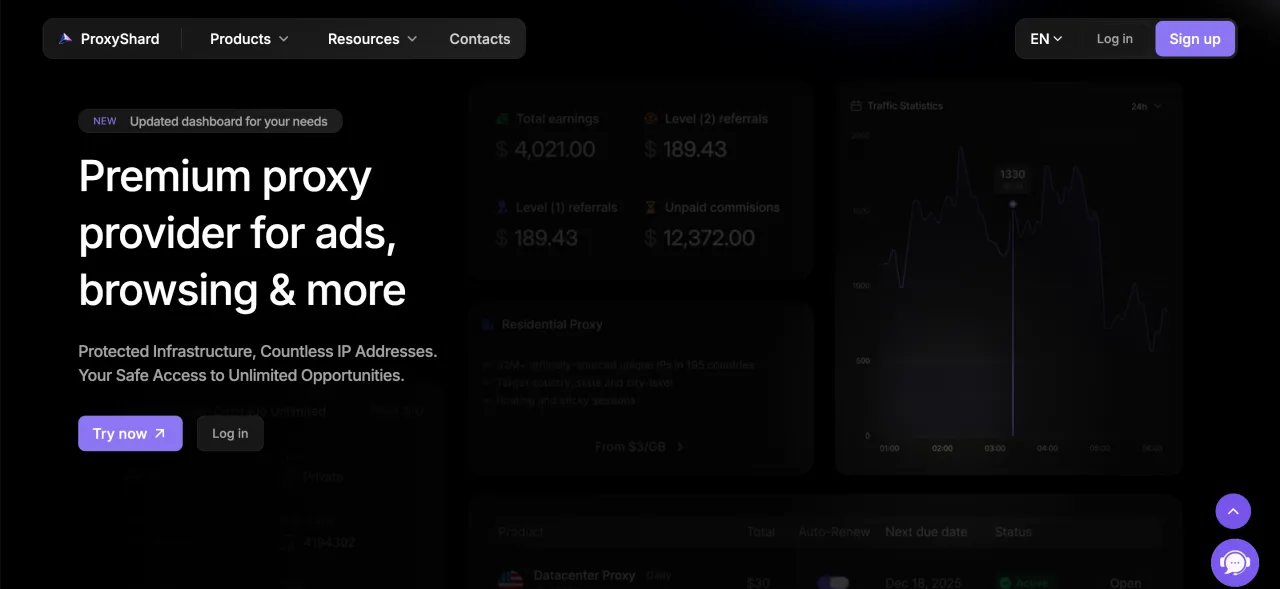
ProxyShard is a proxy provider that covers residential, datacenter, ISP, and mobile proxy types from a single dashboard. The service is pitched at developers, marketers, and automation engineers who need a working proxy stack without spending a week configuring it. Pricing starts at $1.20 per month for datacenter IPs and $2 per gigabyte for residential traffic, which puts it on the affordable end of the market. Whether it holds up under real workloads is what this review covers.
What ProxyShard Offers
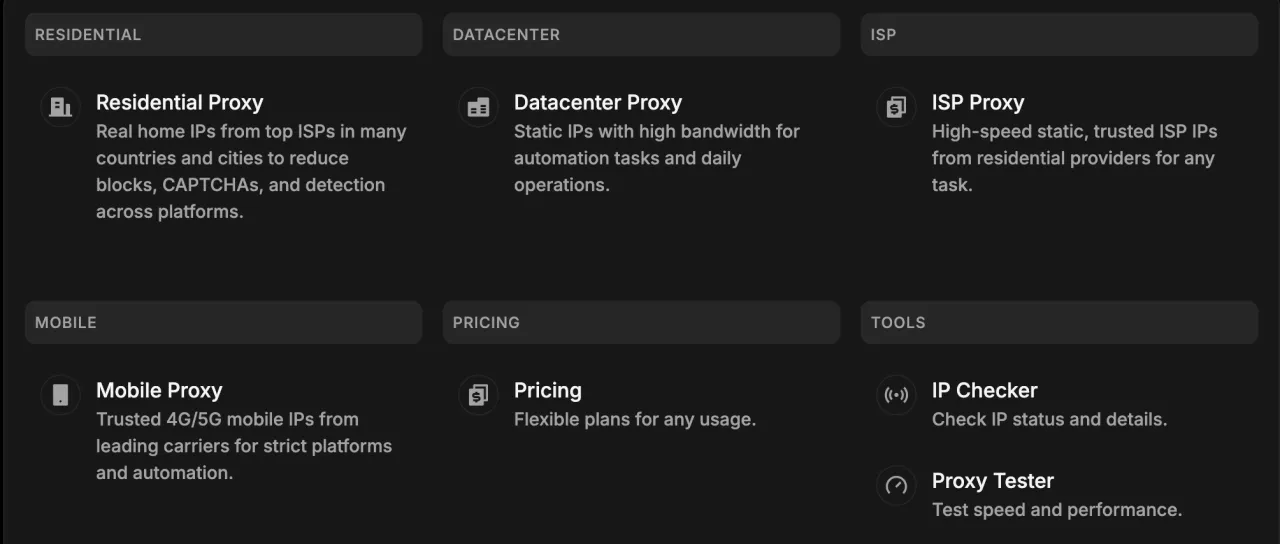
The product lineup is straightforward: four proxy types, each priced differently, each aimed at a distinct set of tasks. That is the right way to structure a proxy service, because residential IPs and datacenter IPs solve fundamentally different problems. Residential addresses come from real household connections registered under consumer ISPs, which is why they carry a stronger reputation score with anti-bot systems. Datacenter addresses are hosted in server facilities, which makes them faster and cheaper but more recognizable to fingerprinting systems. ProxyShard gives you both, plus ISP proxies (datacenter-speed IPs that are registered under ISP blocks, giving some of the trust of residential at a lower price) and mobile proxies (IPs drawn from real 4G and 5G carrier networks).
The residential pool sits at over 80 million IPs, with targeting available at the country, region, city, and ISP level. For reference, a pool of 80 million is competitive with large-market providers, though it is below the 150-plus million that the biggest names in the space advertise. What matters more than raw pool size is IP health: stale or heavily recycled IPs burn through ban lists fast, and a smaller, cleaner pool beats a bloated one full of already-flagged addresses. ProxyShard has not published independent IP health benchmarks, so take the headline number as a starting point rather than a guarantee.
The datacenter product is priced at $1.20 per month and is exclusive to one buyer, meaning no shared pools. That is a meaningful distinction. Shared datacenter pools are the source of most "my IPs are already banned" complaints, because another customer's aggressive scraping taints the whole subnet. Exclusive allocation means the IP's reputation history starts fresh with you. Throughput on the datacenter and ISP products goes up to 10 Gbps, which is more than enough for bulk API requests, large-scale parsing, or traffic-heavy monitoring workflows.
Proxy Types and Pricing
Here is how the four product lines break down as of mid-2026.
| Type | Price | Protocols | Bandwidth | Exclusivity | Best For |
|---|---|---|---|---|---|
| Residential | $2/GB | HTTP, SOCKS5 | Per GB | Shared pool | Scraping, SERP, geo-research |
| Residential Unlimited | $30/day | HTTP, SOCKS5, UDP | Unlimited, up to 5,000 connections | Shared pool | High-volume tasks |
| Datacenter | $1.20/month | HTTP, SOCKS5, UDP | Up to 10 Gbps | Exclusive | Speed-critical automation |
| ISP | From $2/month | HTTP, SOCKS5, UDP | Up to 10 Gbps | Exclusive | Long sessions, e-commerce monitoring |
| Mobile | From $4/day | UDP support | Unlimited | Shared pool | Social media, app QA, ad verification |
The residential unlimited plan at $30 per day is worth a closer look. Five thousand concurrent connections with no bandwidth cap is genuinely useful for crawling at scale: if you are hitting a target that throttles by session count rather than by bandwidth, having 5,000 clean sessions available simultaneously is the important variable. At that price point, the daily rate is reasonable for a single high-intensity job, but it would get expensive if you ran it for a full month, since $30 times 30 is $900. For continuous workloads, the per-gigabyte residential plan makes more sense unless your data collection is extremely high-volume and latency-sensitive.
The $2 per gigabyte residential rate is below the market average of roughly $3 to $4 per gigabyte for 100 GB orders from established providers. That is a genuine price advantage, not a rounding error. Just be aware that residential proxy pricing often has tiered discounts at higher volumes, so the unit price you see at entry level may drop further once you are buying hundreds of gigabytes per month.
Geographic Coverage
ProxyShard publishes live IP counts for specific countries, which is a transparency practice worth noting. Many providers give you a headline number and nothing else. Here is a sample of the available inventory as shown on the site.
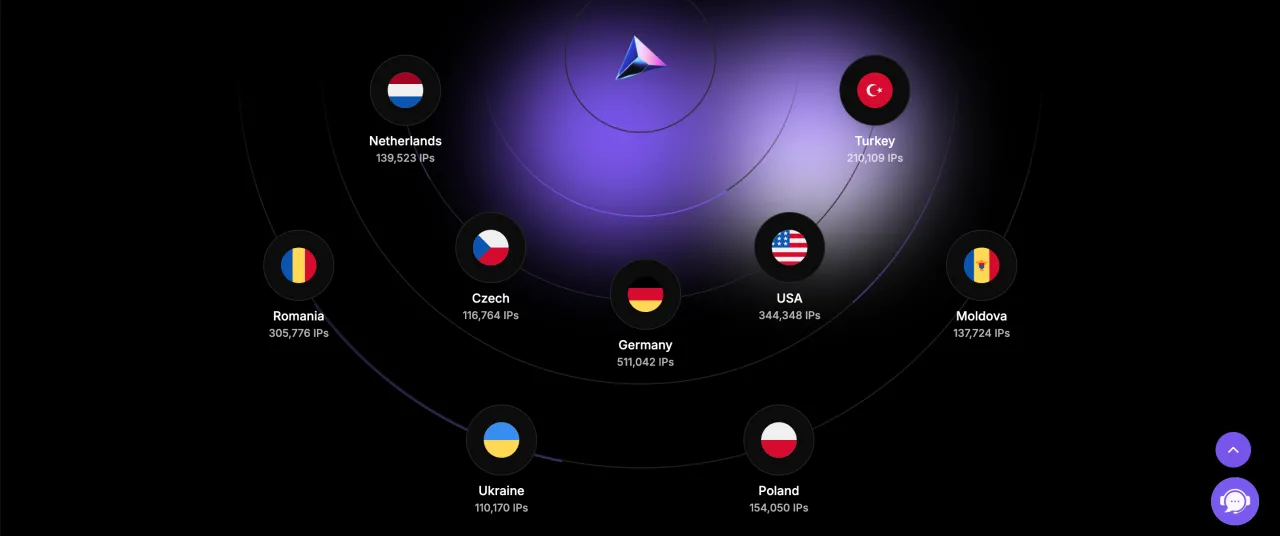
The European coverage is strong. Germany with over 500,000 IPs is a solid foundation for any task targeting DE-specific content: price monitoring on German marketplaces, SERP checks for Google.de, or ad verification for campaigns running in the DACH region. The US inventory at around 344,000 is respectable, though if your primary target is American traffic at very high concurrency, larger providers have deeper US pools. The presence of Eastern European countries like Moldova, Ukraine, and Romania is useful for teams running affiliate or media-buying workflows where those geos come up frequently.
Infrastructure and Uptime
ProxyShard advertises failover mechanisms for backup channels, which in practical terms means that if a routing path goes down, traffic reroutes automatically rather than dropping the connection. This matters most for long-running jobs: a 12-hour scrape that loses its proxy connection halfway through and does not reconnect is a wasted 12 hours. Automatic failover is table stakes for any provider serious about uptime, and it is good to see it mentioned explicitly rather than buried in support documentation.
The site also mentions throughput up to 10 Gbps on datacenter and ISP products. For context, a single gigabit connection can handle roughly 100,000 lightweight HTTP requests per minute under ideal conditions. At 10 Gbps, that ceiling is more than enough for most enterprise-scale operations. The real-world number will be lower because of request overhead, target site response times, and network conditions, but the raw capacity is there.
One thing to verify independently before committing to any provider is actual uptime over time, not just the infrastructure claims on the marketing page. For ProxyShard specifically, the feedback available from early users suggests the connections are stable in day-to-day use, particularly for the membership proxy plans. That aligns with what you would expect from a provider focused on business workflows rather than casual browsing.
Use Cases

-
Web Scraping and SERP Tracking. Residential proxies are the right tool here. When you send a scraping request through a residential IP, the destination server sees a request that looks like it originated from a home broadband connection in a specific city. That is much harder to block than a request from a known datacenter subnet. ProxyShard's residential product supports HTTP and SOCKS5, with targeting down to city and ISP level. SOCKS5 support matters because some scraping tools and some target sites require it, and a proxy that only speaks HTTP will stop you cold in those situations. For SERP tracking specifically, city-level targeting lets you check how search results differ between, say, Hamburg and Munich for the same keyword, which is genuinely useful for local SEO analysis. Without precise geo-targeting, you are getting a regional average that may not reflect what real users in specific cities actually see.
-
Social Media Automation and Multi-Account Management. Mobile proxies are the correct choice for social media platforms. Platforms like Instagram, TikTok, and Facebook have become significantly better at detecting datacenter IPs and flagging accounts that connect through them. Mobile IPs from real carrier networks carry the same kind of trust signal that residential IPs do, but they also match the traffic profile of users actually browsing on phones, which is where the majority of social media activity happens. ProxyShard's mobile product includes device fingerprint switching, which is an additional layer of protection for multi-account workflows. ProxyShard also maintains an open-source anti-detect browser called ShardBrowser, built on Chromium 148, that handles WebGL, WebGPU, Client Hints, fonts, and TLS fingerprint spoofing with over 170 bundled device profiles. It connects natively over SOCKS5, which pairs directly with ProxyShard's proxy credentials. That combination of proxy and anti-detect browser from the same team reduces integration friction noticeably.
-
E-commerce Price Monitoring and Long-Session Tasks. ISP proxies are built for this. The reason is session stability: an ISP proxy holds the same IP for as long as you need it, which means you can maintain a logged-in session on a target site, navigate through paginated product listings, and collect price data without triggering re-authentication or CAPTCHA challenges that rotating residential proxies can cause. The exclusive allocation model means nobody else's behavior on that IP is going to get it flagged while you are mid-session.
-
Crypto Trading and Automation. Crypto exchanges enforce geo-restrictions and rate limits that vary by region. Running trading bots or data collection through a proxy lets you operate from the correct apparent location and distribute requests across multiple IPs to stay under per-IP rate limits. The datacenter product, with its low latency and high throughput, is the practical choice for trading workflows where response time directly affects execution quality. For exchange registration or KYC verification workflows, residential IPs are safer because exchanges increasingly flag datacenter subnets during account creation.
Who Should Use ProxyShard
ProxyShard fits best in a few specific situations. If you are running affiliate marketing, media buying, or multi-account workflows and want a single provider that covers residential, mobile, and ISP proxies without enterprise-level pricing, this is a reasonable choice. The $2 per gigabyte residential rate is competitive, the exclusive datacenter and ISP plans avoid the shared-pool problems that frustrate so many buyers, and the infrastructure claims around failover and high uptime are at least consistent with what early users have reported in practice.
It is less obviously suited for buyers who need enormous US or Asian residential pools. The published inventory shows strong European coverage, especially Germany, but if you need millions of US residential IPs for domestic-focused work, larger providers with deeper American pools may be more appropriate. For European-focused work, and particularly for workflows that benefit from Eastern European geos, ProxyShard's inventory is genuinely useful.
Beginners will find the product lineup straightforward enough to navigate. There is no aggressive KYC gate before you can start, which is a meaningful difference from enterprise-focused providers that require sales calls and compliance reviews before issuing credentials. You sign up, choose a plan, and get access immediately.
Verdict
ProxyShard is a solid mid-market proxy provider with pricing that undercuts the bigger names, particularly on residential traffic at $2 per gigabyte. The exclusive allocation on datacenter and ISP products is a genuine differentiator that saves you from the shared-pool reliability problems that plague lower-tier providers. The residential pool of 80 million IPs across 100-plus countries is competitive, though the geographic depth leans European. The infrastructure, including failover mechanisms and 10 Gbps throughput on datacenter products, is appropriate for business-grade workloads.
If you are evaluating ProxyShard against the largest providers in the market, the main trade-off is pool depth versus price. You pay more with the biggest players, but you get deeper US and Asian inventory and longer track records of enterprise reliability. For European-focused work, affiliate operations, and teams that want clean exclusive IPs at an honest price, ProxyShard is worth a serious look.
Use promo code CAPROXY to get 15% off Datacenter & Residential Proxies. Valid on all orders, up to 5 uses per customer. Available for new and existing customersVisit Website ProxyShard