Last updated: 2026-10-06
Pay-per-gigabyte pricing made sense when scraping jobs were small and infrequent. Today, teams running AI training pipelines, continuous price monitors, or large-scale web scrapers can burn through 50 to 100 TB a month without blinking. At $1 per GB, that is a six-figure monthly bill. Unlimited residential proxies exist to solve exactly that problem: you pay a flat rate, you get no bandwidth cap, and your cost per terabyte collapses to almost nothing compared to standard metered plans.
This page covers eight providers that sell unlimited residential proxy plans. We have looked at pool sizes, geographic coverage, pricing structures, supported protocols, and how each one handles rotation. The list below will help you pick the right fit depending on your volume, your target sites, and your budget.
What Are Unlimited Residential Proxies?
A residential proxy routes your traffic through an IP address assigned to a real consumer device by an internet service provider (ISP). Because the IP belongs to a household rather than a data center, target websites treat it as ordinary human traffic. Standard residential proxy plans charge by the gigabyte transferred, so your monthly cost scales directly with usage. Unlimited plans break that link by charging a flat fee for a fixed time period instead, which means you can transfer as much data as you need without incurring overage fees or getting throttled once you cross a threshold.
The trade-off is that unlimited plans almost always cost more upfront than a small GB package. They make financial sense once your monthly consumption is high enough that the per-GB equivalent of the flat fee drops below what you would pay on a metered plan. At 10 TB per month, the crossover is often around the $300 to $500 range depending on the provider. At 100 TB per month, the savings against standard pricing can reach 95% or more, which is not a hypothetical claim: ProxyScrape's own calculator shows $107,370 saved at 100 TB versus their $2,630 flat rate.
Who Actually Needs an Unlimited Plan?
Three types of operations make the most consistent use of unlimited residential bandwidth. The first is large-scale web scraping, where you are running 24/7 crawlers against e-commerce sites, real estate portals, or job boards and the volume is simply too high for metered pricing to be practical. The second is AI and machine learning data collection: LLM training requires enormous corpora of real-world text, image, and video data, and the collection infrastructure cannot stop every time a bandwidth cap is hit. The third is continuous price intelligence, where you are tracking thousands of SKUs across dozens of retailers in multiple countries every hour and need uninterrupted access.
For occasional or moderate scraping, a standard GB-based plan will almost always be cheaper. If you are spending less than roughly $200 a month on residential bandwidth today, unlimited is probably not worth the switch yet.
Top 8 Unlimited Residential Proxy Providers
The eight providers below all offer unlimited residential traffic at a flat rate. Seven of them sell time on a large shared pool. Live Proxies sells a fixed set of private IPs instead, and its section explains how that changes the math. They vary in pool size, supported protocols, and price points, so read through each section before committing.
1. Proxyscrape
Official website: https://proxyscrape.com/
ProxyScrape is a developer-focused provider with one of the larger residential pools in this segment. It is a strong fit for teams running enterprise-scale scraping or AI data collection jobs that need predictable costs at high volume, and the 99.95%+ advertised success rate holds up well against moderately protected targets.
- Carriers/geo: 48M+ residential IPs, with country, state, and city targeting available
- Protocols: HTTP/HTTPS, back-connect rotating proxies
- Authentication: Username and password
- Rotation: Back-connect rotating with sticky session support
- Price: From $296 per day, $933 per 7 days, $2,630 per 30 days
2. Live Proxies
Official website: https://liveproxies.io/
Live Proxies takes a different route to unlimited traffic. The other plans on this list sell a time window with an uncapped pipe into a large shared pool. Live Proxies offers unmetered residential plans with privately allocated IPs and lets you push as much traffic through them as you like for 30 days. The limit moves from gigabytes to IPs.
That makes it the cheapest way into unmetered residential traffic here: $130 for 30 days with 25 IPs, a fraction of the four-figure monthly price of the pool-based plans. Per IP it works out to $5.20 on the smallest plan and $3.30 on the 100 IP plan.
The trade-off is scale. Each IP is one proxy endpoint with sticky sessions of up to 24 hours, and an IP is swapped for a fresh one only when it sits idle. The provider's help center puts it plainly: a 500 IP plan gives you 500 unique IPs at any moment and up to about 750 over a 30-day cycle. Live Proxies supports unlimited threads, so the number of allocated IPs does not represent a concurrency limit.
That profile suits long-running work with steady parallelism: account management, social media automation, price checks on a fixed set of pages, or a scraper running unlimited threads around the clock. It is not built for crawls that need a new IP on every request across millions of pages. For those, a pool-based plan from the rest of this list fits better.
Two conditions come with the plan. The proxies only start working once you authorize at least one of your own server IPs in the dashboard (up to three at a time), and a fair use policy applies, with accounts that abuse the plan blocked. B2C plans can include up to 500 privately allocated IPs, while B2B plans provide access to a much larger shared residential pool. Enterprise customers receive custom scalable plans with access to the broader residential pool, typically priced based on bandwidth usage.
- Carriers/geo: Private allocation of 25, 50 or 100 residential IPs, 55+ locations with country-, city-, and ASN-level targeting
- Protocols: HTTP/HTTPS
- Authentication: Username and password, plus a mandatory IP whitelist (up to 3 IPs) on unmetered plans
- Rotation: Sticky sessions of up to 24 hours, idle IPs replaced automatically
- Price: Unmetered residential plans start from $130 for 25 IPs / 30 days
3. Nsocks
Official website: https://nsocks.com/
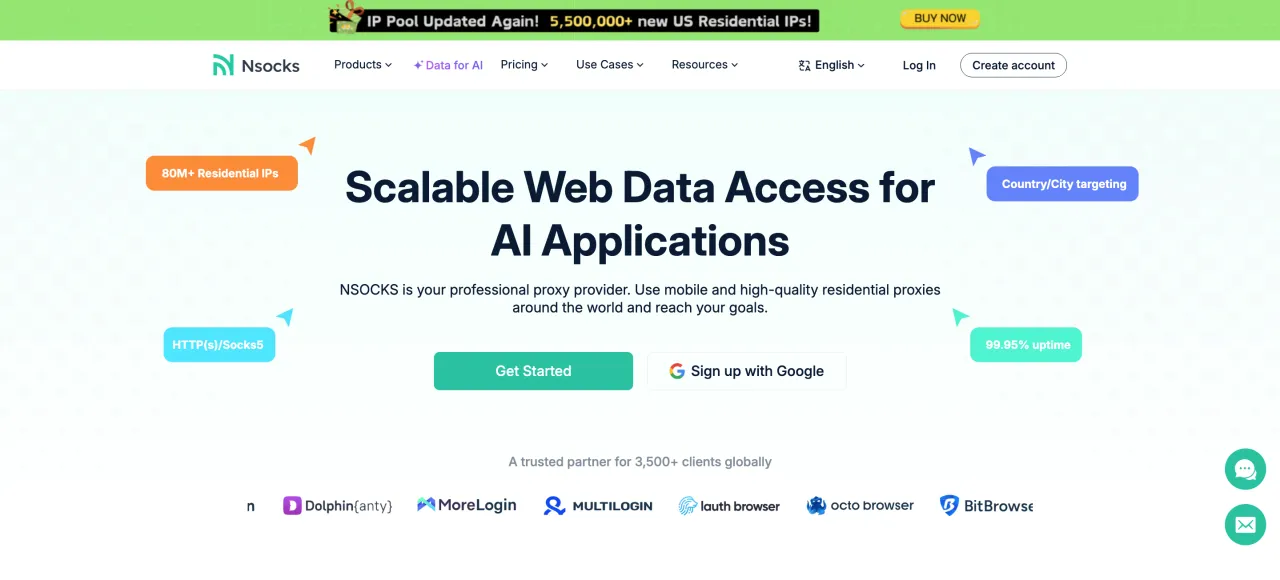
Nsocks positions its unlimited plan directly at LLM training and multimodal data pipelines, which is a more specific angle than most providers take. The pool reaches 80 million residential IPs, and the service advertises over 99.9% request success rates with no concurrency restrictions. Short-term plans starting from one hour make it viable for burst workloads rather than just long-running operations.
- Carriers/geo: 80M+ residential IPs, with city, ZIP code, carrier, and ASN targeting
- Protocols: HTTP/HTTPS, SOCKS5
- Authentication: Username and password
- Rotation: Unlimited concurrent sessions, no rotation restrictions
- Price: From $9.66 per hour, $231.67 per day, $2,150 per 30 days, $3,887.40 per 60 days
4. Proxyma
Official website: https://proxyma.io/
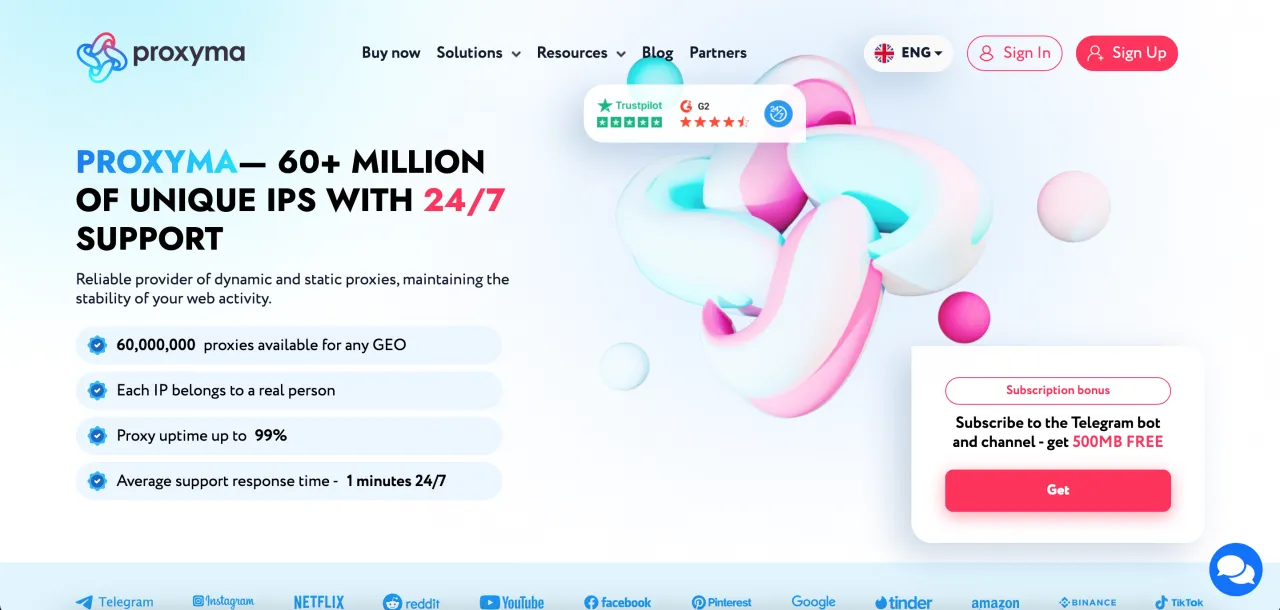
Proxyma is oriented toward users who want straightforward setup without handing over payment credentials upfront, since the service accepts cryptocurrency and does not require binding a payment method to start. Each plan allocates a dedicated private server rather than a shared pool, which means the IP is not used by other customers simultaneously. With 40 million IPs and speeds starting from 200 Mbit/s up to 1,000 Mbit/s, it competes on price against larger providers.
- Carriers/geo: 40M+ residential IPs (average 7M online)
- Protocols: HTTP/HTTPS
- Authentication: Username and password, crypto payment accepted, no card binding required
- Rotation: Dedicated server per user, unlimited traffic throughput
- Price: From $265 per day (1-day plan), $875 for 7 days, $2,620 per 30 days
5. Proxy001
Official website: https://proxy001.com/
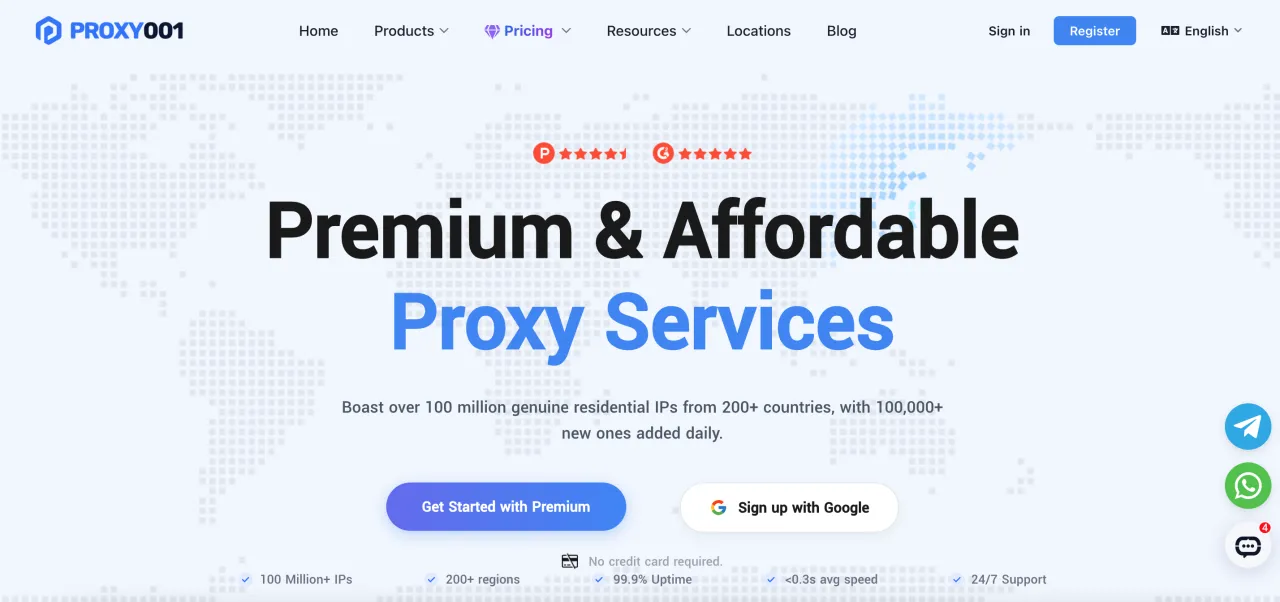
Proxy001 explicitly markets its unlimited residential plan as the top choice for LLM training data collection, and the infrastructure backs that claim with 100 Gbps+ total bandwidth available across the service. Beyond text data, it supports streaming and video platforms including YouTube, GitHub, and Netflix, which separates it from providers that only handle standard HTTP targets. The 20M+ real residential IP pool covers major geographies with solid uptime for continuous collection workloads.
- Carriers/geo: 20M+ real residential IPs, global coverage
- Protocols: HTTP/HTTPS, SOCKS5
- Authentication: Username and password
- Rotation: Unlimited concurrent connections and IP rotations, no traffic constraints
- Price: From $35 per day
6. ProxyLite
Official website: https://proxylite.com/
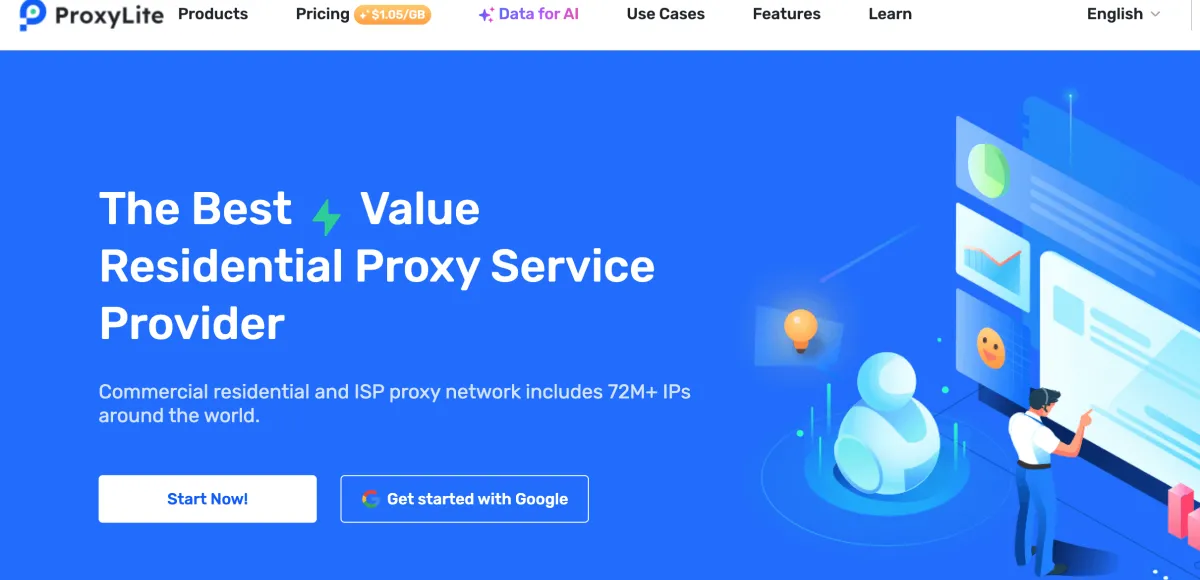
ProxyLite offers unlimited residential proxy plans with a focus on straightforward purchasing and a clean interface that appeals to buyers who do not want to negotiate enterprise contracts. The service covers the main use cases for unlimited bandwidth, including continuous scraping and price monitoring, and it is accessible to individual developers and small teams rather than purely targeting large enterprises.
- Carriers/geo: Residential IPs across major global regions
- Protocols: HTTP/HTTPS, SOCKS5
- Authentication: Username and password
- Rotation: Rotating residential proxies with unlimited traffic
- Price: From $9.82 per hour, $235.67 per day, $2,100 per 30 days, $3,814 per 60 days
7. NovProxy
Official website: https://novproxy.com/
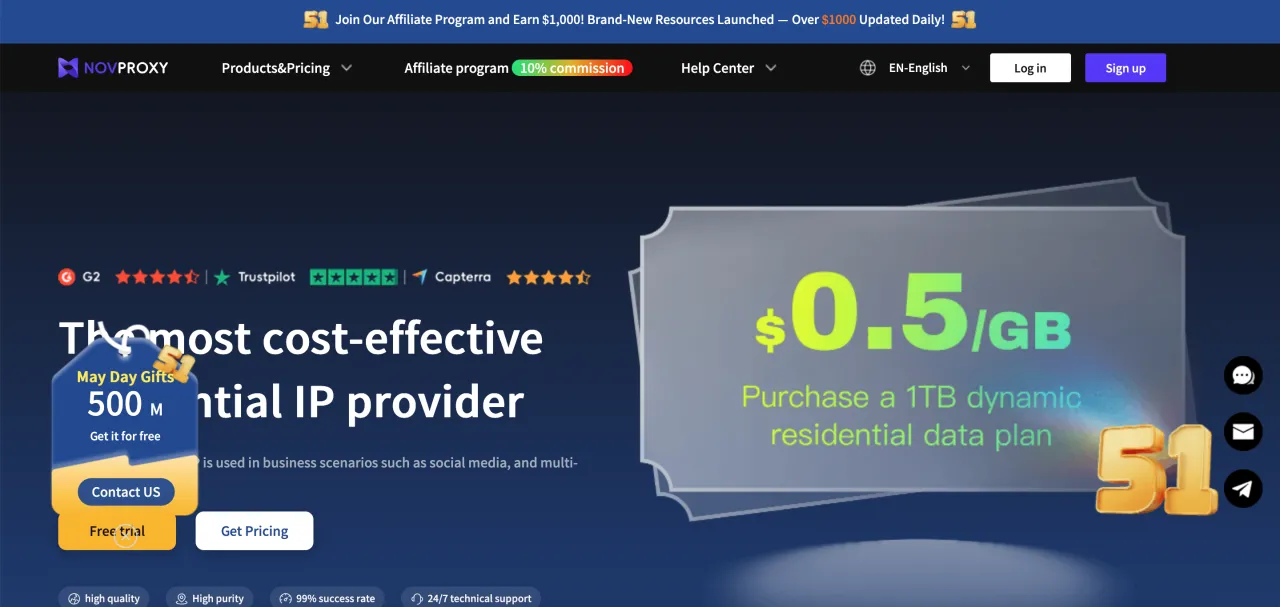
NovProxy enters the unlimited residential space as a newer provider with competitive pricing for teams that want to test unlimited plans without committing to large upfront budgets. It covers the essential requirements for high-volume scraping and is worth evaluating if the better-known names in this list exceed your current budget while your data needs still call for a flat-rate structure.
- Carriers/geo: Residential IPs across multiple global regions
- Protocols: HTTP/HTTPS, SOCKS5
- Authentication: Username and password
- Rotation: Rotating proxies, unlimited traffic on flat-rate plans
- Price: From $260 day, $699 per 7 days, $1,899 per 30 days
8. OkeyProxy
Official website: https://okeyproxy.com/
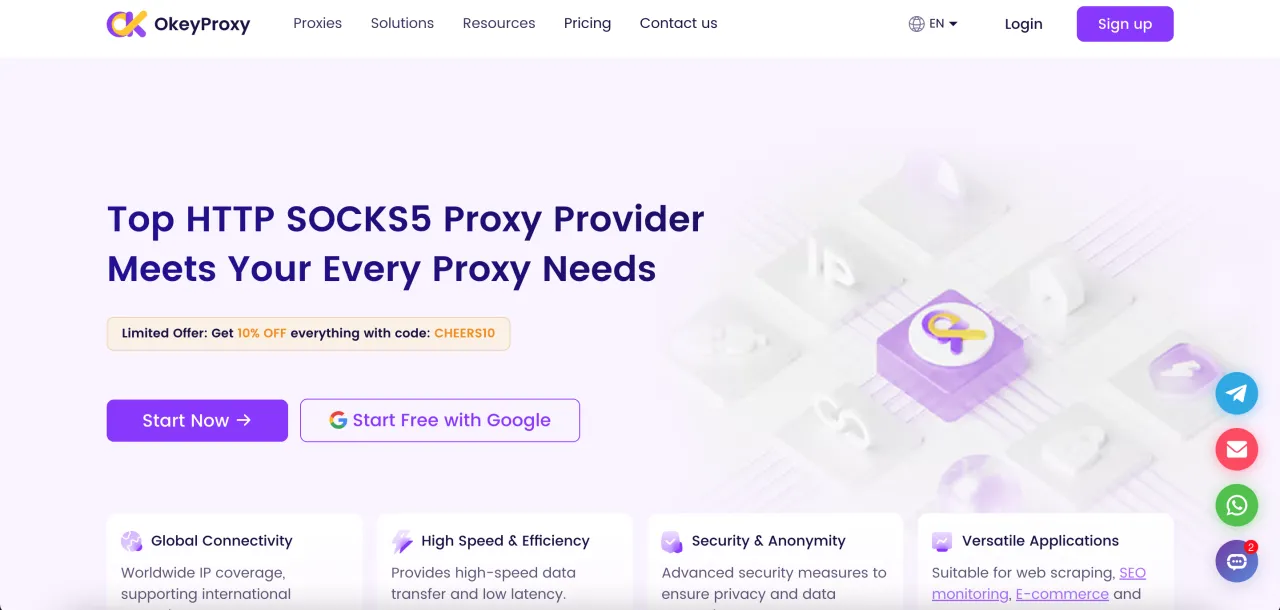
OkeyProxy offers unlimited residential proxies as part of a broader proxy catalog that also includes ISP and datacenter options, making it a reasonable single-vendor choice for teams that need more than one proxy type. The unlimited residential plan suits buyers doing sustained scraping who also want the flexibility of static ISP IPs for account management tasks on the same account.
- Carriers/geo: Residential IPs with global geo coverage
- Protocols: HTTP/HTTPS, SOCKS5
- Authentication: Username and password, IP whitelist
- Rotation: Rotating residential with unlimited bandwidth on plan
- Price: From $30 per hour, $500 per day, $3,895 per 30 days, $7,400 per 60 days
Unlimited vs. Standard Residential Proxies
| Feature | Standard Plan | Unlimited Plan |
|---|---|---|
| Pricing structure | Per GB consumed | Fixed monthly fee |
| Traffic limits | Capped at purchased amount | No cap |
| Cost predictability | Varies with usage | Fully predictable |
| Infrastructure | Shared residential pool | Often dedicated server setup |
| Best for | Controlled or intermittent scraping | Enterprise-scale or continuous operations |
| Concurrent connections | Usually limited by plan tier | Typically unlimited, or set by the number of IPs in the plan |
Things to Check Before Buying
Unlimited bandwidth sounds like the same thing everywhere, but it is not. A few questions will save you from a bad purchase.
- Is it a dedicated server or shared infrastructure? Proxyma, for example, gives each customer a dedicated proxy server, which means no one else is competing for bandwidth on your connection. Most other providers pool customers onto shared back-connect infrastructure, which is fine for standard scraping but can introduce contention under extreme load.
- What does "unlimited" mean for concurrency? Some plans advertise unlimited traffic but cap concurrent threads at 100 or 500. If you run parallel scrapers, confirm the concurrency limit before purchasing.
- Is the limit on traffic or on IPs? Most plans here cap time and connection speed (the 50 to 200 Mbps figures in the table below), but not how many IPs you rotate through. Live Proxies works the other way round: traffic is unmetered, and the plan size is the number of private IPs. If your job needs a fresh IP on every request, count how many unique IPs you will actually get before you buy.
- What is the minimum commitment? Several providers here offer day-based plans. Nsocks starts at one hour, Proxy001 starts at one day. That flexibility lets you test at scale before committing to a 30-day contract.
- Does the provider cover your target country well? Pool size numbers can be misleading. A provider with 80 million IPs globally might have only 50,000 in a country you specifically need. Check the geo breakdown if your targets are localized.
- What authentication method do you need? Username and password authentication works from any server without pre-configuring your IP. IP whitelist authentication is more secure but breaks if your server's IP changes. Most providers here support both methods.
Pricing Summary
| Provider | IP Pool | Starting Price | Minimum Period |
|---|---|---|---|
| ProxyScrape | 48M+ | $296/day (200Mbps) | 1 day |
| Live Proxies | 25-100 private IPs | $130/30 days (25 IPs) | 30 days |
| Nsocks | 80M+ | $9.66/hour (200Mbps) | 1 hour |
| Proxyma | 40M+ | $265/day (200Mbps) | 1 day |
| Proxy001 | 20M+ | $140/day (100Mbps) | 1 day |
| ProxyLite | N/A | $9.82/hour (200Mbps) | 1 hour |
| NovProxy | N/A | $8/hours (100Mbps) | 3 hours |
| OkeyProxy | N/A | $30/hours (50Mbps) | 1 hour |
Final Thoughts
Unlimited residential proxies are not for everyone. If your monthly data consumption is measured in gigabytes rather than terabytes, a standard pay-per-GB plan will cost you less. But once your scrapers are running continuously, or you are feeding a data pipeline for model training, the flat-rate model changes the economics entirely. The providers above cover a wide range of budgets and pool sizes, from Nsocks with 80 million IPs at the top end to newer options like NovProxy and ProxyLite. If a fixed set of IPs is enough for your job, Live Proxies is the cheapest way in: $130 buys 30 days of unmetered traffic through 25 private IPs. Pick the one whose pool covers your target geographies, confirm the concurrency limits in writing before you pay, and test on a short-term plan first if the provider offers one.