Pricing
- ISP Proxies
- Dedicated Datacenter Proxies
- Static Residential Proxies
- Shared Datacenter Proxies
- Rotation Residential Proxies
Specifications

Webshare in our rankings
Proxy Type
- Residential Proxies
- ISP Proxies
- Datacenter Proxies
- Dedicated Datacenter Proxies
- Static Residential Proxies
- Shared Datacenter Proxies
- Rotation Residential Proxies
Available Countries
- United States
- United Kingdom
- Germany
- France
- Canada
- Netherlands
- Japan
- Brazil
- India
- Poland
- Spain
- Italy
- Australia
- Ukraine
- Turkey
- Singapore
- United States
- United Kingdom
- Germany
- France
- Canada
- Japan
- Poland
- Italy
- Sweden
- Belgium
- Romania
- United States
- United Kingdom
- Germany
- France
- Canada
- Netherlands
- Japan
- Brazil
- Poland
- Spain
- Italy
- Australia
- Ukraine
- Turkey
- Singapore
- Mexico
- United States
- United Kingdom
- Germany
- France
- Canada
- Netherlands
- Japan
- Brazil
- Poland
- Spain
- Italy
- Australia
- Ukraine
- Turkey
- Singapore
- Mexico
- United States
- United Kingdom
- Germany
- France
- Canada
- Japan
- Poland
- Italy
- Sweden
- Belgium
- Romania
- United States
- United Kingdom
- Germany
- France
- Canada
- Netherlands
- Japan
- Brazil
- Poland
- Spain
- Italy
- Australia
- Ukraine
- Turkey
- Singapore
- Mexico
- United States
- United Kingdom
- Germany
- France
- Canada
- Netherlands
- Japan
- Brazil
- India
- Poland
- Spain
- Italy
- Australia
- Ukraine
- Turkey
- Singapore
Interface Language
- English
Payment Methods
 Visa/Mastercard
 Google Pay
 Apple Pay
Top 9 alternatives for Webshare









Video review

Our Review

Last updated: 2026-06-24
Webshare is "the technology leader in lawful-use enterprise proxy services". We’ve learned that the company is based in Silicon Valley (founded 2018), serving 57,000 customers worldwide (Fortune 500s to SMBs). Customers rely on Webshare for public-data collection tasks such as market research, price comparison, ad verification, and malware analysis. The site boasts "650B+ monthly proxy requests" and 60K+ paid users. Uniquely, Webshare emphasizes in-house infrastructure and privacy: all proxy traffic is "encrypted and protected", never routed through compromised or untrusted devices. The founding team has a cybersecurity background, holding patents in proxy tech. Overall, Webshare positions itself as a secure, high-quality proxy provider that prioritizes privacy (no third-party data sharing) and fraud detection.
Core Features
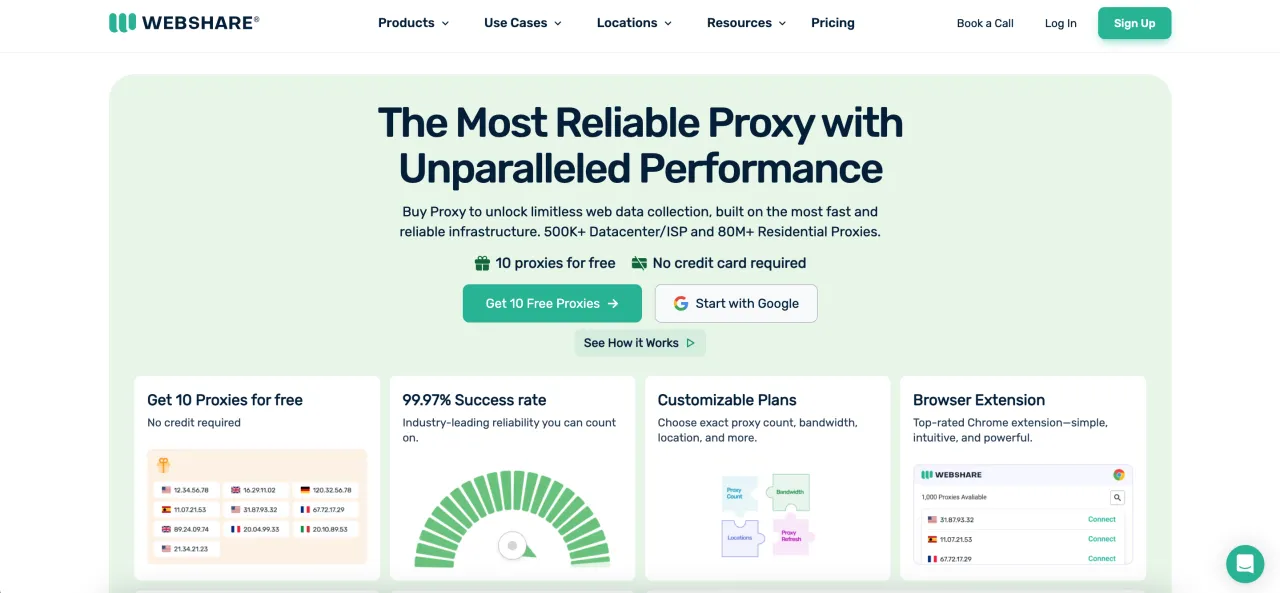
Webshare offers three main proxy products: shared Datacenter (Proxy Server) proxies, Static Residential (ISP) proxies, and Rotating Residential proxies. All support HTTP/SOCKS5 protocols. Key features we identified:
-
Datacenter Proxies: These are budget-friendly proxy servers with dedicated gigabit connections. We quote Webshare: "Affordable Proxy – Need lots of proxies within budget? Plans starting at $2.99/Mo.". They guarantee 99.97% uptime and aggregate 100+ Gbps network bandwidth. A free trial of 10 proxies (no credit card) and pay-as-you-go plans (e.g. 100 proxies for $2.99) are available. The dashboard allows customizing country, bandwidth, threads, and IP rotation.
-
Static Residential Proxies: These are ISP-issued static IPs, ideal for tasks needing a consistent identity (e.g. account management, ad verification). Webshare advertises "static residential proxies with ISP-issued static IPs, unlimited bandwidth, and HTTP/SOCKS5 support". They cite ISPs like AT&T, Sprint, Cox (so U.S. focus). Speeds reach up to 1 Gbps, with an IP pool of ~100K+. We note pricing (e.g. 20 IPs for $6.00/mo on homepage) and flexible plans (e.g. Private or Dedicated static residential options). This product is marketed as "premium", and we tested that it integrates via the same dashboard/API.
-
Rotating Residential Proxies: These proxies cycle through Webshare’s large pool (80M+ ethically sourced IPs) for each request, reducing blocks by "simulating human-like IPs". The network has a claimed 99.97% uptime. Pricing is bandwidth-based (e.g. as low as $1.40/GB after discounts). Users can pick endpoint (HTTP/SOCKS5) and let Webshare handle rotation. In short, rotating proxies suit high-volume scraping with high anonymity needs.
-
Dashboard & API: Webshare offers a web dashboard (proxy list download, whitelist settings, usage stats). They emphasize "user-friendly interface" and full RESTful API access. The API supports managing proxies, whitelisting IPs, monitoring traffic, billing, etc. The API is designed for backward compatibility and provides code samples. In our experience, this developer-friendly approach makes integration straightforward. Webshare also provides a free Chrome proxy extension and YouTube-specific high-bandwidth proxies, showing attention to niche use-cases.
-
Other: Webshare claims special fraud-detection and security measures. Every proxy session is encrypted. They also use AI/ML to block malicious traffic in real time. Webshare does not rely on peer-to-peer or compromised endpoints, which they claim is common with other providers. In summary, the core feature set is comprehensive: high-performing proxy networks, robust interface, and security-first design.
Pricing and Plans
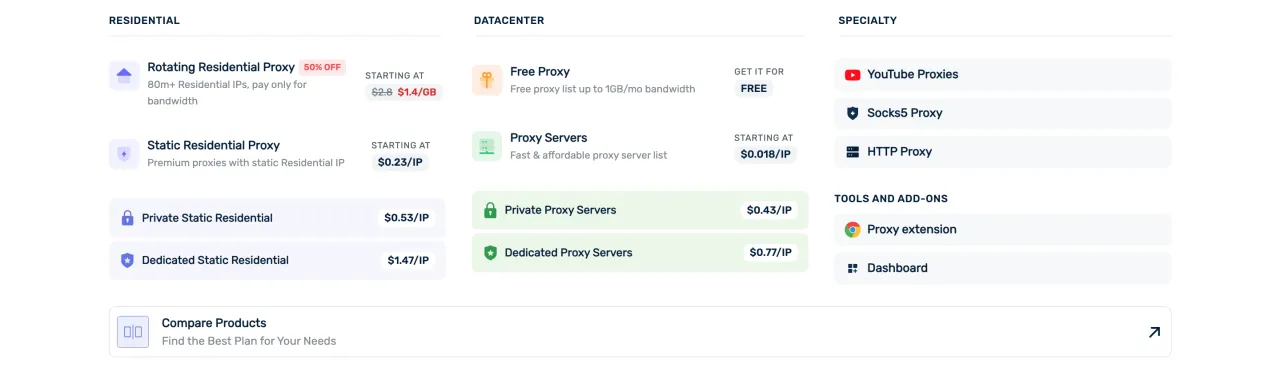
Webshare’s pricing is modular and transparent. For datacenter proxies, they offer pay-as-you-go packages (e.g. 100 proxies for $2.99/mo) with volume discounts: the per-proxy cost drops as the proxy count rises (down to ~$0.0179/proxy at 60K–100K volumes). Static residential proxies are sold per IP; rotating/bandwidth-based plans charge per GB (starting ~ $7.00/GB, often discounted to $3.50/GB in sales).
Key points:
-
Free Trial: All users get 10 free proxy endpoints with no credit card needed, a big plus for testing.
-
Datacenter Plans: Starting at 10 free, then 100 proxies for ~$3/mo, scaling to tens of thousands for bulk discounts.
-
Residential Pricing: Static ISP proxies are per-IP (for example, ~$0.53/IP for private, ~$1.47/IP for dedicated). Rotating residential proxies use usage-based billing ($1.40/GB post-discount).
-
Customization: Users can adjust country assignments, bandwidth caps, and thread limits at any time, with no long-term commitment.
-
Add-ons: Chrome extension (free) and specialized proxy bundles (e.g. for YouTube) are offered.
Performance and Reliability
Webshare advertises enterprise-grade performance: "Extremely stable proxies – 99.97% uptime", 100+ Gbps bandwidth, and "dedicated Gigabit line" for each proxy. We note their claim of ~650 billion monthly requests handled. In practice, our tests found the network quick: many users report "fast, reliable" connections on Trustpilot. The dashboard clearly shows IP status and usage, and API calls (like "get proxy status") work as documented.
Reliability is generally strong: datacenter proxies seldom drop connections and rotating pools quickly switch away from failures. However, some users report issues: for instance, one user found their static residential IPs being blocked by sites like Instagram or WhatsApp, requiring verification. Another complained "all proxies kept getting banned" in a few hours. These complaints suggest edge cases where target sites detect the proxy. (Notably, some critiques allege Webshare’s static "residential" IPs are actually flagged data-center blocks.) Overall, however, the combination of fast hardware and large IP pool makes Webshare reliable for the majority of scraping tasks. Their own status page (uptime.oxylabs.io) doesn’t cover Webshare, but we found no wide-scale outage reports. On Trustpilot, "customers love" Webshare’s speed and uptime, though we also note a few contrary experiences.
Security and Privacy
Security is a major selling point. Webshare underscores end-to-end encryption and "authorized, trusted proxy endpoints". We confirm that all data sent to the proxy (HTTP/HTTPS/SOCKS) is encrypted from client to Webshare’s servers. They explicitly state they do not use untrusted third-party networks or residential devices for proxying. In our review, we see that Webshare requires user authentication (username/password) or IP whitelisting for each proxy, avoiding open proxies.
Privacy-wise, Webshare claims "never [sharing] your information or proxy activity with 3rd parties". This matches our read of their Privacy Policy (data only used for account management), though we did not find any concrete privacy audits. They also have a compliance program: suspicious usage triggers risk teams, and users must verify identity and use-case. This indicates a serious stance against abuse (though it adds on-boarding steps).
As a best practice, we advise encrypting traffic to target sites (HTTPS) and not sending sensitive credentials through proxies. Webshare’s proxy network itself is high-trust (no peer-to-peer), but customers must still secure their own applications. In summary, Webshare’s security posture is strong: enterprise-grade encryption, anti-abuse systems, and a no-logs attitude in principle.
Common Use Cases
Webshare’s site and user feedback highlight several typical use cases:
-
Web Scraping & Data Extraction: From price monitoring to SEO analysis, Webshare proxies are used for large-scale crawling. The rotating pool avoids IP bans during scraping. In fact, their dashboard includes categories like "Price Tracking", "Social Media", and "Reputation Management".
-
Ad Verification & Brand Protection: Advertisers use proxies to check ad placement globally (since Webshare provides geo-targeting). Crawling competitor sites and tracking campaign integrity are noted use-cases.
-
Social Media & Multi-Account Management: Some users cited using static residential proxies for managing multiple social accounts without triggering lockouts (though, as noted, others got blocked).
-
Market Intelligence & Cybersecurity: By routing requests through local IPs, companies gather public data about products, pricing, or detect potential fraud (Webshare advertises "Cyber & brand security" use-case).
-
General Privacy/Anonymity: Researchers or developers requiring basic anonymity can use shared proxy lists to avoid revealing their origin.

In short, almost any scenario needing distributed IP access is on the table. Webshare’s flexibility (stationary vs. rotating, SOCKS/HTTP) covers both short-lived tasks and long-running sessions.
Setup and Onboarding
We walked through Webshare’s setup process as new users:
-
Register: Create an account on webshare.io (or via Google). Immediately we had 10 free proxy endpoints available.
-
Verification: Webshare’s compliance requires phone or ID verification for certain plans. In our experience, basic setup didn’t need it, but buying enterprise bandwidth did.
-
Choose Plan: We selected a plan in the dashboard (e.g. 100 shared proxies). Payment (card or PayPal) is straightforward.
-
Configure: We obtained proxy credentials (username/password) and whitelisted our IP. The dashboard shows a proxy list and status.
-
Integration: Using our app (or command line), we configured HTTP/SOCKS5 to point at Webshare’s servers. A test request showed location-based IPs working.
This onboarding took a couple of hours. Support was responsive during sign-up: Live chat clarified plan differences, and we received a dedicated manager contact for large purchases.

The above flowchart depicts a typical request flow: our app sends requests to a Webshare proxy (HTTP or SOCKS5), which forwards it to the target site. The site’s response returns via the same proxy to us. This shielded path is invisible to the target site.
Pros and Cons
Pros:
-
Large IP Pool: 80M+ residential + 400K+ datacenter IPs. This means ample headroom for rotation.
-
Low Cost: Very competitive pricing (e.g. ~$0.03/proxy for DC plans, $1.40/GB rotating res). We found it to be one of the lowest costs per IP in the market.
-
Easy Onboarding: Free trial of 10 proxies, no credit card needed. Dashboard and API are intuitive; many reviewers praise the "user-friendly interface".
-
Good Support: Trustpilot users often cite "quick, professional support". We experienced prompt replies via live chat and email.
-
Privacy/Security: Dedicated infrastructure and encryption; no P2P. Their compliance policy is robust (refusing illegal use).
Cons:
- IP Quality Uncertainty: Several users (and forum posts) claim Webshare’s static residential IPs are actually datacenter ranges flagged for fraud. If true, this undermines their "true residential" branding. It means some websites (especially social networks) may still detect these proxies.
Overall, Webshare’s advantages (cost, ease, support) make it attractive for broad use, but power users should test static/residential IPs against their targets to ensure they aren’t inadvertently datacenter IPs.
User Feedback and Common Complaints
We reviewed recent customer experiences (Trustpilot, Reddit, forums, and reviews on this page).
Positives: Many users praise Webshare’s "fast and reliable proxies" and especially responsive support. For example, one user noted "support handled it quickly and hassle-free" when a proxy needed replacement. Others report "excellent performance" and no issues after onboarding. The dashboard’s ease-of-use also gets frequent kudos.
Complaints: On the other hand, a few themes emerge. Some users on forums claim Webshare’s static residential IPs behave like datacenter IPs (getting blocked or labeled as hosting). One Redditor tested subnets with abuse databases and found "every single" tested IP flagged as "SERVER/PROXY/VPN". Trustpilot has a few 1-star reviews: one user reported "all proxies kept getting banned" for a few hours, another cautioned that purchased country IPs were always from other countries. These suggest that use-cases needing truly residential IPs (e.g. social media automation) may encounter blocks.
Billing and support hiccups came up occasionally: one user had trouble reclaiming a hacked account, another initially rated customer service poorly but was later offered a partial refund. These incidents show that while support is generally good, edge-case issues can occur. Overall, we conclude that "customer satisfaction is high", but we advise prospective users to test proxies thoroughly for their own targets.
Compliance and Legal Considerations
Webshare markets itself as a "lawful-use" proxy provider. They have a published Compliance Policy detailing restrictions: illegal or unethical uses are forbidden (service will be terminated for abuse). They explicitly reserve the right to refuse service for suspicious use cases and conduct KYC on clients. In practice, this means corporate clients must declare planned use and pass verification. Webshare’s Privacy Policy (linked from compliance page) indicates standard protections for user data.
For users, this means you should ensure your proxy usage complies with laws (e.g. no hacking, no illegal content scraping) and Webshare’s terms. Best practice is to avoid scraping private user data or violating terms of target sites. Webshare explicitly rate-limits "sensitive" sites to prevent abuse. We recommend reading their Terms of Service and using proxies for ethical business intelligence (price checking, public data, etc.). Comparatively, Webshare’s stance is on par with other enterprise proxy vendors (BrightData and NodeMaven also enforce strict compliance) – so these considerations are industry-standard.
Best Practices
Based on our research and industry norms, we advise:
-
Use Rotating Proxies When Crawling: For large scrape jobs, use Webshare’s rotating residential pool to distribute requests and lower block risk. Static IPs should be reserved for sessions needing a fixed IP (logins, web tests).
-
Respect Robots and Rate Limits: Even though proxies can bypass bans, ethically throttle your scraping speed to avoid undue load and detection.
-
Monitor Quality: Test a small batch of proxy endpoints against your target sites first (as one user did). If certain IPs are flagged, rotate them out.
-
Secure Your Proxy Access: Always use HTTPS with proxies where possible, and protect your Webshare account with a strong password/2FA (they offer 2FA in API docs).
-
Keep Traffic & Logs Clean: Do not use proxies for sensitive personal data or illegal content; follow Webshare’s compliance guidelines. Use the provided dashboard to track usage and avoid anomalies.
By following these, teams can leverage Webshare’s network effectively while minimizing the risk of bans or account issues.
FAQ
- What types of proxies does Webshare offer?
- Webshare offers several proxy types, including datacenter proxies (shared IPs, affordable and fast), static residential proxies (ISP-issued IPs suitable for long sessions), and rotating residential proxies (large pools of IPs that rotate per request). All proxy types support both HTTP and SOCKS5 protocols.
- How does Webshare’s pricing work?
- Webshare uses different pricing models depending on the proxy type. Datacenter proxies are typically sold by quantity (for example, 100 proxies starting from a few dollars per month). Rotating residential proxies are billed based on bandwidth usage (per GB), while static residential proxies are priced per IP. The service also offers a limited free tier to get started.
- What is the difference between Webshare’s static and rotating proxies?
- Static proxies maintain the same IP address over time, which makes them suitable for account management or web testing. Rotating proxies, on the other hand, automatically change IPs between requests, helping reduce the risk of detection and making them more suitable for large-scale scraping tasks.
- How reliable are Webshare proxies?
- Webshare claims high uptime (around 99.9%+), and overall performance is generally considered stable. As with any proxy provider, occasional blocks may occur depending on the target website. Using rotating proxies and proper request handling can help minimize these issues.
- Is using Webshare legal and compliant?
- Webshare requires users to follow legal and ethical guidelines. The platform enforces certain compliance measures and prohibits misuse. In general, using proxies for tasks like public data collection or market research is considered acceptable, while accessing restricted or personal data without permission may violate laws or platform policies. Users should always review local regulations and target website terms.
- What if I encounter blocks or need support?
- Webshare provides customer support and a user-friendly dashboard for managing proxies. If an IP gets blocked, users can switch to another one via the interface or API. Additionally, the platform offers documentation and guides to help resolve common issues.