
IPRoyal has been selling proxies since 2013, and the part of its catalog that earns the name is the static one: dedicated datacenter addresses in 63 countries and ISP addresses in 38. Rotating residential is advertised from $1.75/GB, but that rate starts at 10 TB, and a single pay-as-you-go gigabyte costs $7.00, so this is not the provider you pick for cheap traffic. Prices verified in October 2026.
What you get instead is breadth on the per-IP side, four proxy types under one login, and payment options that work from regions where cards get declined. What you do not get is a cheap way to find out whether any of it suits your target, and that shapes the whole review below.
Pricing
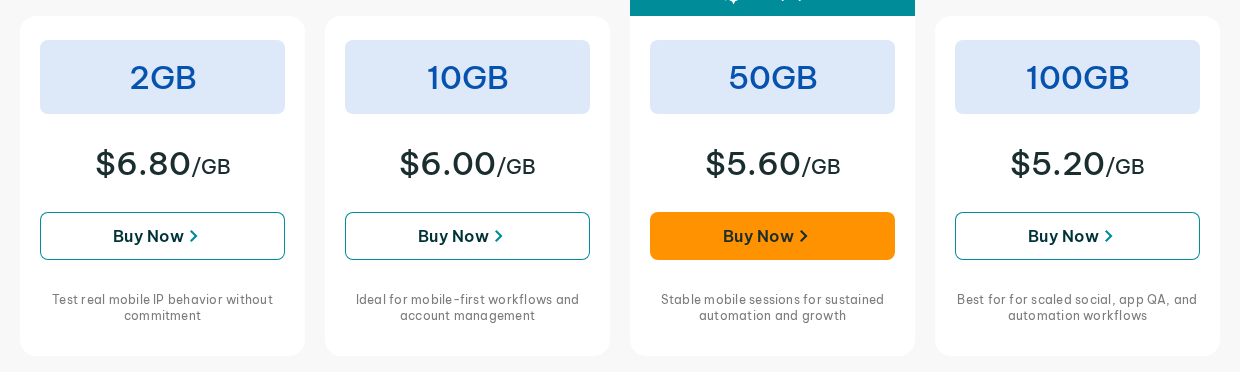
Prices checked against the IPRoyal website:
- ISP Proxies
- Dedicated Datacenter Proxies
- Static Residential Proxies
- Dedicated Mobile Proxies
- Rotation Residential Proxies
- Rotation Mobile Proxies
Specifications


IPRoyal in our rankings
Proxy Type
- Mobile Proxies
- Residential Proxies
- ISP Proxies
- Datacenter Proxies
- Dedicated Datacenter Proxies
- Static Residential Proxies
- Dedicated Mobile Proxies
- Rotation Residential Proxies
- Rotation Mobile Proxies
Available Countries
- United States
- United Kingdom
- Germany
- France
- Netherlands
- Poland
- Spain
- Italy
- Australia
- Austria
- Bulgaria
- Ireland
- Lithuania
- Malaysia
- Romania
- United States
- United Kingdom
- Germany
- France
- Canada
- Netherlands
- Japan
- Brazil
- India
- Poland
- Spain
- Italy
- Australia
- Ukraine
- Turkey
- Singapore
- United States
- United Kingdom
- Germany
- France
- Canada
- Netherlands
- Japan
- Brazil
- Poland
- Spain
- Italy
- Australia
- Turkey
- Singapore
- Korea
- Hong Kong
- United States
- United Kingdom
- Germany
- France
- Canada
- Netherlands
- Japan
- Brazil
- India
- Poland
- Spain
- Italy
- Australia
- Ukraine
- Turkey
- Singapore
- United States
- United Kingdom
- Germany
- France
- Canada
- Netherlands
- Japan
- Brazil
- India
- Poland
- Spain
- Italy
- Australia
- Ukraine
- Turkey
- Singapore
- United States
- United Kingdom
- Germany
- France
- Canada
- Netherlands
- Japan
- Brazil
- Poland
- Spain
- Italy
- Australia
- Turkey
- Singapore
- Korea
- Hong Kong
- United States
- United Kingdom
- Germany
- France
- Netherlands
- Poland
- Spain
- Italy
- Australia
- Austria
- Bulgaria
- Ireland
- Lithuania
- Malaysia
- Romania
- United States
- United Kingdom
- Germany
- France
- Canada
- Netherlands
- Japan
- Brazil
- India
- Poland
- Spain
- Italy
- Australia
- Ukraine
- Turkey
- Singapore
- United States
- United Kingdom
- Germany
- France
- Netherlands
- Poland
- Spain
- Italy
- Australia
- Austria
- Bulgaria
- Ireland
- Lithuania
- Malaysia
- Romania
Interface Language
- English
- 简体中文
Payment Methods
 Crypto
 AliPay
 Visa/Mastercard
 Google Pay
Other Features
- Residential traffic never expires
- Sticky sessions up to 7 days
- Authorization by IP address
- Sub-user management
- Crypto and AliPay payments
- City-level targeting
- SOCKS5 and HTTP support
Top 9 alternatives for IPRoyal









Our Review

Last updated: 2026-10-14
Who IPRoyal is for and who should skip it
IPRoyal has been in this business since 2013, and the strongest part of the catalog is the static side. Dedicated datacenter addresses cover 63 countries and ISP addresses cover 38, which is a broad list for products you buy one IP at a time.
Take it when you need an address that stays yours for months: a group of long-lived accounts, a regional storefront you check every morning, automation that has to look like the same home connection on every visit. ISP proxies exist for exactly that, and the per-IP price flattens early, so a small order is not punished much.
Dedicated mobile sits at the other end, 15 countries and a monthly price per address. You buy it when the target is hostile enough that a carrier IP is the only thing that survives, and you accept that one mobile address costs more per month than a whole rack of datacenter ones.
Skip IPRoyal if your main job is rotating residential collection in volume. The traffic rate sits in the upper part of the range at every step of the ladder, and on a scraping budget that difference is the entire margin. Cheap gigabytes are not what this provider sells.

Screenshot: iproyal.com, taken by us
What it actually costs
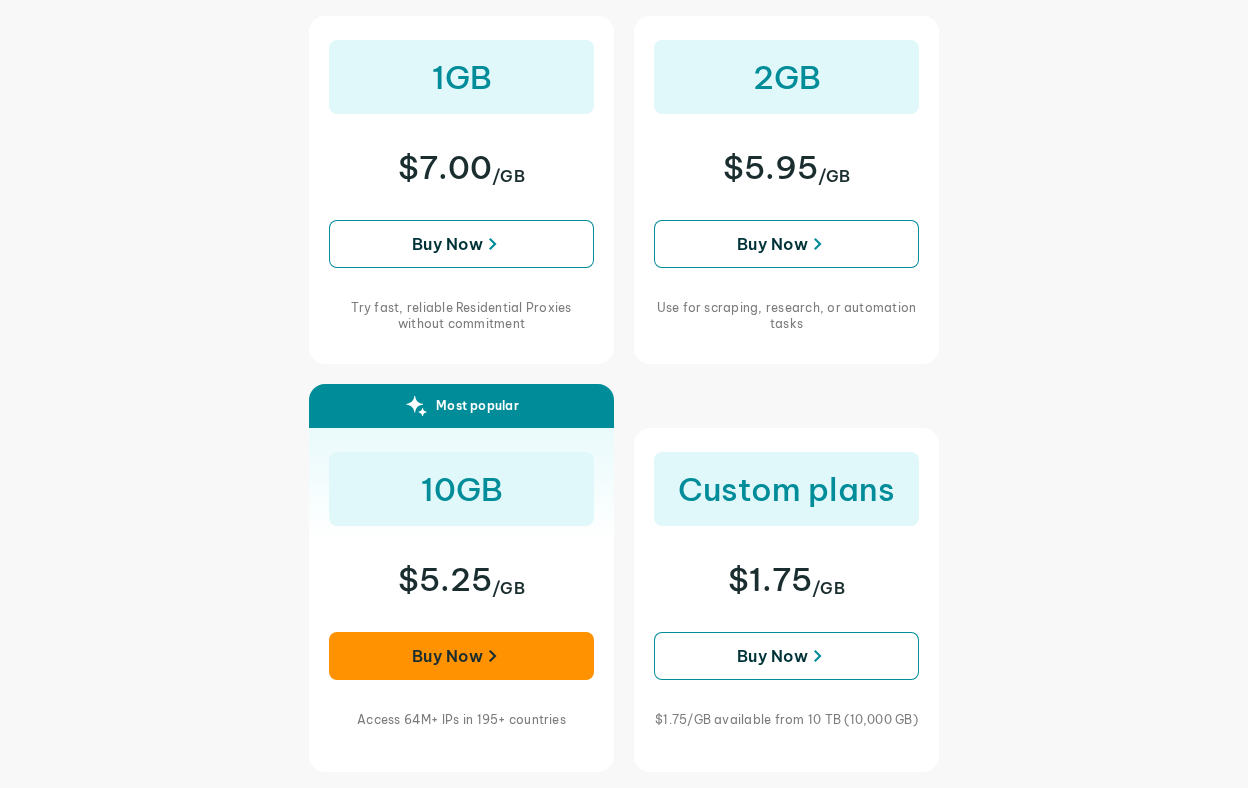
The storefront advertises residential traffic from $1.75/GB. The pricing page says where that number lives: "$1.75/GB available from 10 TB (10,000 GB)". A single pay-as-you-go gigabyte costs $7.00, and the plan marked "most popular" is $5.25 a gigabyte.
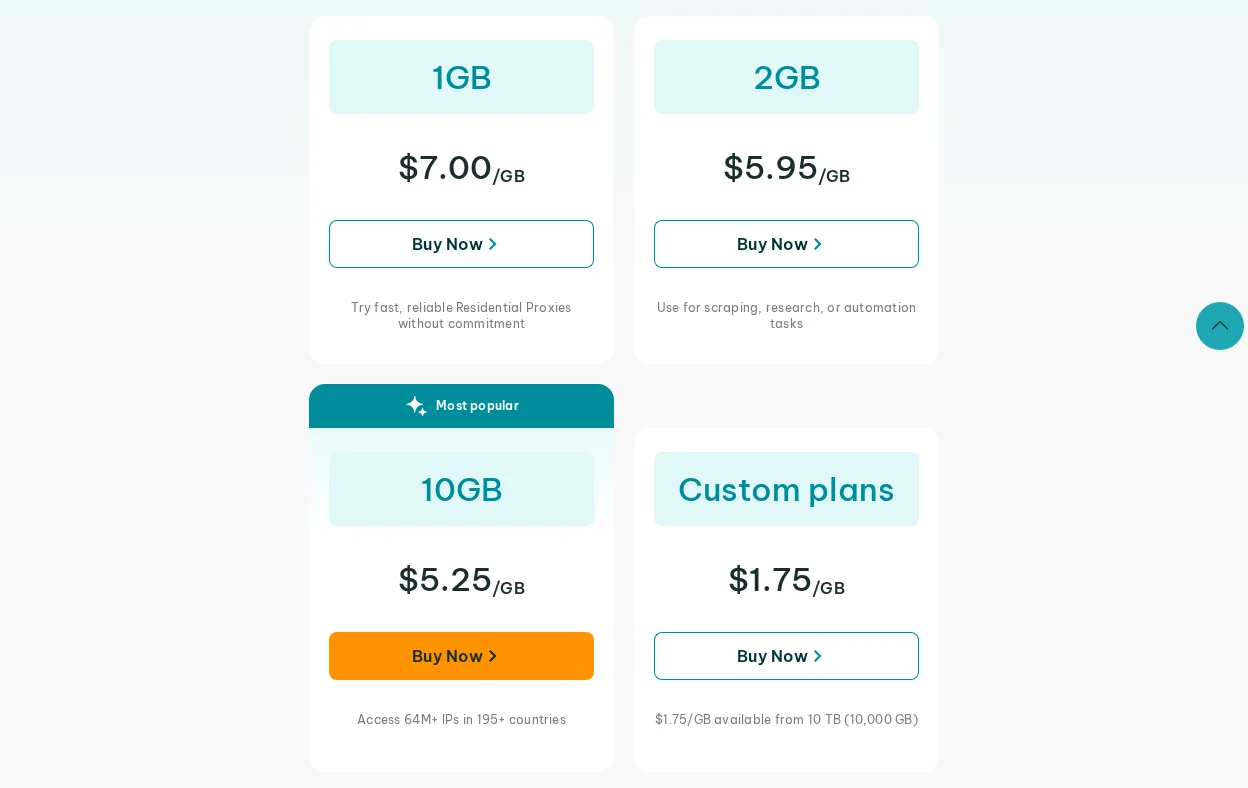
Screenshot: iproyal.com/pricing/residential-proxies, October 2026
Two things soften that price. Residential traffic never expires, so a pack bought for a quarterly crawl does not burn out at the end of the month, which is the usual trap at this price level. And a monthly subscription takes 5% off the same ladder, worth it only if your volume is steady.
At 100-150 GB the rate is $4.55/GB, so a hundred gigabytes of residential traffic costs about $455 a month. That is the figure to plan around.
The ladder below shows how the residential rate moves as the order grows.
There is no cliff in that curve, only a slope. You have to commit to thousands of gigabytes before the rate reaches the level that several competitors already charge at forty to sixty, and most buyers never order that much.
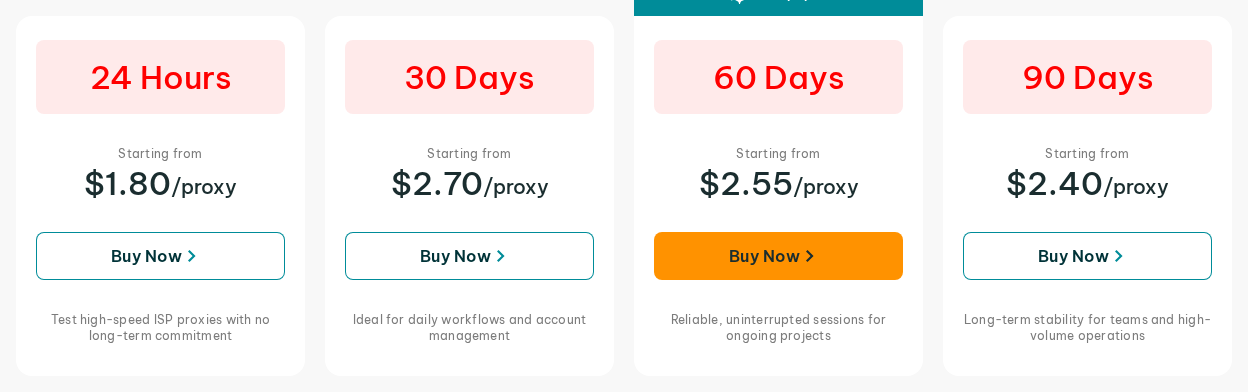
Static products run on a different unit. An ISP address costs $4 on its own, $2.94 once you take ten, and the price stops moving at $2.70, so ten addresses come to $29.40 a month.
What the per-IP price hides is a ceiling on traffic: each datacenter or ISP proxy is limited to 100 GB inside a rolling 30-day cycle. For account work that is generous. For anything that pulls video or heavy pages it is a real constraint, and it appears nowhere in the price grid.
Dedicated mobile is billed per IP per month at $130, which cannot be set against a gigabyte price at all. Decide the unit first, then argue about the provider.
Where IPRoyal loses to the named alternatives
These five providers sell the same product types at comparable scale, so the volumes below are identical in every table and the only thing that changes is the name in the first column.
| Rotation Residential Proxies, $/GB | 40-60 GB | 100-150 GB | 1000 GB |
|---|---|---|---|
| IPRoyal | 4.90 | 4.55 | 3.15 |
| NodeMaven | 3.98 | 3.75 | 2.75 |
| Proxy Seller | 2.30 | 2.20 | 1.45 |
| Proxyscrape | 4.25 | 3.50 | 2.00 |
| Thordata | 1.50 | 1.00 | 0.73 |
| Geonix | 2.10 | 1.80 | 0.75 |
At a hundred gigabytes a month the gap between IPRoyal and Thordata is more than three hundred dollars, and it widens every month you keep collecting. That is not a tier you can argue your way out of with a promo code.
The grouped bars show the same comparison at three order sizes.
IPRoyal stays in the top band at all three volumes, which makes this a positioning choice rather than a quirk of one tier. Traffic is simply not the product they compete on.
| ISP Proxies, $/IP per month | 1 IP | 10 IPs | 200-250 IPs |
|---|---|---|---|
| IPRoyal | 4.00 | 2.94 | 2.70 |
| NodeMaven | 4.99 | 4.99 | 4.99 |
| Proxy Seller | 3.00 | 2.91 | 2.40 |
| Geonix | 2.00 | 1.84 | 1.34 |
On ISP the picture is much closer, and IPRoyal trades a higher price for a country list of 38 against the six that NodeMaven sells. If your target country is one of the common ones, Geonix does the same job for roughly half the monthly bill at scale.
| Dedicated Datacenter Proxies, $/IP per month | 1 IP | 10 IPs | 200-250 IPs |
|---|---|---|---|
| IPRoyal | 1.53 | 1.53 | 1.53 |
| Proxy Seller | 1.64 | 1.53 | 1.15 |
| Proxyscrape | - | 1.90 | 1.60 |
| Geonix | 1.43 | 1.36 | 1.00 |
IPRoyal charges one flat rate no matter how many datacenter addresses you take, which is friendly for a handful and costly for a few hundred. Buy one IP and you are fine. Buy two hundred and you are paying a third more than Geonix for identical work.
| Dedicated Mobile Proxies, $/IP per month | 1 IP | 10 IPs |
|---|---|---|
| IPRoyal | 130 | 130 |
| Proxy Seller | 49 | 49 |
| Geonix | 45 | 45 |
Mobile is where the gap is hardest to defend: three dedicated mobile ports at IPRoyal cost about as much as eight at Geonix. Ask the sales desk which carriers and which cities you get before you accept that difference.
What you buy together with the gigabyte
Cheap traffic usually means a small pool, and that trade is the first thing worth checking. It does not hold here: IPRoyal declares 34M+ addresses while Thordata declares 100M+ and Proxyscrape 120M+ at lower per-gigabyte rates, so the premium is not buying you a larger network.
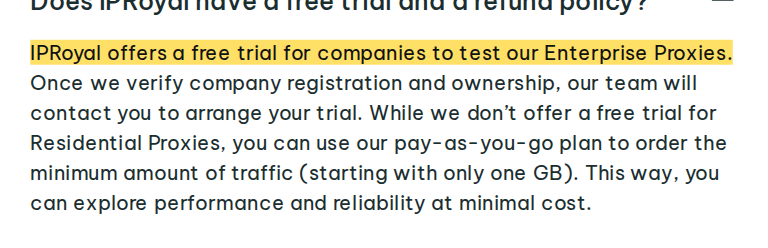
The second thing to price is the test itself. IPRoyal has no money-back window in its specs, and the free trial is offered to companies testing Enterprise Proxies after company verification, which means a private buyer tests by paying full price.
Compare the cost of trying the alternatives: NodeMaven sells a $3.50 trial, Geonix a $1.99 one, Proxy Seller gives a 24-hour refund window and Proxyscrape a 72-hour one. A few dollars against a full order is the real difference between these providers for a first-time buyer.
Screenshot: iproyal.com/quick-start-guides/residential-proxies, October 2026
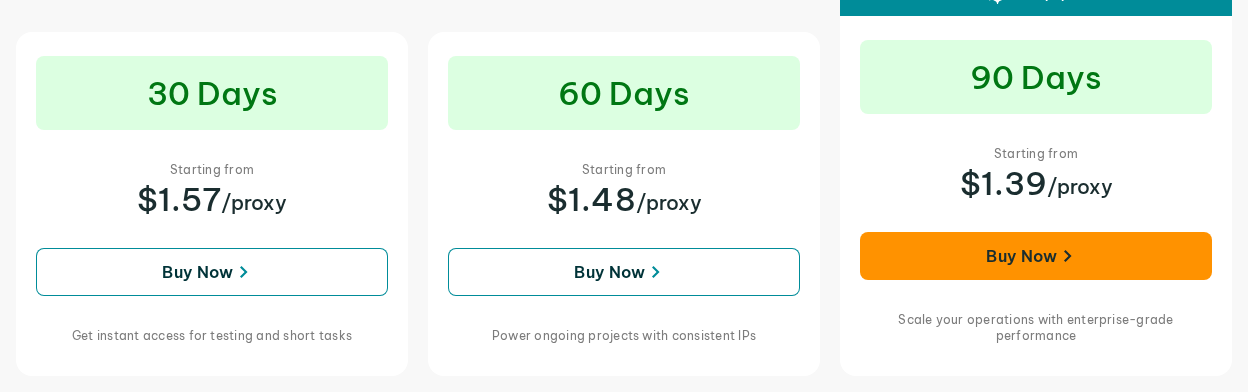
Inside the account the numbers move. We signed up, and the dashboard home lists the same five products, but not at the storefront prices. ISP starts at $2.04 per proxy there against $2.00 outside. Datacenter starts at $1.21 against $1.39. Web Unblocker starts at $0.70 per thousand requests against $1.00. Check the price on the checkout page, not on the marketing page, before you compare IPRoyal with anyone.

Screenshot: our IPRoyal dashboard, taken by us
The dashboard itself is tidy. Tools on the left include a proxy tester and an IP lookup, and a short quiz on the home screen points newcomers to a proxy type before they spend anything, which saves the classic first mistake of buying residential traffic for a job that needs a static IP.
Payment is the easy part. Crypto, AliPay, Visa/Mastercard and Google Pay are all accepted, which matters if your cards get declined at checkout. Pay attention to the combination, though: crypto plus no refund window means the money leaves for good.
What users say
Opinion on IPRoyal splits hard, and both halves are easy to find. On Trustpilot one reviewer describes the support team as fast, kind and genuinely helpful, which is the kind of praise that usually follows a staffed chat desk rather than a ticket queue.
The other half is blunt. Another Trustpilot reviewer calls the service a scam, says the proxies were bad and that support would not refund or replace them. Read that complaint next to the refund rules in the last section, because the two describe the same situation from opposite sides of the counter.
Two concrete scenarios
Scenario one: twenty accounts that must stay alive for months, one address each. At $2.94 per ISP IP that is $58.80 a month, and the per-proxy traffic ceiling is not a problem for form filling and feed reading. Pick the countries before you buy, because moving an aged account to a new address later is the expensive part. Our guide to proxies for multi-accounting goes deeper on session hygiene.
Scenario two: a nightly crawl of price pages that do not fight back, fifty parallel threads. Fifty dedicated datacenter IPs cost $1.53 each here, so $76.50 a month, and that figure will not improve when you scale to five hundred.
Geonix charges $1.14 per IP at the same fifty, which is $57 for the same rack of addresses doing the same work. Over a year that gap is real money, and the flat IPRoyal rate is what causes it.
Refund rules and session limits
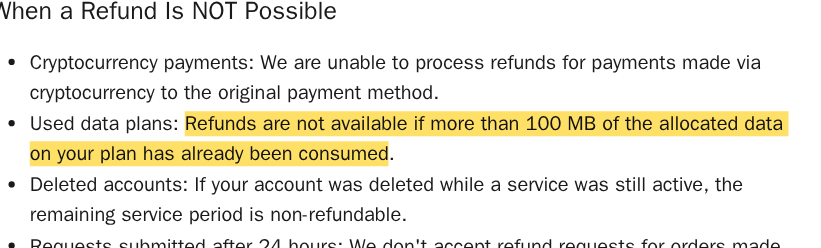
The refund terms are stricter than the plain absence of a money-back window suggests, and the thresholds differ by product. For residential plans, the help center states: "Refunds are not available if more than 100 MB of the allocated data on your plan has already been consumed". The wording lives in the IPRoyal refund policy.
Treat that as a hard limit on testing. A hundred megabytes is a short crawl of a few hundred pages, so any serious evaluation puts you past the threshold before you have an opinion worth having.
Screenshot: help.iproyal.com/en/articles/7215815-what-is-your-refund-policy-for-the-residential-plan, October 2026
Session control, on the other hand, is documented plainly: a sticky session can be held from one second up to seven days. Seven days covers almost any account workflow, and it is the main reason to run sticky sessions rather than buy a static IP for short tasks.
Verdict
Buy IPRoyal if you need static addresses in a country that smaller shops do not carry, if you pay in crypto or AliPay and want that accepted without a conversation, and if you can absorb the cost of testing with no refund behind you.
Do not buy it if rotating residential collection is your main line of work, or if you need to validate a provider on a small budget first. Both of those have cheaper answers, and they are sitting in the tables above.
Sources
- IPRoyal: What is the Fair Usage Policy? (checked October 2026)
- IPRoyal: Residential Proxies Quick-Start Guide (checked October 2026)
- IPRoyal on Trustpilot (checked October 2026)
- IPRoyal: What is your refund policy for Residential Proxies? (checked October 2026)
- IPRoyal: Rotation (checked October 2026)
FAQ
- What tasks is IPRoyal a good fit for?
- Long-lived accounts and region checks on ISP addresses, bulk collection from targets that do not fight back on datacenter IPs, and the most hostile targets on dedicated mobile. For cheap rotating residential traffic at scale, other providers in the tables above cost far less per gigabyte.
- Does IPRoyal have a free trial?
- Not for individual buyers. According to IPRoyal, the free trial is for companies testing Enterprise Proxies and requires company verification first, so a private customer evaluates the service by making a normal purchase.
- Can I get my money back?
- There is no standard money-back window in the specs. IPRoyal's help center also states that refunds are not available on residential plans once more than 100 MB of the allocated data has been consumed, so test small or accept the spend.
- What payment methods are accepted?
- Crypto, AliPay, Visa/Mastercard and Google Pay. Crypto and AliPay make IPRoyal workable from regions where card checkouts fail, but combine crypto with the refund terms carefully.
- How long can a sticky session last?
- IPRoyal's documentation sets the range from one second up to seven days, which is enough for account work that has to stay on the same exit address across several days.
- Is there a traffic limit on ISP and datacenter proxies?
- Yes. Each datacenter or ISP proxy order is capped at 100 GB per proxy within a rolling 30-day cycle, which the per-IP price does not show. Plan around it if your pages are heavy.
- Which provider should I compare IPRoyal against?
- For residential traffic, Thordata and Geonix are much cheaper at every volume. For ISP addresses, Geonix and Proxy Seller are cheaper per IP, while IPRoyal carries a wider country list.












I’ve been using IProyal for a while and I’m really impressed. The proxies work smoothly and I don’t have to worry about connection issues.
Reply