Our Test
How this test works
The code of this test is open — run it on your own proxies: github.com/caproxy-com/proxy-benchmark
Pricing
Prices checked against the Thordata website:
- Rotation Residential Proxies
Specifications

Thordata in our rankings
Proxy Type
- Residential Proxies
- Rotation Residential Proxies
Available Countries
- United States
- United Kingdom
- Germany
- France
- Canada
- Netherlands
- Japan
- Brazil
- India
- Poland
- Spain
- Italy
- Australia
- Ukraine
- Turkey
- Singapore
- United States
- United Kingdom
- Germany
- France
- Canada
- Netherlands
- Japan
- Brazil
- India
- Poland
- Spain
- Italy
- Australia
- Ukraine
- Turkey
- Singapore
Interface Language
- English
- Русский
- 简体中文
- Português
- Việt
Payment Methods
 Crypto
 AliPay
 Visa/Mastercard
Top 9 alternatives for Thordata







→ Top 10 ThorData Alternatives in 2026
Video review
Our Review

Last updated: 2026-10-19
ThorData is a Hong Kong-based proxy and web data infrastructure provider that has been operating since 2018. The product line covers residential, mobile, static ISP, and datacenter proxies, plus a suite of scraping tools including a SERP API, Web Scraper API, Web Unlocker, and a headless Scraping Browser. More recently, the company added pre-built datasets and video data products aimed at AI training workloads.
The pitch is straightforward: a large residential IP pool at prices that undercut most established providers, combined with scraping tooling that handles JavaScript rendering and anti-bot systems so you do not have to build that layer yourself. ThorData claims over 100 million residential IPs, 99.9% uptime, and a 99.7% success rate across its proxy infrastructure.
Whether those numbers hold under real conditions depends on what you are scraping, which targets you hit, and how you configure rotation. This review breaks down every product, the pricing structure, where ThorData performs well, and where it falls short.
The Proxy Infrastructure
Residential Proxies
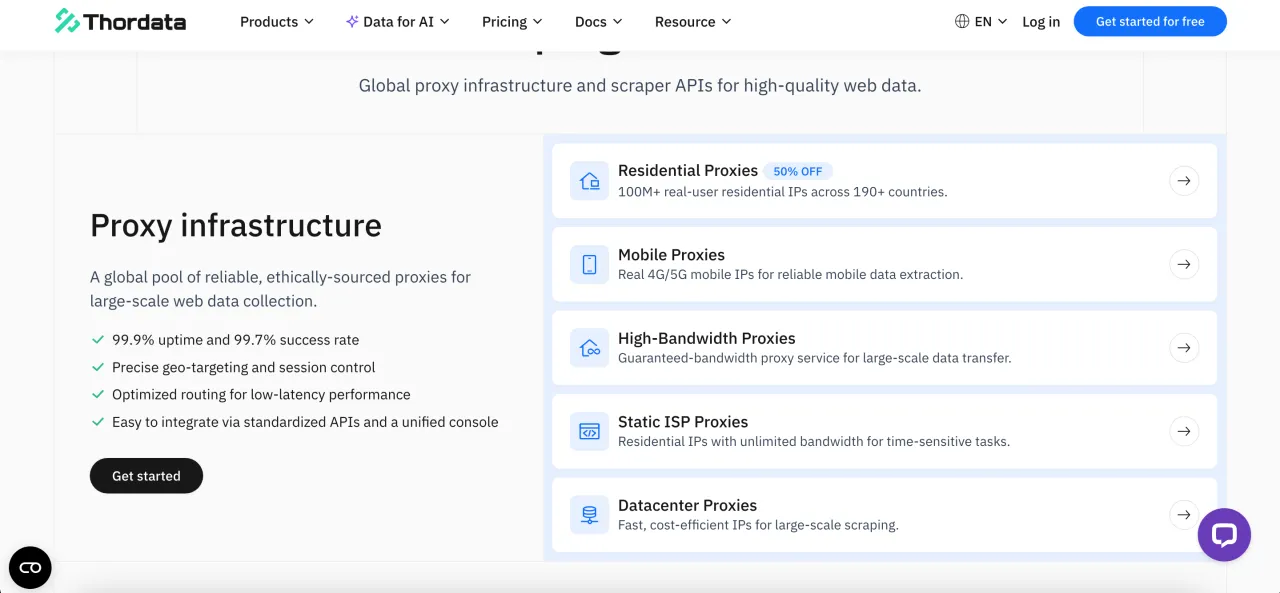
ThorData's residential pool is the flagship product. The company advertises 100 million+ real-user IPs. Various third-party reviews have cited numbers between 60 million and 100 million depending on when the measurement was taken — the pool has grown significantly since 2024. The IPs are sourced from genuine user devices through an opt-in SDK model, which is the industry standard approach for ethical sourcing.
Geo-targeting works at the continent, country, state, and city level, and an ASN parameter lets you pick a specific ISP network. The depth of city-level coverage varies by region — US, UK, Germany, France, Brazil, Japan, South Korea, Australia, Netherlands, and Mexico all have strong city-level availability. Smaller markets in Central Asia or sub-Saharan Africa will give you country-level targeting reliably but city-level results may be inconsistent.
Session control supports both rotating and sticky modes. Sticky sessions hold the same IP for 1 to 90 minutes: you set the duration in the username (10 minutes by default), and the IP changes earlier if the device behind it goes offline or if you send no requests for about a minute. For most e-commerce scraping and price monitoring workflows, that session duration is sufficient. If you are running tasks that require multi-hour persistent sessions — certain account-based workflows or long checkout funnels — you will need to plan for session refreshes.
Pricing for residential proxies depends on package size: $2.00/GB for 1 GB, $1.50/GB for 50 GB and $0.80/GB for 350 GB. The High Volume packages go lower still — $0.73/GB at 1 TB and $0.65/GB at 5 TB — so the advertised “from $0.65” applies only to the largest package. The pay-as-you-go model means no monthly minimum, which keeps entry costs low for teams with variable workloads.
Mobile Proxies
Mobile proxies use real 4G and 5G connections from carrier networks. These are the highest-trust IPs you can buy for targets that fingerprint connection type, and ThorData's mobile pool covers major carriers across key markets. Pricing runs from $5.00/GB for 1 GB down to $2.20/GB for a 500 GB package.
Mobile proxies matter most when your target actively differentiates between mobile and desktop traffic — certain social platforms, mobile-first retail sites, and app-based content APIs behave differently when they see a genuine mobile ASN. For standard web scraping, residential proxies are sufficient. Mobile proxies are worth the premium for specific use cases like mobile ad verification, social media data collection, and scraping content that is only served to mobile user-agents from mobile carrier IPs.
Static ISP Proxies
Static ISP proxies give you a residential IP registered to a real ISP (not a datacenter ASN) that you keep for as long as you need it — no rotation, no session expiry. ThorData prices these at $0.75/IP after the current discount from the standard $1.50/IP rate. Bandwidth is listed as unlimited on static ISP proxies, which is a meaningful advantage for tasks like long-running rank tracking, account management, or any workflow where IP stability over days or weeks matters more than pool size.
ISP proxies sit in a useful middle ground: they have the ASN trust profile of a residential connection but the speed and stability of datacenter infrastructure. On targets like Google, Amazon, and major retail sites that block datacenter ranges aggressively, ISP proxies consistently outperform datacenter IPs while costing less than rotating residential bandwidth for predictable workloads.
Datacenter Proxies
Datacenter proxies start at $0.75/IP (discounted from $1.50/IP). These are fast, cheap, and appropriate for targets that do not run aggressive anti-bot systems — internal tools, less protected APIs, data sources that do not fingerprint IP reputation. Do not expect datacenter IPs to work reliably against Google, major e-commerce platforms, or any site running Cloudflare, Akamai Bot Manager, or PerimeterX at full sensitivity. That is not a ThorData-specific limitation; it applies across the industry.
High-Bandwidth Proxies
ThorData also sells High Bandwidth Proxies billed per day instead of per GB: $280 for a single day, $79/day on a 30-day plan and $69/day on a 60-day plan. This product targets operations running sustained large-scale transfers where bandwidth predictability matters more than per-GB cost optimization — it pays off once daily traffic is large enough that per-GB billing would cost more.
The Scraping Solutions
SERP API
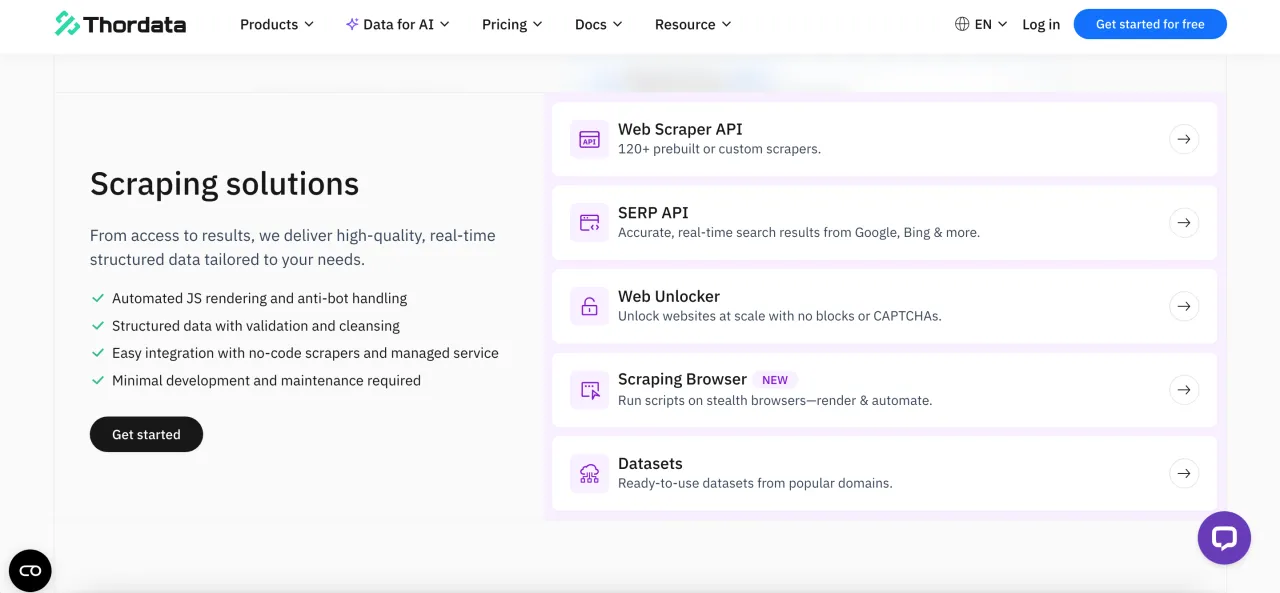
ThorData's SERP API pulls structured results from Google, Bing, and other search engines in real time. Pricing starts at $0.70 per 1,000 responses with a free trial available. The API handles CAPTCHA solving, geo-targeting for localized SERPs, and returns structured JSON that includes organic results, ads, featured snippets, and related searches depending on what the target SERP contains.
For SEO teams running rank tracking at scale or building keyword research tools, $0.70/1K puts ThorData SERP API in a competitive price range. The critical question for any SERP API is freshness and accuracy — whether you are getting the actual SERP for the location you specified or a cached approximation. ThorData claims real-time results.
Web Scraper API
The Web Scraper API includes 120+ prebuilt scrapers for popular targets — Amazon, Google, LinkedIn, Facebook, Zillow, Booking.com, and more. Pricing starts at $0.50 per 1,000 results. Custom scrapers are also supported for targets not covered by the prebuilt set.
Prebuilt scrapers matter because they encode target-specific extraction logic, handling the structural quirks of each site's HTML and the anti-bot behavior specific to that domain. Building and maintaining these scrapers in-house is time-consuming. At $0.50/1K results, you are paying for maintained extraction logic that would cost significantly more in engineering time to replicate and keep current as sites update their structures.
Web Unlocker
The Web Unlocker is ThorData's managed anti-bot bypass layer. You send a request to the endpoint, and ThorData handles IP rotation, fingerprint management, browser rendering if needed, and CAPTCHA solving. Pricing starts at $1.00 per 1,000 responses.
Web Unlocker is the right product when you want a simple HTTP interface — send a URL, get back the page HTML — without managing proxy rotation yourself. It works well for one-off enrichment tasks and workflows where you do not need to control the full scraping pipeline. For complex workflows requiring custom headers, specific session behavior, or fine-grained request control, the Scraping Browser gives you more flexibility.
Scraping Browser
The Scraping Browser runs full Chromium instances in stealth mode with JavaScript rendering, automated fingerprint rotation, and built-in proxy integration. Pricing starts at $2.50/GB of bandwidth consumed. You control the browser via standard Puppeteer or Playwright APIs, which means migration from existing browser automation code is minimal.
This is the product to use when your target requires full JS execution — single-page applications, sites that load content via AJAX after initial render, or workflows that need to interact with page elements (clicking, form submission, infinite scroll). The stealth configuration reduces detection compared to running a standard Chromium instance through a proxy, because browser fingerprints like WebGL renderer, audio context, and navigator properties are randomized consistently with the proxy IP's apparent geography and device profile.
Data Feeds and AI-Oriented Products
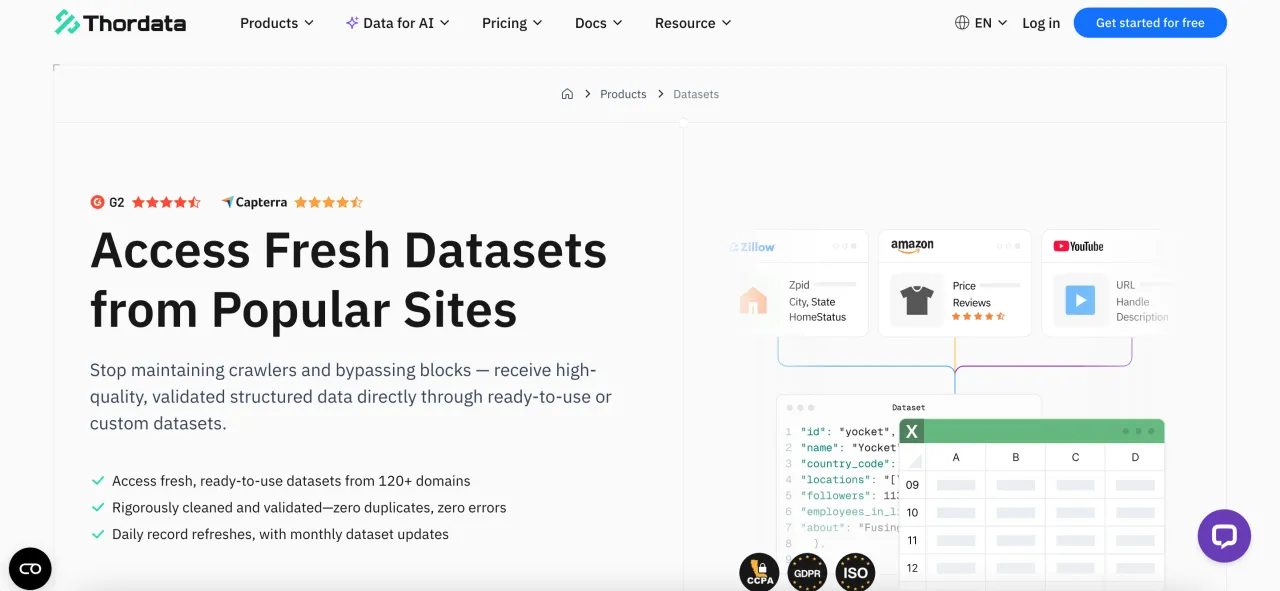
ThorData has built out a data product layer beyond raw proxy access. The Datasets product provides ready-to-use structured data starting at $0.25 per 1,000 records from popular domains. For teams that need data snapshots rather than live scraping infrastructure, this is a faster path to usable data.
The video data products are the most distinctive part of ThorData's catalog. The Video Datasets product claims 6 billion original videos from 700 million unique channels, built specifically for LLM and multimodal model training. The Video Data Scraper extracts video and metadata at scale with cloud platform integration. These products reflect a deliberate positioning toward AI training data supply chains, a market that has grown substantially since 2024 as demand for high-quality training corpora accelerated.
Pricing Summary
| Product | Starting Price | Unit | Free Trial |
|---|---|---|---|
| Residential Proxies | $0.65–$2.00 | per GB | Up to 500 MB for new users, on request |
| Mobile Proxies | $2.20–$5.00 | per GB | No |
| Static ISP Proxies | $0.75 | per IP | On request |
| Datacenter Proxies | $0.75 | per IP | On request |
| High-Bandwidth Proxies | $69–$280 | per day | — |
| SERP API | $0.70 | per 1K responses | Yes |
| Web Scraper API | $0.50 | per 1K results | Yes |
| Web Unlocker | $1.00 | per 1K responses | Yes |
| Scraping Browser | $2.50 | per GB | No |
| Datasets | $0.25 | per 1K records | — |
All plans operate on a pay-as-you-go basis with no mandatory monthly contracts. Larger packages are cheaper per unit. For flat-rate billing, the High Bandwidth plans described above cost $69 to $280 per day depending on the term.
Integration and Developer Experience
ThorData provides a unified dashboard for managing proxy credentials, monitoring usage, and switching between products. The API follows standard HTTP proxy authentication conventions, which means integration with existing scraping frameworks requires minimal configuration changes.
Below is a basic Python example for routing requests through ThorData's residential proxy endpoint with sticky session control:
import requests

proxy_user = "your_username"
proxy_pass = "your_password"
session_id = "abc123"  # same sessid = same IP for sesstime minutes (1-90)

proxy_url = f"http://td-customer-{proxy_user}-sessid-{session_id}-sesstime-30:{proxy_pass}@t.pr.thordata.net:9999"

proxies = {
    "http": proxy_url,
    "https": proxy_url,
}

headers = {
    "User-Agent": "Mozilla/5.0 (Windows NT 10.0; Win64; x64) AppleWebKit/537.36 Chrome/124.0.0.0 Safari/537.36"
}

response = requests.get("https://target-site.com/product-page", proxies=proxies, headers=headers, timeout=30)
print(response.status_code, len(response.text))
For geo-targeted requests, the parameters go into the username as well: td-customer-USERNAME-country-au-state-victoria-city-melbourne, -continent-asia, or -asn-AS7922 for a specific ISP. The residential endpoint accepts HTTP and HTTPS; SOCKS5 is not offered for residential proxies. We ran this format on our own ThorData account in September 2026: requests with one session ID kept the same IP, and ASN targeting returned an address from the requested network.
A Playwright-based example using the Scraping Browser endpoint:
from playwright.async_api import async_playwright
import asyncio

async def scrape_with_browser():
    async with async_playwright() as p:
        browser = await p.chromium.connect_over_cdp(
            "wss://USERNAME:PASSWORD@ws-browser.thordata.com"  # Scraping Browser credentials
        )
        page = await browser.new_page()
        await page.goto("https://target-site.com", wait_until="networkidle")
        content = await page.content()
        print(content[:500])
        await browser.close()

asyncio.run(scrape_with_browser())
ThorData also ships a free Chrome proxy manager extension that handles proxy switching and authentication directly in the browser. For manual verification workflows — checking localized content, ad placements, or price display — this extension removes the friction of reconfiguring system-level proxy settings.
Real-World Performance: What Holds Up and What Does Not
What Works Well
The rotating residential pool is clean and diverse. In our own test (see Our Test above), every request went through, each came from a different IP spread across many subnets and ISP networks, and none of the exit IPs belonged to hosting providers or appeared on public blocklists. Reddit let every request through and Zillow, which blocks datacenter traffic, admitted most of them. For price monitoring and other scraping where repeated or flagged IPs get blocked, that is what matters most.
The SERP API is built for SEO rank tracking across locations. The structured JSON output reduces post-processing overhead compared to parsing raw SERP HTML.
Static ISP proxies with unlimited bandwidth are genuinely useful for account-based workflows where per-GB billing becomes unpredictable. Paying a flat per-IP rate and knowing bandwidth will not spike your invoice is operationally cleaner for certain use cases.
Where It Falls Short
Speed is not ThorData's strongest point. In our test, a request over a fresh connection took around two seconds at the median, well above the sub-0.5-second response time ThorData's documentation advertises; requests over an already open connection were several times faster, so sticky sessions and connection reuse make a real difference. If you are running latency-sensitive operations where response time directly affects throughput, benchmark ThorData against your specific target and concurrency level before committing to volume.
Trial and refund terms are narrower than they look. The free trial of up to 500 MB is for new users only, covers residential proxies, and is issued by support on request rather than automatically at sign-up. Refunds are conditional: under ThorData's refund policy, you can request one within 7 days of your first purchase of a product if you have used no more than 30% of the package and no more than 2 GB, and payments made in cryptocurrency are not refunded.
The IP pool size claims vary across sources — 60 million, 90 million, 100 million — reflecting either measurement methodology differences or rapid pool growth over the review period. The marketing page currently shows 100M+. What matters more than the headline number is ASN diversity and subnet distribution, which ThorData does not publish; our test measures both, and they are among the strongest results in it. Even so, test against your specific hard targets (particularly heavy Cloudflare or Akamai sites) before scaling up.
The Scraping Browser at $2.50/GB is priced reasonably for the market, but browser-based scraping is inherently bandwidth-heavy because full page rendering loads all assets. Budget carefully if you are using the Scraping Browser at scale — costs can escalate faster than they would with a raw proxy + lightweight scraper combination.
Target Site Coverage
ThorData explicitly calls out support for these high-value targets in its product documentation:
- Google — SERP data, localized search results, Shopping feeds
- Bing — SERP data via the SERP API
- Amazon — Product pages, pricing, reviews, seller data
- LinkedIn — Profile and company data via Web Scraper API
- Facebook — Social data extraction
- YouTube — Video metadata (with dedicated Video Data Scraper)
- Zillow — Real estate listing data
- Booking.com — Hotel and travel pricing data
These prebuilt integrations reduce the maintenance burden significantly. Amazon and Google in particular update their page structures and anti-bot signatures frequently enough that maintaining custom scrapers in-house requires dedicated engineering effort. Outsourcing that maintenance to a provider's prebuilt scraper makes economic sense for most teams unless you have very specific extraction requirements.
Use Case Fit
| Use Case | Recommended Product | Fit |
|---|---|---|
| E-commerce price monitoring | Residential Proxies / Web Scraper API | Strong |
| SEO rank tracking | SERP API / Static ISP Proxies | Strong |
| Ad verification | Residential Proxies / Mobile Proxies | Strong |
| Social media data collection | Mobile Proxies / Web Scraper API | Good |
| Sneaker copping / limited drops | Residential / ISP Proxies | Moderate (latency caveat) |
| AI training data collection | Datasets / Video Datasets / Web Scraper API | Strong |
| High-concurrency datacenter scraping | Datacenter Proxies | Good (unprotected targets) |
| JS-heavy SPA scraping | Scraping Browser / Web Unlocker | Good |
| Account management (long-lived IPs) | Static ISP Proxies | Strong |
| Enterprise with SLA requirements | High-Bandwidth Proxies (contact sales) | Contact sales to verify SLA terms |
How ThorData Compares on Price
Pricing context matters. At $2.00/GB for a single gigabyte, the entry price is not where ThorData stands out; the advantage shows up with volume, where the rate falls to $0.80/GB at 350 GB and $0.65/GB at 5 TB — a price point that is difficult to find from providers with comparable IP pool sizes. Teams that do not need white-glove account management or guaranteed SLA response windows get the most out of it.
The trade-off is latency on fresh connections and, to some degree, pool quality consistency on the very hardest targets. If your use case involves scraping sites that run enterprise-grade bot detection at full sensitivity, the gap between ThorData and more expensive providers may show up in success rate differences on those specific targets. For the broad category of commercial scraping tasks — price monitoring, SERP tracking, public data collection — ThorData's cost advantage is real and the quality is sufficient.
Who Should Use ThorData
ThorData is a strong fit for developers and data teams that need large-scale proxy access at competitive prices and do not need an enterprise SLA. The combination of a large residential pool, competitive ISP proxy pricing with unlimited bandwidth, and a full scraping API suite makes it a genuinely capable end-to-end platform rather than just a proxy reseller.
The AI training data products — particularly the video datasets — give ThorData a differentiated position for teams building or fine-tuning multimodal models that need large-scale video corpora. That is not a product category most proxy providers have invested in seriously, and ThorData's 6 billion video dataset claim is a meaningful differentiator if that is your workload.
Skip ThorData if you need a contractual SLA, need the absolute lowest latency for time-critical operations like limited-release retail copping where milliseconds matter, or if you are running a mission-critical pipeline where unexpected downtime has severe business consequences and you have not built adequate failover logic.
For budget-conscious teams, growing startups, and developers who want to avoid paying enterprise premiums for capabilities they do not need, ThorData delivers real value. New users can ask support for up to 500 MB of free residential traffic, and the SERP, Web Scraper, and Web Unlocker APIs have free trials of their own, so you can validate performance against your actual targets before committing any significant spend — take advantage of that before scaling up.
Promo code thor020 gives 10% off the basic Residential Proxies plan (rotating residential)Visit Website Thordata
FAQ
- How much do Thordata residential proxies cost?
- It depends on the package: $2.00/GB for 1 GB, $1.50/GB for 50 GB and $0.80/GB for 350 GB. The High Volume packages go down to $0.73/GB at 1 TB and $0.65/GB at 5 TB, so the advertised “from $0.65” applies only to the largest package.
- Is there a free trial?
- Yes, for new users only: up to 500 MB of residential traffic. It is not issued automatically – register an account and ask the online support team for it. Mobile proxies have no trial.
- Can I get a refund?
- Only on conditions. You have 7 days after the first purchase of a product, you must have used no more than 30% of the package and no more than 2 GB, and payments made in cryptocurrency are not refunded. The full terms are in the refund policy.
- Is there a Thordata promo code?
- Yes: thor020 gives 10% off the basic Residential Proxies plan. Enter it in lowercase. It does not work for mobile, ISP or datacenter proxies, the scraping APIs or the High Volume packages.
- How long do sticky sessions last?
- From 1 to 90 minutes, set with the sesstime parameter in the username; the default is 10 minutes. The IP changes earlier if the device behind it goes offline or if you send no requests for about a minute.
- Which locations can I target?
- Continent, country, state, city and ASN. ASN targeting lets you pick a specific ISP network, which few residential providers offer.
- Does Thordata support SOCKS5?
- Not for residential proxies: the endpoint accepts HTTP and HTTPS. A SOCKS5 connection to it failed when we checked on our own account in September 2026.
- How fast are Thordata proxies?
- In our September 2026 test, the first request over a fresh connection took around two seconds at the median, while requests over an already open connection were several times faster. If speed matters, reuse connections and use sticky sessions.