Pricing
- ISP Proxies
- Static Residential Proxies
- Rotation Residential Proxies
- Rotation Datacenter Proxies
Specifications

MangoProxy in our rankings
Proxy Type
- Residential Proxies
- ISP Proxies
- Datacenter Proxies
- Static Residential Proxies
- Rotation Residential Proxies
- Rotation Datacenter Proxies
Available Countries
- United States
- United Kingdom
- Germany
- France
- Canada
- Netherlands
- Japan
- Brazil
- India
- Poland
- Spain
- Italy
- Australia
- Ukraine
- Turkey
- Singapore
- United States
- United Kingdom
- Germany
- France
- Japan
- Brazil
- India
- Spain
- Italy
- Australia
- Ukraine
- Turkey
- Singapore
- Korea
- Mexico
- Hong Kong
- United States
- United Kingdom
- Germany
- France
- Canada
- Netherlands
- Japan
- Brazil
- India
- Poland
- Spain
- Italy
- Australia
- Ukraine
- Turkey
- Singapore
- United States
- United Kingdom
- Germany
- France
- Canada
- Netherlands
- Japan
- Brazil
- India
- Poland
- Spain
- Italy
- Australia
- Ukraine
- Turkey
- Singapore
Interface Language
- English
- Русский
Payment Methods
 Crypto
 Visa/Mastercard
Top 9 alternatives for MangoProxy









Video review
Our Review

Last updated: 2026-08-26
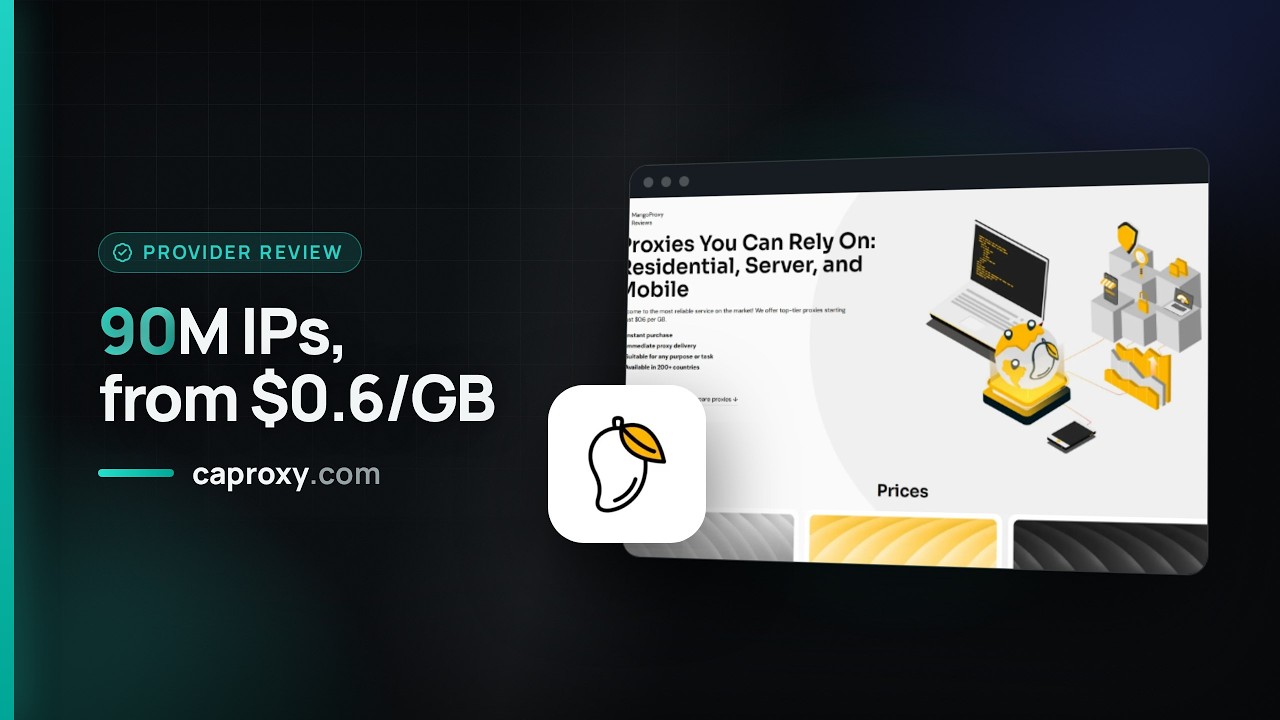
MangoProxy is a proxy infrastructure service that gives you access to residential, ISP, and datacenter proxies from a single platform. The pool currently sits at over 90 million IP addresses, with daily refreshes that keep the address stock from going stale. That last point matters more than it sounds: a pool that does not get updated regularly accumulates blocked and flagged IPs, which drives up your ban rate over time.
The platform is aimed squarely at professionals doing data collection, affiliate marketing, multi-accounting, and SEO monitoring. That said, the entry price is low enough that individual developers and small teams can use it without needing to sign an enterprise contract. Residential proxies start at $0.6 per GB, static datacenter and ISP proxies at $1.9 per IP, and mobile proxies at $18.9 per IP. You can pay with any major card or cryptocurrency.
MangoProxy positions itself as a mid-budget provider rather than the cheapest option on the market. The emphasis is on stable infrastructure and transparent per-GB billing rather than extreme volume discounts. For teams that need consistent, predictable performance over weeks or months, that trade-off usually makes sense.

MangoProxy offers three core proxy types. Each one solves a different problem, so picking the wrong one for your task will cost you both money and results. Here is how they break down in practice.
Residential Proxies
Residential IPs come from real consumer devices registered under Internet Service Providers (ISPs, the companies that provide home internet connections). Because target websites see them as ordinary residential IPs, they carry a much higher reputation score than datacenter addresses. MangoProxy's residential pool covers 90 million+ HTTP/HTTPS and SOCKS5 IPs, with a claimed response time under 0.5 seconds even under load. Rotation is automatic, meaning the proxy endpoint assigns a fresh IP for each request or at a configured interval, which is important for sustained scraping where using the same address repeatedly will get you flagged.

These are the right choice when your target site has active bot detection, fingerprinting, or IP reputation scoring. Sneaker stores, travel aggregators, social media platforms, and major e-commerce marketplaces all fall into this category. The $0.6/GB starting price is competitive for residential proxies in 2026, where the mid-market average for 100 GB sits around $3 to $4 per GB from most providers.
Static Proxies (Datacenter and ISP)
Static proxies give you a fixed IP address that stays the same for the duration of your session or subscription period. MangoProxy bundles datacenter and ISP static proxies together under one product, with a pool of over 1 million IPs. Both types support IPv4, HTTP/HTTPS, and SOCKS5. Pricing starts at $1.9 per IP.

The distinction between datacenter and ISP static matters operationally. Datacenter IPs originate from server farms rather than consumer ISPs. They are faster and cheaper but more detectable because classification databases (which sites use to score inbound traffic) know what datacenter IP ranges look like. ISP static proxies are assigned through real ISPs but hosted on server infrastructure, so they appear as regular user addresses while behaving like dedicated servers. This makes ISP statics the better pick for multi-accounting and SERP monitoring, where you need a consistent identity that does not look like a bot farm. Datacenter statics are fine for bulk scraping, automated testing, and mass mailing where detection risk is lower.
Mobile Proxies
Mobile proxies route your traffic through real mobile devices connected to cellular networks (3G, 4G, LTE). They carry the strongest reputation of any proxy type because mobile IP ranges are shared among thousands of real users, making it almost impossible for a target site to block one address without also blocking a large group of legitimate users. MangoProxy's mobile pool covers 5 million+ IPs across 46+ countries, runs at 2 to 5 Mbps, and supports HTTP and SOCKS5. Traffic is unlimited per IP, and pricing starts at $18.9 per IP.

The higher price is justified for tasks where residential proxies are not enough. Advanced anti-fraud systems, crypto exchanges with aggressive session analysis, and social media platforms with device-level tracking all respond better to mobile IPs. If your use case is standard scraping or price monitoring, residential proxies will do the job for a fraction of the cost.
Infrastructure and Performance
MangoProxy advertises 99.7%+ uptime and a response time under 0.5 seconds across all proxy types. The IP pools are refreshed daily, which reduces the risk of encountering flagged or blocked addresses in a long-running project. Geotargeting goes down to country, city, ASN (Autonomous System Number, the identifier that groups IP ranges under a single network operator), postal code, and GPS coordinates, which is more granular than most mid-budget providers offer.
The platform integrates with 450+ tools including antidetect browsers, tracker platforms, parsers, and automation systems. That breadth of compatibility is meaningful because it reduces the engineering work needed to plug MangoProxy into an existing workflow. The public API supports all dashboard functionality, so teams running automated infrastructure can provision proxies, rotate addresses, and monitor usage without touching the web interface.
Geographic coverage is broad. The largest pools are in the United States (6.75 million IPs), Brazil (36 million IPs), Germany (4.05 million IPs), Italy (4.05 million IPs). Smaller but still usable pools exist for the UK (1.8 million), Vietnam (2.25 million), Turkey (1.35 million), and others. If you need a country that is not currently covered, MangoProxy claims it can add new locations within a few hours of request, which is a useful escape hatch for niche geographic targeting.
All IPs are sourced from legal channels with no spam history in the pool, according to the provider's documentation. This matters because addresses with a history of abuse will trigger block lists immediately, regardless of how sophisticated your rotation logic is.
Use Cases
MangoProxy covers a wide range of tasks. The ones where residential proxies genuinely earn their price are scraping well-protected targets like Amazon, eBay, and Walmart, monitoring search engine results pages (SERPs) across different locations, running ad verification workflows, and managing multiple social media accounts at scale. Affiliate marketers running traffic arbitrage campaigns also benefit from the IP variety, since launching campaigns from the same IP range repeatedly will get accounts flagged on most ad platforms.

Datacenter statics handle the volume-intensive, lower-risk tasks well: bulk data extraction from sites without aggressive bot protection, automated QA and debugging environments, and mass mailing pipelines. Mobile proxies are the right tool for crypto farming, airdrop participation that requires account diversity, and anything involving platforms that fingerprint at the device and carrier level.
Personal use cases are also supported. Unrestricted browsing, bypassing geo-restrictions on streaming or content platforms, and basic online privacy are all straightforward applications that do not require anything more than the entry-level residential plan.
Pricing Model
MangoProxy operates on a pay-as-you-go model for residential proxies, billed per gigabyte of traffic. This is the right structure for teams with variable workloads: you are not paying for capacity you do not use in a slow month. Static and mobile proxies are billed per IP, which suits projects where you need a stable address for a defined period.
| Proxy Type | Starting Price | Pool Size | Locations | Protocols |
|---|---|---|---|---|
| Residential | $0.6 / GB | 90M+ IPs | 200+ | HTTP/HTTPS, SOCKS5 |
| Static (DC and ISP) | $1.9 / IP | 1M+ IPs | Multiple | IPv4, HTTP/HTTPS, SOCKS5 |
| Mobile | $18.9 / IP | 5M+ IPs | 46+ | HTTP, SOCKS5 |
Payment is accepted via credit and debit cards from any country, as well as cryptocurrency. There is no requirement to sign a long-term contract for standard plans, which keeps the commitment low for teams that want to test the infrastructure before scaling up.
Who Should Use MangoProxy
MangoProxy is a good fit for growing teams that need reliable residential infrastructure without committing to enterprise-level spend. The $0.6/GB residential price is attractive, the pool size of 90 million+ IPs is large enough to sustain serious scraping workloads without excessive IP repetition, and the daily pool refresh keeps quality from degrading over time.
It is not the right choice if you need a fully managed scraping API that handles JavaScript rendering, CAPTCHA solving, and browser fingerprinting for you. MangoProxy provides the IP layer, you are responsible for the rest of the stack. For teams with that engineering capability, that is a feature rather than a limitation, since it means you keep full control over your request logic and spend less per request than you would on a managed scraping service.
The 10,000+ satisfied customers figure and the testimonials from companies like 22Byte, MarketLab, and CpaBazuka suggest that the service holds up in production environments across affiliate marketing, data collection, and ad campaign management. The 24/7 support with an average response time under 10 minutes is a meaningful operational detail for teams running time-sensitive campaigns where a proxy outage needs to be resolved quickly.
If your main priority is the absolute lowest possible cost per GB and you are willing to accept higher variance in IP quality, there are cheaper options in the market. MangoProxy is making a different bet: consistent quality, a large clean pool, and infrastructure you can depend on for long-running projects.
Promo code CAPYRATE gives 20% off every residential proxy order (reusable)Visit Website MangoProxy