Last updated: 2026-07-29
NetNut has been around long enough to build a recognizable name, but as of July 2026 it is no longer just a question of price or pool size. Google and the FBI publicly disrupted the NetNut network on July 2, 2026, identifying it as a botnet built from infected consumer devices operating under the alias "Popa." If you were using NetNut, or a white-label service that resells its pool, this is no longer just a "should I switch for better pricing" decision — it's a "get off this network" decision.
This article covers 10 solid alternatives to NetNut in 2026, all of which source their IP pools differently and are not implicated in the Google/FBI action. The list includes providers ranging from enterprise-grade platforms with 400 million IPs to leaner, budget-friendly services. For each provider you will find the key specs, pricing, and an honest take on who it actually suits.
What happened to NetNut
On July 2, 2026, Google announced a coordinated takedown of the NetNut residential proxy network together with the FBI and Lumen. Google's Threat Intelligence Group assessed the network at a minimum of 2 million devices, most of them ordinary consumer hardware such as smart TVs and streaming boxes that had been enrolled without their owners' knowledge through bundled SDKs. Google also stated it has high confidence that a number of popular residential proxy brands were white-labeling the same underlying pool through NetNut's reseller program.
For a full breakdown of what happened and what it means for the proxy market, see our updated NetNut review.
Why look for a NetNut alternative?
Until recently the case for switching was mostly about price and pool size. That is still true, but it is now secondary to a bigger question: is the network you're paying for actually sourced from people who agreed to share their bandwidth? NetNut's July 2026 disruption is a reminder that pool-size marketing numbers don't tell you where those IPs came from. Whatever provider you pick next, it's worth asking directly how they recruit IPs, and treating vague or evasive answers as a red flag.
NetNut positions itself mainly around ISP proxies sourced from a network of internet service providers rather than peer-to-peer residential devices. That architecture gives it decent speed and stability, but it also means the pool of real household IPs is smaller than what peer-to-peer residential networks offer. When you need to hit targets that do aggressive fingerprinting and reputation scoring against residential ASNs specifically, that distinction matters. Beyond the technical side, NetNut's entry plans are not particularly cheap, and the self-service experience has historically been less polished than what competitors now offer.
The providers below cover different angles. Some are better on raw pool size. Some win on price per gigabyte. Some have better tooling for developers or cleaner dashboards for people who do not want to read documentation on a Saturday morning. Read through and pick what fits your actual workflow.
What to look for in a proxy provider
Before going through the list, it is worth spelling out the criteria that actually matter when evaluating a proxy service, because marketing pages all say the same reassuring things regardless of how the product performs.
- Pool size and diversity: A larger pool means less IP reuse per request, which translates to lower ban rates. But raw numbers can be inflated, look for providers that are transparent about active, verified IPs rather than total claimed IPs.
- Geo coverage and targeting depth: Country-level targeting is table stakes. City-level and ASN-level targeting is what you actually need for local SEO checks, ad verification, and regional price monitoring.
- Session control: Sticky sessions that hold a single IP for a configurable duration are critical for anything involving login flows or multi-step checkout processes. Rotating sessions are better for pure scraping at scale.
- Success rate: This is more important than speed. A proxy that responds in 200ms but fails 30% of requests is worse than one that takes 600ms and succeeds 98% of the time.
- Price per GB: Residential proxies typically run between $0.49 and $5 per GB depending on volume, commitment level, and network quality. Anything above $5/GB for residential is hard to justify in 2026 unless the provider offers something genuinely unusual.
- Protocol support: HTTP, HTTPS, and SOCKS5 should all be available. SOCKS5 matters for non-HTTP traffic and for tools that need lower-level socket control.
Top 10 NetNut alternatives
1. Novada
Official website: https://novada.com/
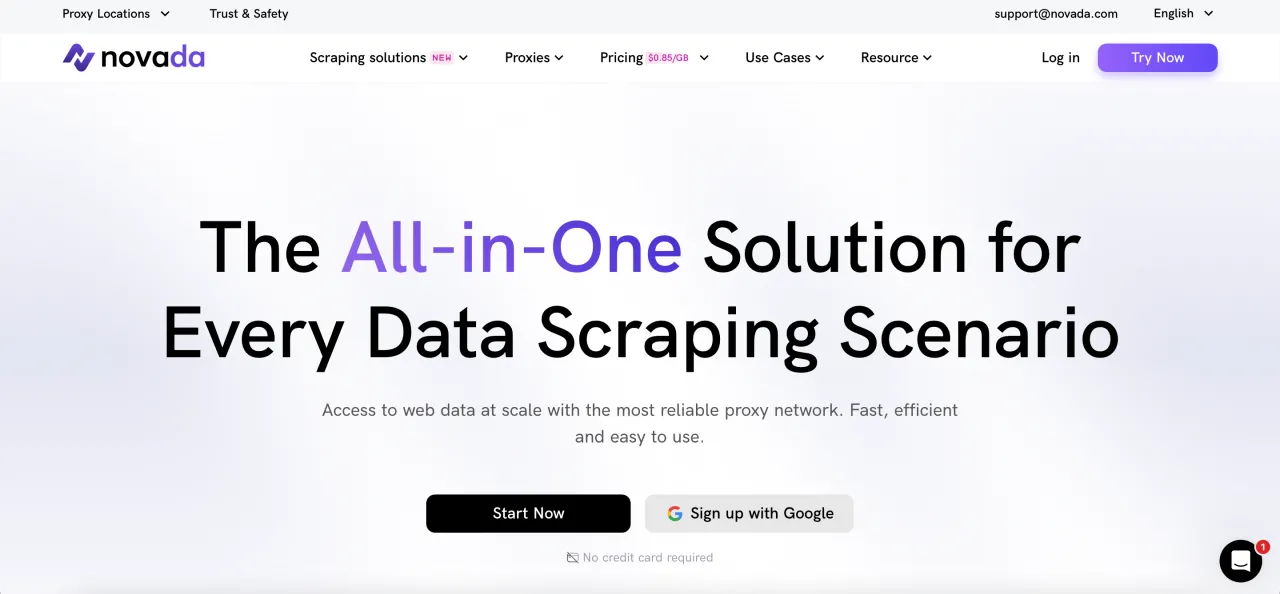
Novada is a relatively new name that has grown quickly, now serving over 8,000 enterprises globally with a full-stack proxy offering that covers residential, mobile, ISP, and datacenter types. The residential pool sits at 100 million verified IPs, with sub-0.5s response times and a claimed 99.99% success rate. Figures that hold up well under testing. It is a strong pick for teams that want a single vendor for all proxy types rather than stitching together multiple services.
- Carriers/geo: City-level targeting, 120+ mobile carriers for mobile proxies
- Protocols: HTTP, HTTPS, SOCKS5
- Authentication: Username/password and IP allowlist
- Rotation: Rotating and sticky sessions from 1 to 120 minutes, configurable per request
- Price: Residential from $0.85/GB, mobile from $1.50/GB, rotating ISP from $0.65/GB, rotating datacenter from $0.50/GB, static ISP from $1.18/IP, dedicated datacenter from $0.72/IP
2. BrightData
Official website: https://brightdata.com/
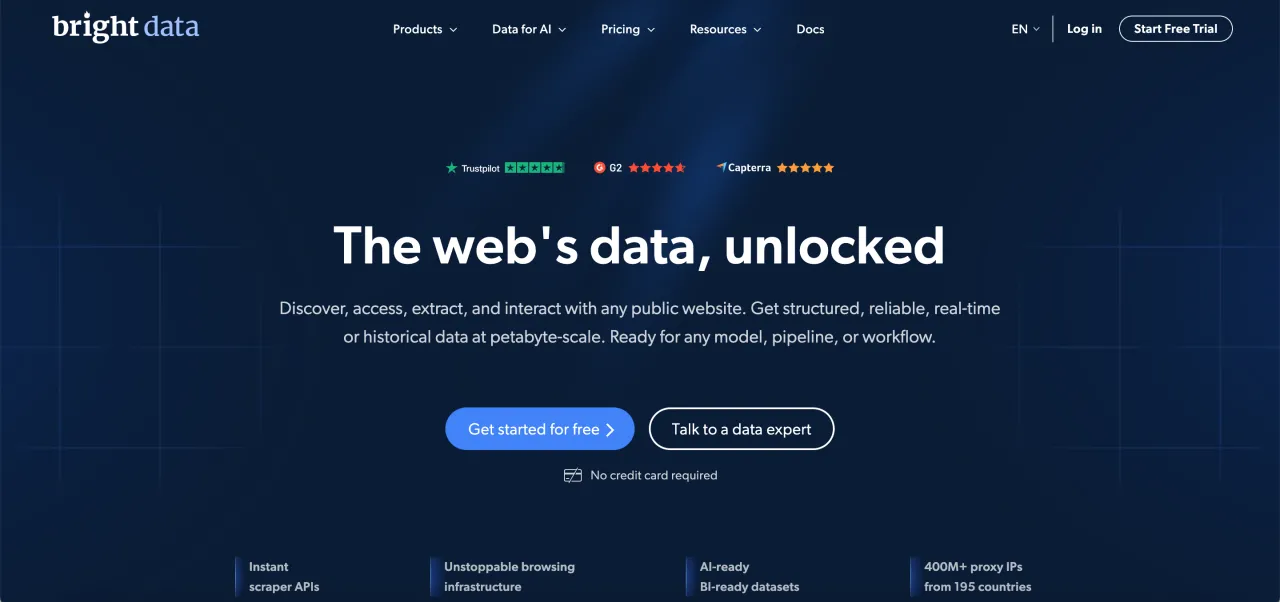
Bright Data is the largest proxy and web data platform on the market, with over 400 million IPs and a full suite of tools that goes well beyond raw proxies: a scraper API, an AI Scraper Studio, a web archive, dataset marketplace, and managed browser infrastructure. It is primarily aimed at businesses and enterprise teams, and the KYC process reflects that. If you are an individual developer looking for a quick setup with no friction, this is probably not your first call. But for teams that need petabyte-scale data collection with serious compliance guarantees, nothing else comes close.
- Carriers/geo: City and ASN targeting, 400M+ residential IPs, 1.3M+ ISP IPs
- Protocols: HTTP, HTTPS, SOCKS5
- Authentication: Username/password, API key for programmatic access
- Rotation: Rotating and sticky sessions, rotation interval configurable via request parameters
- Price: Pay-as-you-go and subscription plans, residential proxies from approximately $5/GB at entry, dropping significantly at volume, dedicated datacenter and ISP also available
3. NodeMaven
Official website: https://nodemaven.com/
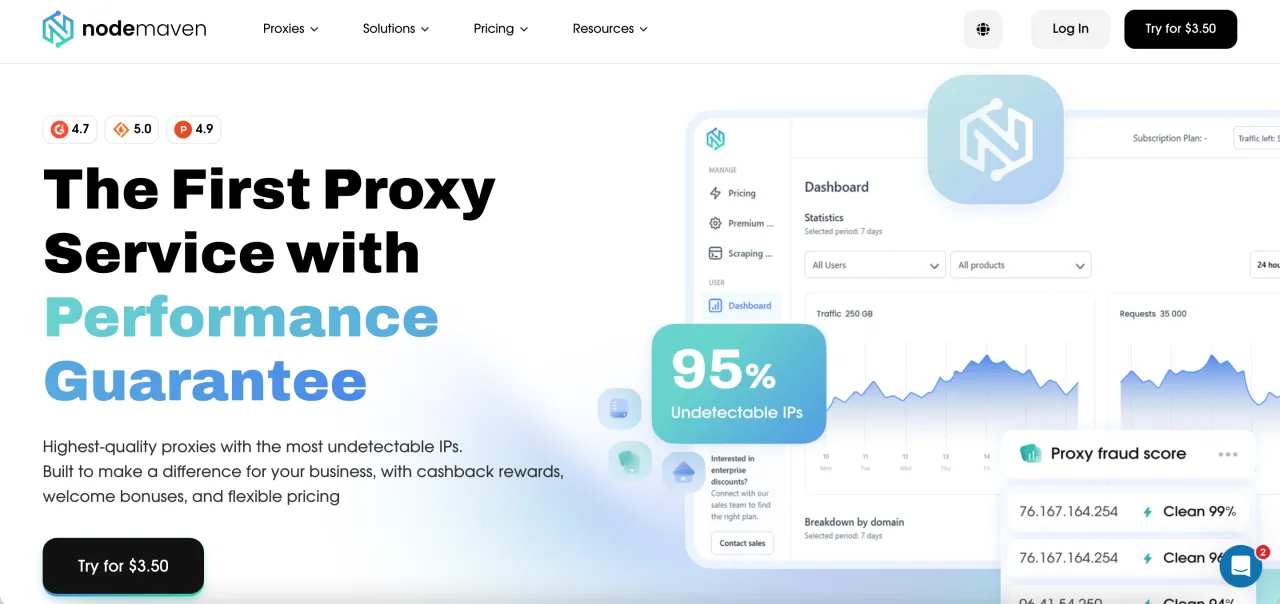
NodeMaven takes a different angle from most providers in this list. Rather than competing on total pool size, it focuses on IP quality. Running a real-time filtering algorithm that screens addresses before assigning them to you, resulting in a 95% IP clean rate and a reported 99.4% business success rate. The residential pool is 30 million IPs, which is smaller than some competitors, but a clean pool of 30 million outperforms a dirty pool of 200 million in practice. There is also an industry-first cashback program that converts used traffic into reusable proxy credits.
- Carriers/geo: City and ZIP-level targeting, 250K+ mobile IPs
- Protocols: HTTP, HTTPS, SOCKS5
- Authentication: Username/password
- Rotation: Rotating and sticky sessions up to 7 days, traffic rolls over on monthly plans
- Price: Residential and mobile proxies from $2.20/GB, ISP proxies from $2.99/IP, $3.50 trial available, custom pricing for 1000+ GB
- Promo: Code CAPYRATE35 gives you 35% off your first order
4. ProxyEmpire
Official website: https://proxyempire.io/
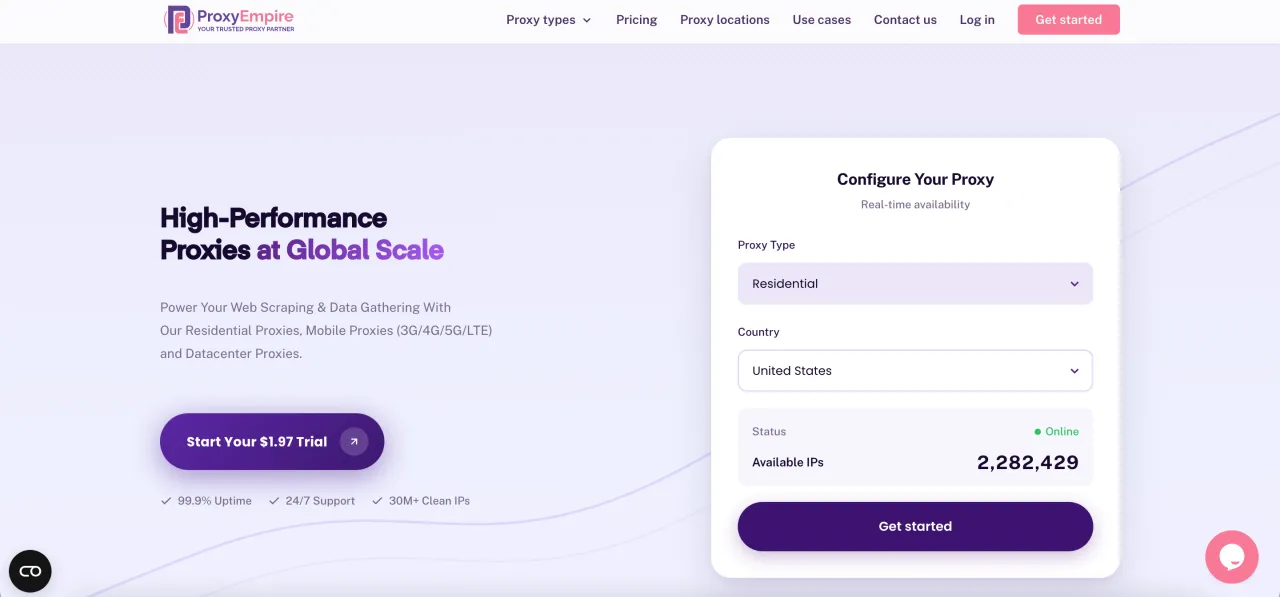
ProxyEmpire covers residential, mobile, and datacenter proxies with a 30 million IP pool, unlimited concurrent sessions, and rollover bandwidth. Meaning unused GB do not disappear at month end. The 24/7 support is staffed by actual humans rather than a chatbot, which is more useful than it sounds when something breaks at 2am before a critical scraping run. The $1.97 trial makes it easy to test before committing to a full plan.
- Carriers/geo: Residential IPs, broad mobile carrier coverage worldwide
- Protocols: HTTP, HTTPS, SOCKS5
- Authentication: Username/password and IP allowlist
- Rotation: Rotating and sticky sessions, unlimited concurrent sessions on all plans
- Price: Residential proxies from $0.75/GB, mobile proxies from $1.25/GB, datacenter proxies from $0.35/GB, rollover bandwidth included, $1.97 trial
5. Proxyscrape
Official website: https://proxyscrape.com/
Proxyscrape started as a free proxy list aggregator and has since built out a paid proxy infrastructure covering residential and datacenter IPs. It is one of the more developer-friendly services on this list, with a straightforward API and pricing that is accessible for smaller projects. The platform is a good fit for teams that are cost-sensitive and comfortable with a more self-service setup, and it still maintains one of the more active free proxy lists for those who need quick, throwaway IPs for testing.
- Carriers/geo: Global coverage across residential and datacenter pools, multiple countries available
- Protocols: HTTP, HTTPS, SOCKS4, SOCKS5
- Authentication: Username/password and IP allowlist
- Rotation: Rotating proxies, sticky session support on paid residential plans
- Price: Residential and mobile proxies from $1.15/GB, datacenter proxies from $1.60/IP, free datacenter proxy list available
6. Evomi
Official website: https://evomi.com/
Evomi is a Swiss-based provider that has been gaining traction as a clean, ethically-sourced residential proxy service with competitive pricing. It covers residential, mobile, datacenter, and ISP proxy types, and the Swiss incorporation means it operates under stricter data privacy standards than many competitors. The dashboard is clean and genuinely easy to navigate, which matters if you are onboarding a team that is not deeply technical.
- Carriers/geo: Residential and mobile coverage with city-level targeting
- Protocols: HTTP, HTTPS, SOCKS5, UDP, HTTP3/QUIC
- Authentication: Username/password and IP allowlist
- Rotation: Rotating and sticky session modes, session duration configurable
- Price: Residential proxies from $0.49/GB, mobile proxies from $2.20/GB, ISP proxies from $1.00/IP, datacenter proxies from $0.30/GB
- Promo: Code CAPROXY5 gives you 5% off all plans except Core Residential
7. Soax
Official website: https://soax.com/
Soax is a well-established residential and mobile proxy provider with a verified, constantly refreshed IP pool. One of its more distinctive features is the pool cleanliness focus: Soax actively filters out low-quality and flagged IPs rather than just maximizing total count. It offers fine-grained geo targeting down to city and ISP level, which is useful for SEO work, ad verification, and localized price monitoring where country-level targeting is not precise enough.
- Carriers/geo: City and ISP-level targeting, broad mobile carrier support
- Protocols: HTTP, HTTPS, SOCKS5
- Authentication: Username/password
- Rotation: Rotating and sticky sessions, rotation interval from 0 to 600 seconds configurable via endpoint parameters
- Price: Residential and mobile proxies from $2.00/GB, datacenter proxies from $0.40/GB, volume discounts available
8. Thordata
Official website: https://thordata.com/
Thordata is a newer provider that has built its reputation around a large residential IP pool and competitive per-GB pricing, making it attractive for high-volume scraping operations where cost efficiency is the primary concern. The platform supports standard HTTP and SOCKS5 connections and provides both rotating and sticky session modes. It is a no-frills option. Not the most feature-rich dashboard, but the proxy infrastructure itself is solid and the pricing is among the more aggressive on this list.
- Carriers/geo: Country and city-level targeting available
- Protocols: HTTP, HTTPS, SOCKS5
- Authentication: Username/password and IP allowlist
- Rotation: Rotating and sticky sessions, configurable session length
- Price: Residential proxies from $0.65/GB, mobile proxies from $2.20/GB, ISP proxies from $2.50/IP, datacenter proxies from $2.25/IP
9. Infatica
Official website: https://infatica.io/
Infatica runs a peer-to-peer residential proxy network. The service is built with web scraping as its primary use case, and the API is well-documented enough that integration into a Python requests or Scrapy pipeline takes about 15 minutes. Infatica also offers a mobile proxy network for use cases that require 4G carrier IPs, and the pricing structure is straightforward with no confusing tier multipliers.
- Carriers/geo: Residential and mobile IP types
- Protocols: HTTP, HTTPS, SOCKS5
- Authentication: Username/password and IP allowlist
- Rotation: Rotating and sticky sessions, session stickiness configurable per request
- Price: Residential proxies from $2.60/GB, mobile proxies from $4.00/GB, ISP proxies from $1.95/IP, datacenter proxies from $0.30/GB
10. DataImpulse
Official website: https://dataimpulse.com/
DataImpulse positions itself firmly at the budget end of the residential proxy market, with per-GB pricing that is consistently lower than most of the names on this list. The pool covers 5 million residential IPs, which is smaller than providers like Novada or Bright Data, but more than adequate for mid-scale scraping projects. There is no monthly minimum, which makes it a realistic option for projects with irregular traffic patterns or for agencies that need to top up on demand without a recurring commitment.
- Carriers/geo: Country and city targeting
- Protocols: HTTP, HTTPS, SOCKS5
- Authentication: Username/password
- Rotation: Rotating proxies, sticky sessions available
- Price: Residential proxies from $1.00/GB, mobile proxies from $1.60/GB, datacenter proxies from $0.50/GB, no monthly minimum, pay-as-you-go available
Residential vs ISP proxies. Which one do you actually need?
This is the question that should drive your provider choice, because NetNut is specifically an ISP proxy provider and the distinction matters. ISP proxies (sometimes called static residential proxies) are IP addresses assigned by real internet service providers but hosted on datacenter servers. They combine the ISP ASN of a legitimate consumer IP with the speed and stability of datacenter infrastructure. Residential proxies, by contrast, route your traffic through real user devices. Actual laptops, phones, and home routers. Which means the ASN, the device fingerprint metadata, and the traffic pattern all look like a genuine user.
For most scraping targets, residential proxies are the safer choice. Websites that fingerprint heavily. Major e-commerce platforms, social networks, travel aggregators. Look at ASN reputation, connection behavior patterns, and whether the IP has been associated with prior abuse. A peer-to-peer residential IP from a household broadband connection in a city scores better on all of those signals than a datacenter-hosted ISP IP, even if both are technically registered under a consumer ISP. The practical difference shows up most clearly on targets that maintain aggressive reputation scoring: residential IPs typically achieve 15 to 25 percentage points higher success rates on the hardest targets compared to ISP proxies.
ISP proxies win on speed and stability. Because they sit in datacenters, latency is lower and sessions do not drop when a real user's home router reboots. For use cases like account management, form automation, or anything requiring a persistent, long-lived connection, ISP proxies are genuinely the better tool. For pure scraping at scale where you are rotating IPs constantly anyway, residential wins on pass-through rate.
Pricing comparison
| Provider | Residential (per GB) | Mobile (per GB) | ISP / Datacenter | Free trial |
|---|---|---|---|---|
| Novada | from $0.85 | from $1.50 | ISP from $0.65/GB, DC from $0.50/GB | – |
| BrightData | from $5.00 | from $5.00 | ISP from $0.9/IP, DC from $0.30/IP | Free trial on registration |
| NodeMaven | from $2.2 | from $2.2 | ISP from $2.99/IP | $3.50 trial |
| ProxyEmpire | from $0.75 | from $1.25 | DC from $0.35/GB | $1.97 trial |
| Proxyscrape | from $1.15 | from $1.15 | DC from $1.60/IP | Free datacenter list |
| Evomi | from $0.49 | from $2.2 | ISP from $1.0/IP, DC from $0.30/GB | Trial credits available |
| Soax | from $2.00 | from $2.00 | DC from $0.40/GB | Limited trial on request |
| Thordata | from $0.65 | from $2.20 | ISP from $2.5/IP, DC from $2.25/IP | Contact sales |
| Infatica | from $2.60 | from $4.00 | ISP from $1.95/IP, DC from $0.30/GB | Trial on request |
| DataImpulse | from $1.00 | from $1.60 | DC $0.50/GB | – |
Which provider should you choose?
If you're moving off NetNut specifically because of the July 2026 disruption, prioritize providers that are explicit about consensual, opt-in IP sourcing (a peer-to-peer SDK model with disclosed compensation to device owners) rather than picking solely on price. Proxyscrape and Evomi are both explicit about this in their marketing, it's worth asking the same question of any provider not on this list before you commit spend.
For most teams replacing NetNut, the decision comes down to what NetNut was not giving you. If the issue was pool size and geo coverage, Novada or BrightData cover that ground comprehensively. If the issue was IP quality and ban rates on tough targets, NodeMaven's filtering approach is the most technically interesting solution on this list and worth testing with the $3.50 trial before committing. If the issue was simply cost, Evomi ($0.49/GB), Thordata ($0.65/GB), ProxyEmpire ($0.75/GB), and Novada ($0.85/GB) all offer highly competitive residential pricing. DataImpulse remains a strong option as well, particularly for teams that prefer a straightforward pay-as-you-go model with no monthly minimums.
ProxyEmpire is a strong middle-ground option: the $1.97 trial, rollover bandwidth, and human support make it a low-risk first choice for teams moving off NetNut without a clear replacement in mind. Evomi is worth a look if your organization has compliance requirements and the Swiss jurisdiction is relevant to your procurement process.
There is no universally correct answer here. Test two or three of the providers above on your actual target list before making any long-term commitment. Most of them offer low-cost entry points for exactly that reason.