Pricing
- ISP Proxies
- Dedicated Datacenter Proxies
- Static Residential Proxies
- Shared Datacenter Proxies
- Rotation Residential Proxies
- Rotation Mobile Proxies
Specifications


Infatica in our rankings
Proxy Type
- Mobile Proxies
- Residential Proxies
- ISP Proxies
- Datacenter Proxies
- Dedicated Datacenter Proxies
- Static Residential Proxies
- Shared Datacenter Proxies
- Rotation Residential Proxies
- Rotation Mobile Proxies
Available Countries
- United States
- United Kingdom
- Germany
- France
- Canada
- Netherlands
- Japan
- Brazil
- India
- Poland
- Spain
- Italy
- Australia
- Ukraine
- Turkey
- Singapore
- United States
- United Kingdom
- Germany
- France
- Canada
- Netherlands
- Japan
- Brazil
- India
- Poland
- Spain
- Italy
- Australia
- Ukraine
- Turkey
- Singapore
- United States
- United Kingdom
- Germany
- France
- Canada
- Netherlands
- Japan
- Brazil
- Poland
- Spain
- Italy
- Ukraine
- Turkey
- Singapore
- Korea
- Hong Kong
- United States
- United Kingdom
- Germany
- France
- Canada
- Netherlands
- Japan
- Brazil
- India
- Poland
- Spain
- Italy
- Australia
- Ukraine
- Turkey
- Singapore
- United States
- United Kingdom
- Germany
- France
- Canada
- Netherlands
- Japan
- Brazil
- India
- Poland
- Spain
- Italy
- Australia
- Ukraine
- Turkey
- Singapore
- United States
- United Kingdom
- Germany
- France
- Canada
- Netherlands
- Japan
- Brazil
- Poland
- Spain
- Italy
- Ukraine
- Turkey
- Singapore
- Korea
- Hong Kong
- United States
- United Kingdom
- Germany
- France
- Canada
- Netherlands
- Japan
- Brazil
- India
- Poland
- Spain
- Italy
- Australia
- Ukraine
- Turkey
- Singapore
- United States
- United Kingdom
- Germany
- France
- Canada
- Netherlands
- Japan
- Brazil
- India
- Poland
- Spain
- Italy
- Australia
- Ukraine
- Turkey
- Singapore
- United States
- United Kingdom
- Germany
- France
- Canada
- Netherlands
- Japan
- Brazil
- India
- Poland
- Spain
- Italy
- Australia
- Ukraine
- Turkey
- Singapore
Interface Language
- English
Payment Methods
 Crypto
 Visa/Mastercard
 PayPal
Top 9 alternatives for Infatica







Our Review

Last updated: 2026-06-08
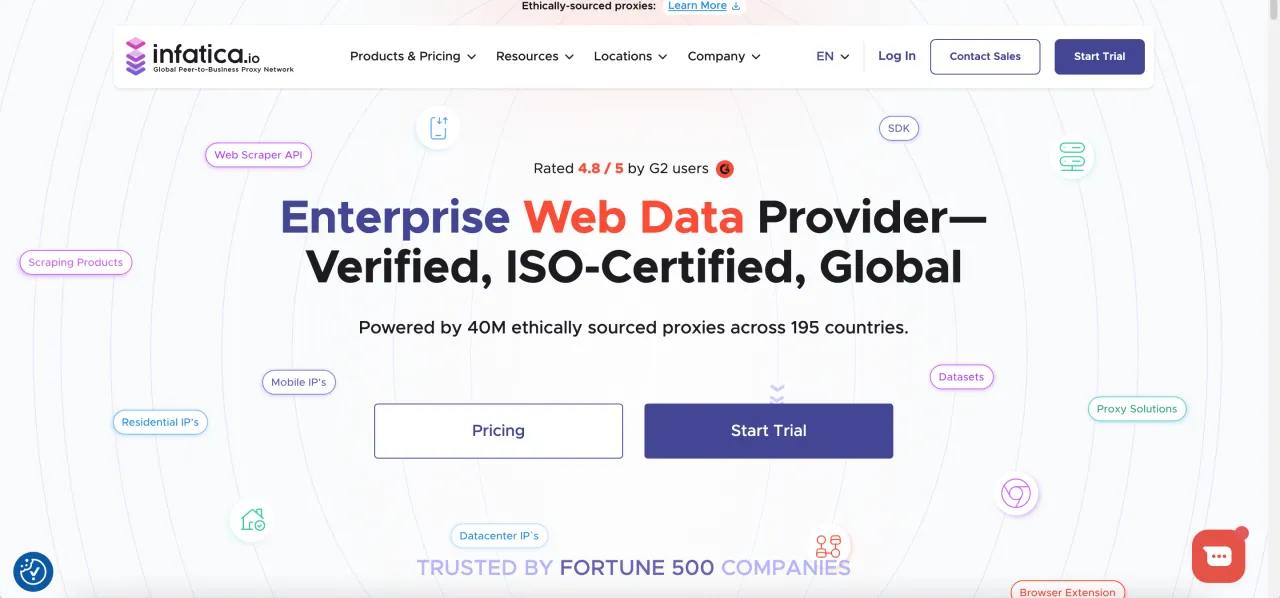
Infatica is a Singapore-headquartered proxy provider that has been operating since 2019. It is not the oldest name in the space, and it is not the largest, but it has spent the last several years quietly building out a product lineup that now covers residential proxies, mobile proxies, static ISP proxies, datacenter proxies, scraping APIs, and even pre-packaged datasets. The company holds ISO certification and claims Fortune 500 clients. Whether or not those claims matter to you depends entirely on your use case, so let us get into what Infatica actually offers and where it stands up under real scrutiny.
What Infatica Offers
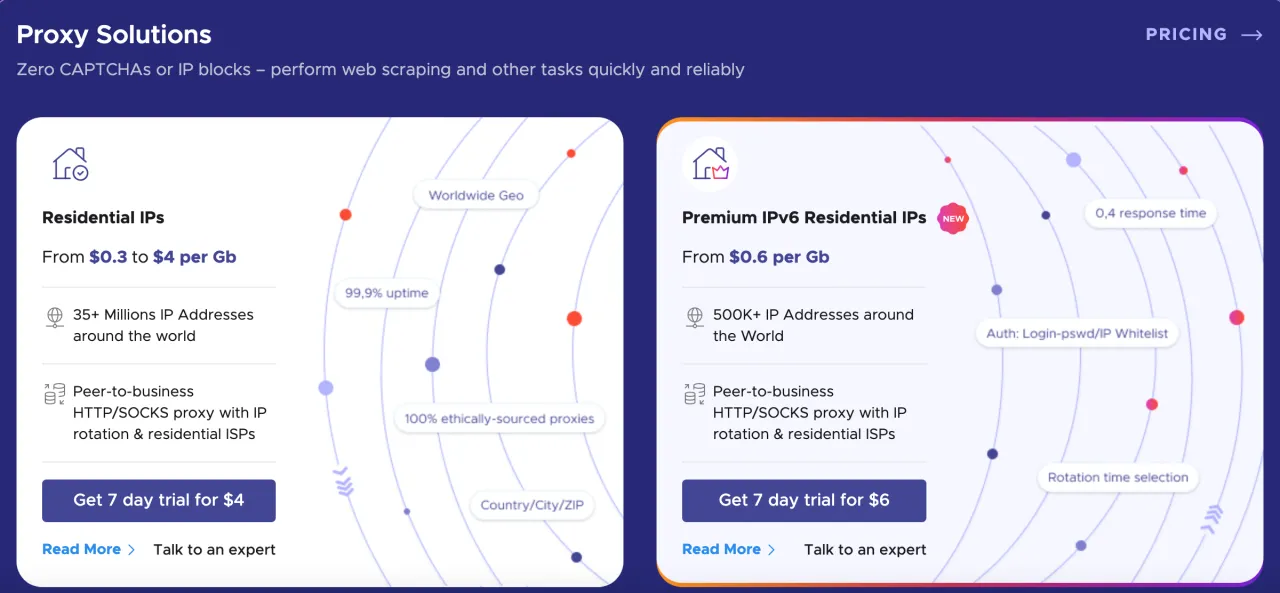
The product catalog is broader than most people expect from a mid-sized provider. At its core, Infatica runs a residential proxy network of 35 million-plus IP addresses, priced on bandwidth consumption anywhere from $0.30 to $4.00 per gigabyte depending on volume. On top of that sit mobile proxies (5 million-plus IPs, $1 to $8 per GB), shared datacenter proxies (500,000-plus IPs, $0.15 to $0.60 per GB), dedicated datacenter proxies (200,000-plus IPs, $1 to $1.50 per IP per month), and static ISP proxies (150,000-plus IPs, $1.95 to $3.00 per IP per month). There is also a Premium IPv6 residential product at $0.60 per GB, which is useful if your target sites respond to IPv6 addresses without the same hostility they show to datacenter ranges.
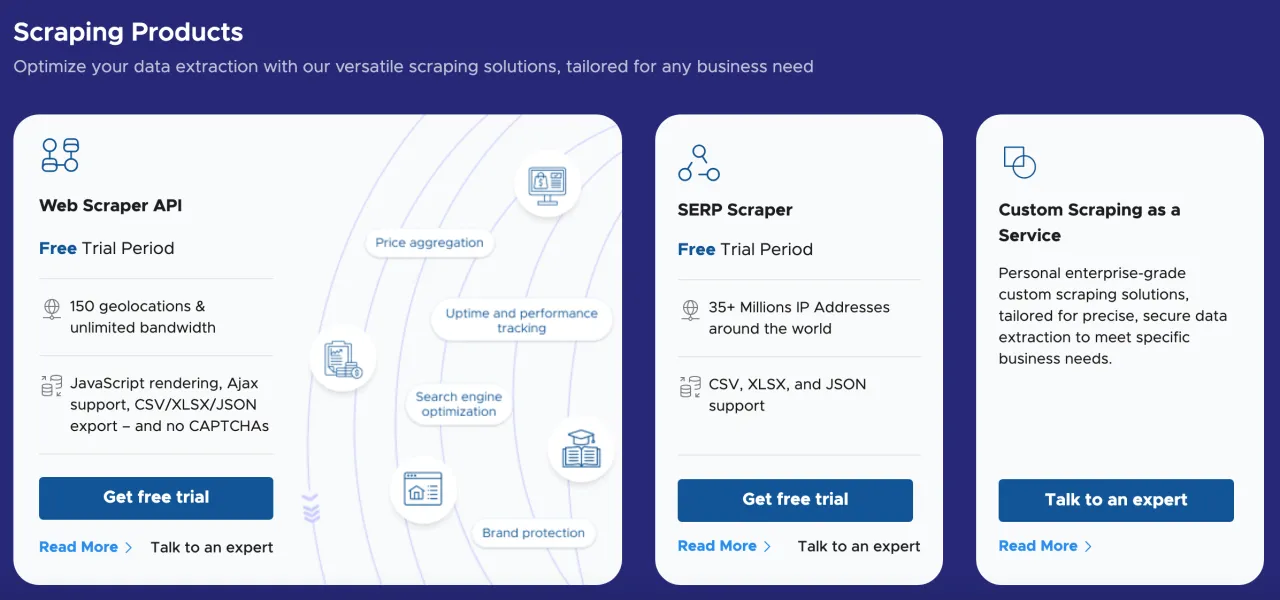
Beyond raw proxies, Infatica sells a Web Scraper API that handles JavaScript rendering, Ajax, and CAPTCHA avoidance across 150 geolocations with unlimited bandwidth, a SERP Scraper API, a YouTube Data API for extracting video metadata and audio, and an AI Search Data API that queries ChatGPT, Gemini, and Perplexity simultaneously and returns sources and citations. Each of these has a free trial period. The datasets product line. Covering LinkedIn, Instagram, TikTok, Twitter, Crunchbase, Indeed, Shopee, and Walmart. Is aimed at teams that want clean, structured data without running their own scraping infrastructure. That is a genuinely useful offer if your bottleneck is parsing rather than collection.
Proxy Network Quality
The residential pool draws from peer-to-business sourcing, meaning real consumer devices opt in to route traffic through Infatica in exchange for some compensation. This is the same model the major players use, and it generally produces IPs that carry good reputation scores because they are registered under real ISPs rather than cloud providers. The practical consequence is that you are far less likely to hit a hard block on a well-protected target compared to what you would experience with a datacenter address. That said, the quality of any residential pool varies by country. In high-demand markets like the United States, the United Kingdom, and Germany, pool density tends to be good. In smaller or lower-income markets, you may get a thinner selection and, occasionally, IPs that have already been rotated through enough users to have accumulated a negative reputation.
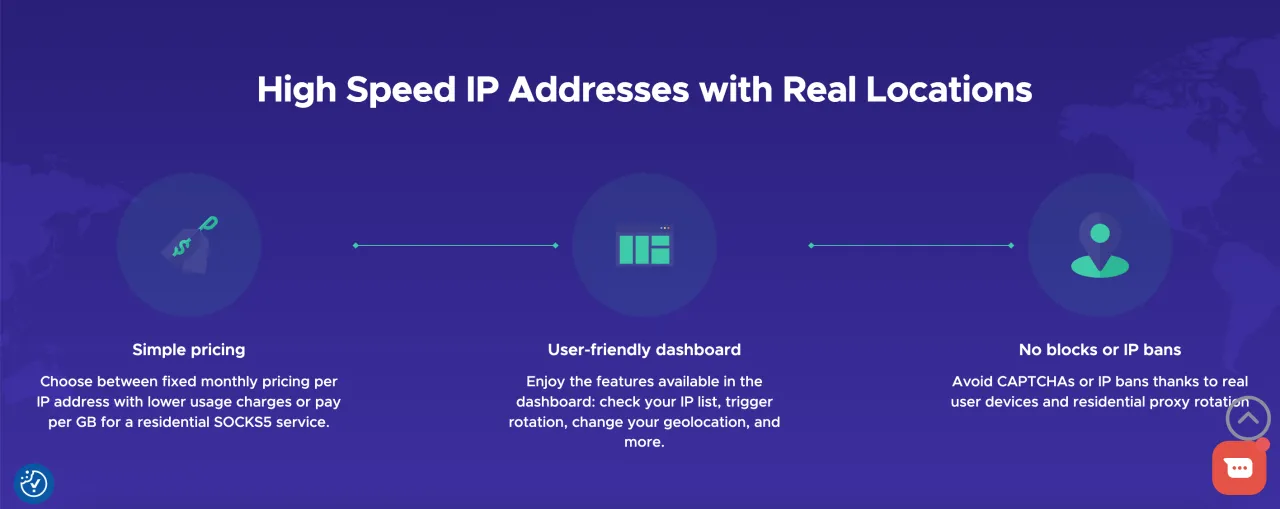
IP rotation is configurable in a few different ways. You can rotate on every request, which is the right choice for large-scale scraping where each page visit should appear to come from a fresh user. Or you can set a sticky session that keeps the same IP for anywhere between 5 and 60 minutes, which matters when you need to maintain state across a login or multi-step checkout flow. The session duration extends as long as the IP stays online, which is worth noting because a residential device can drop off the network at any time. In practice, response times under direct testing average below one second, and success rates consistently sit above 90 percent on most targets. Uptime is quoted at 99 percent, and that figure has held up across extended testing periods. You will occasionally see 503 errors when servers are under load, but that is not unusual for a network of this size.
The geo-targeting goes down to city and ASN level. ASN targeting, for those unfamiliar, means you can request IPs from a specific autonomous system. The organizational unit that owns a block of addresses. Which is useful when your target differentiates between ISPs or when you need to appear as a customer of a particular carrier rather than just a resident of a particular city.
Protocol and Authentication Support
All proxy products support both HTTP/HTTPS and SOCKS5. SOCKS5 operates at a lower level than HTTP, meaning it passes traffic through without inspecting or modifying it. This makes it the right choice for non-HTTP protocols, UDP traffic, or applications where you want to avoid any chance of the proxy altering headers. For standard web scraping with a library like Python's requests or httpx, either protocol works fine, but HTTP proxies are marginally simpler to configure because they do not require the SOCKS library.
Authentication comes in two forms. The first is username and password, which is the standard approach and works everywhere. The second is IP whitelisting, where you register your machine's outbound IP address with Infatica and the proxy server recognizes you by origin rather than credentials. IP whitelisting is slightly more secure because there are no credentials to intercept, but it becomes inconvenient if your machine uses a dynamic IP address that changes after a router restart. For most scraping setups running on cloud instances with static IPs, whitelisting is the cleaner option. For local development environments or anything behind a residential ISP, username and password is the practical choice.
Scraping APIs in Practice
The Web Scraper API is worth examining separately from the proxy products because it operates differently. Rather than giving you a proxy endpoint that your own code connects through, the Scraper API takes a URL, fetches the page on your behalf using a full headless browser environment, and returns rendered HTML, structured JSON, or CSV depending on your export settings. This handles JavaScript-heavy single-page applications automatically, which is a meaningful time saving compared to standing up your own Playwright or Puppeteer cluster. Playwright is a browser automation library from Microsoft that controls a headless Chromium, Firefox, or WebKit instance, Puppeteer is Google's equivalent, Chrome-focused. Both are powerful but require infrastructure to run at scale. The Scraper API offloads that entirely.
The SERP Scraper is specifically built for search engine results pages. Rather than fetching raw HTML from Google and parsing it yourself, you send a query and receive structured results. The pool behind it draws from the same 35-million-plus residential addresses, so the results reflect what an actual user in the target country would see, including localized ranking and ads. This is directly useful for SEO monitoring, ad verification, and competitive rank tracking.
The AI Search Data API is the most unusual product in the lineup. It queries multiple large language model search interfaces simultaneously and returns not just the answer text but the source citations and traceability metadata. For research workflows that need to cross-reference AI-generated content against original sources, this is a time saver. Whether it belongs in a proxy review is a fair question, but it is part of the Infatica offering, so it is worth knowing it exists.
Dashboard and Integration
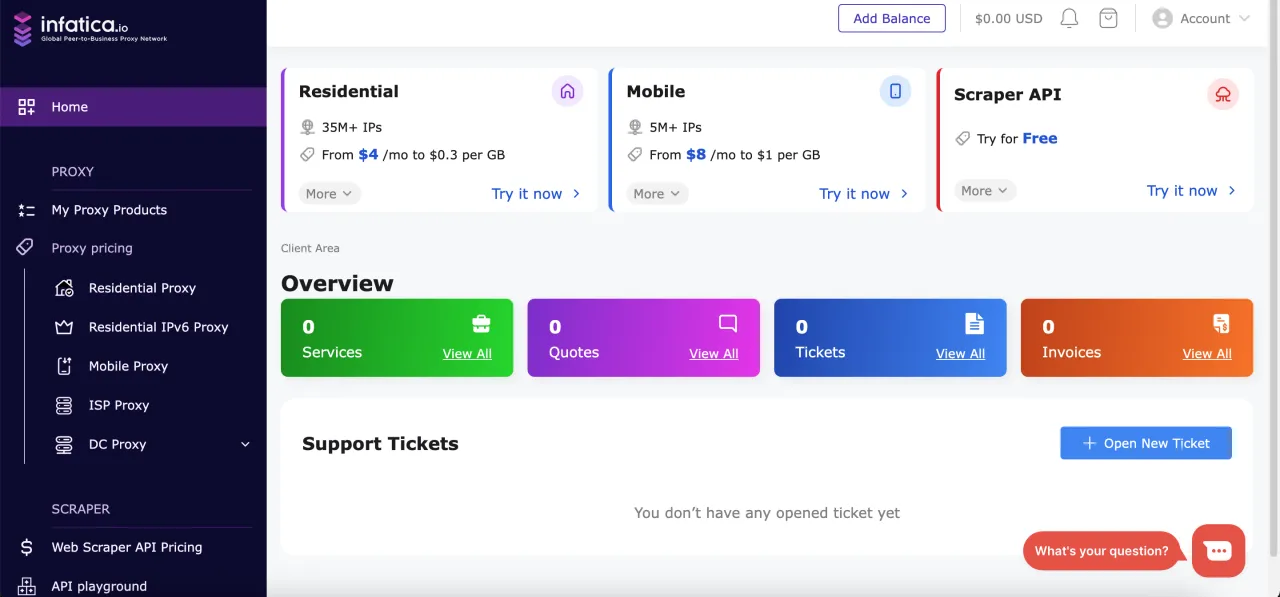
The Infatica dashboard covers the basics well. You can manage IP whitelists, configure rotation settings, select geolocations, monitor bandwidth consumption, and handle billing in one place. There is a quickstart video in the client area, which helps new users get to a working configuration without reading through documentation first. The interface is functional rather than polished. Navigation is clear enough that you will not spend time hunting for settings, but the visual design has not had the same attention as the underlying infrastructure. This is a common tradeoff among providers that have invested heavily in network quality.
Integration into your own code is straightforward. The proxy endpoint format follows the standard host:port:username:password pattern. Here is a working Python example using the requests library with retry logic and a sensible timeout, configured for a sticky residential session:
import requests
from requests.adapters import HTTPAdapter
from urllib3.util.retry import Retry

# Infatica residential proxy endpoint
PROXY_HOST = "residential.infatica.io"
PROXY_PORT = 10000
PROXY_USER = "your_username"
PROXY_PASS = "your_password"

# Sticky session: append session ID to username to hold the same IP
# for up to 30 minutes. Change the session ID to rotate immediately.
SESSION_ID = "mysession001"
proxy_user_session = f"{PROXY_USER}-session-{SESSION_ID}"

proxies = {
 "http": f"http://{proxy_user_session}:{PROXY_PASS}@{PROXY_HOST}:{PROXY_PORT}",
 "https": f"http://{proxy_user_session}:{PROXY_PASS}@{PROXY_HOST}:{PROXY_PORT}",
}

# Retry on connection errors and 5xx responses, but not on 403/404,
# which indicate the target site has flagged the request rather than
# a transient infrastructure problem.
retry_strategy = Retry(
 total=3,
 backoff_factor=1.5,
 status_forcelist=[500, 502, 503, 504],
 allowed_methods=["GET"],
)
adapter = HTTPAdapter(max_retries=retry_strategy)
session = requests.Session()
session.mount("http://", adapter)
session.mount("https://", adapter)

headers = {
 "User-Agent": (
 "Mozilla/5.0 (Windows NT 10.0; Win64; x64) "
 "AppleWebKit/537.36 (KHTML, like Gecko) "
 "Chrome/125.0.0.0 Safari/537.36"
 ),
 "Accept-Language": "en-US,en;q=0.9",
}

try:
 response = session.get(
 "https://example.com/target-page",
 proxies=proxies,
 headers=headers,
 timeout=15, # 15 seconds is generous; drop to 10 for speed-sensitive jobs
 )
 response.raise_for_status()
 print(f"Status: {response.status_code}")
 print(response.text[:500])
except requests.exceptions.ProxyError as e:
 print(f"Proxy connection failed: {e}")
except requests.exceptions.Timeout:
 print("Request timed out")
except requests.exceptions.HTTPError as e:
 print(f"HTTP error: {e}")
If you are working with Scrapy, the popular Python crawling framework, you drop the proxy settings into DOWNLOADER_MIDDLEWARES and handle authentication through the HttpProxyMiddleware. Scrapy manages the retry and concurrency logic automatically, which means you get the same resilience without writing it by hand. For browser-based scraping with Playwright, you pass the proxy configuration into the browser.new_context() call, which routes all traffic from that browser context through the proxy while leaving other contexts unaffected.
Pricing Breakdown
Infatica uses bandwidth-based pricing for residential and mobile proxies, and per-IP monthly pricing for static products. The residential tier runs from $0.30 per GB at the high-volume end up to $4.00 per GB on smaller plans. For context, the market average for residential bandwidth among mid-to-large providers sits around $3 to $4 per GB at entry volumes, so Infatica's floor of $0.30 per GB at scale is competitive. Mobile proxies are more expensive, as they are everywhere, ranging from $1 to $8 per GB. Dedicated datacenter IPs at $1 to $1.50 per IP per month are priced normally for that product type. Shared datacenter bandwidth at $0.15 to $0.60 per GB is genuinely cheap, useful for targets that do not actively filter datacenter ranges.
The trial structure is a 7-day paid trial for residential proxies at $4, and $8 for mobile. This is not a free trial, which will frustrate some users, but it is also the current market standard for providers trying to prevent abuse. A fully free trial tends to attract people who have no intention of paying, which degrades pool quality for actual customers. The scraping API products do offer a free trial period.
| Product | Pool Size | Price | Protocol |
|---|---|---|---|
| Residential IPs | 35M+ addresses | $0.30 to $4.00 / GB | HTTP, SOCKS5 |
| Premium IPv6 Residential | 500K+ addresses | From $0.60 / GB | HTTP, SOCKS5 |
| Mobile IPs | 5M+ addresses | $1.00 to $8.00 / GB | HTTP, SOCKS5 |
| Static ISP IPs | 150K+ addresses | $1.95 to $3.00 / IP / mo. | HTTP, SOCKS5 |
| Shared DC IPs | 500K+ addresses | $0.15 to $0.60 / GB | HTTP, SOCKS5 |
| Dedicated DC IPs | 200K+ addresses | $1.00 to $1.50 / IP / mo. | HTTP, SOCKS5 |
Ethical Sourcing and Compliance
Infatica advertises its proxies as ethically sourced, and the ISO certification supports that claim to a meaningful degree. ISO certification for a proxy provider covers security and data management processes, which is relevant if you are buying on behalf of an organization with procurement compliance requirements. The peer-to-business model means device owners actively opt in rather than having software quietly installed on their machines. This matters operationally because opted-in devices tend to have better uptime and fewer unexpected disconnections than devices where the proxy software was installed without the owner's awareness.

The company does require registration for contact and enterprise inquiries. For individual or smaller-volume users, self-service access through the trial is available without needing to go through a sales conversation first.
Who Should Use Infatica
Infatica fits best for medium to large operations that need a reliable residential or mobile network without paying enterprise prices for the brand name. The 35-million-plus residential pool is large enough for most scraping and monitoring workloads. The geo-targeting depth, down to city and ASN, is more granular than what many similarly priced providers offer. The scraping API products add genuine value for teams that want to skip infrastructure management entirely. And the dataset products are worth a look if you need LinkedIn, Instagram, or e-commerce data and do not want to build a collection pipeline from scratch.
If you are running simple, low-volume tasks and price is your primary concern, the shared datacenter tier at $0.15 per GB is hard to argue against for targets that do not actively filter datacenter addresses. If you need maximum stealth on a protected target, the residential or mobile network is the right call, and the success rates above 90 percent suggest the pool quality is there to back it up. The dashboard will not impress you visually, the trial is paid rather than free, and the company is not yet at the name recognition level of the market leaders. But the underlying infrastructure is solid, and the pricing at higher volumes is genuinely competitive.