Pricing
- Dedicated Datacenter Proxies
- Rotation Residential Proxies
- Rotation Mobile Proxies
Specifications

Proxy Type
- Mobile Proxies
- Residential Proxies
- Datacenter Proxies
- Dedicated Datacenter Proxies
- Rotation Residential Proxies
- Rotation Mobile Proxies
Available Countries
- United States
- United Kingdom
- Germany
- India
- Poland
- Spain
- Italy
- Ukraine
- Austria
- Bahrain
- Belarus
- Ghana
- Indonesia
- Jordan
- Kuwait
- Latvia
- United States
- United Kingdom
- Germany
- France
- Canada
- Netherlands
- Japan
- Brazil
- India
- Poland
- Spain
- Italy
- Australia
- Ukraine
- Turkey
- Singapore
- United States
- United Kingdom
- Germany
- France
- Canada
- Netherlands
- Japan
- Brazil
- India
- Poland
- Spain
- Italy
- Australia
- Ukraine
- Turkey
- Singapore
- United States
- United Kingdom
- Germany
- France
- Canada
- Netherlands
- Japan
- Brazil
- India
- Poland
- Spain
- Italy
- Australia
- Ukraine
- Turkey
- Singapore
- United States
- United Kingdom
- Germany
- France
- Canada
- Netherlands
- Japan
- Brazil
- India
- Poland
- Spain
- Italy
- Australia
- Ukraine
- Turkey
- Singapore
- United States
- United Kingdom
- Germany
- India
- Poland
- Spain
- Italy
- Ukraine
- Austria
- Bahrain
- Belarus
- Ghana
- Indonesia
- Jordan
- Kuwait
- Latvia
Interface Language
- English
- Русский
- 简体中文
Payment Methods
 Crypto
 Visa/Mastercard
Top 9 alternatives for AstroProxy









→ Top 5 Astroproxy Alternatives in 2026
Our Review

Last updated: 2026-06-03
AstroProxy is a proxy provider based in Armenia, offering residential, mobile, and datacenter proxies to businesses and individuals who need to collect data at scale, manage multiple accounts, or bypass geo-restrictions. The pool sits at 50 million IPs, all of which the company describes as ethically sourced and whitelisted before they ever reach a customer. That last part matters more than it might sound, and we will get to it shortly.
The service has been running since at least 2024 and pitches itself primarily at teams doing web scraping, SEO monitoring, market research, and social media management. It scores 4.38 on Reviews.io, which is a reasonable signal but not the whole story. What follows is a closer look at how the product actually holds up once you are past the sign-up page.
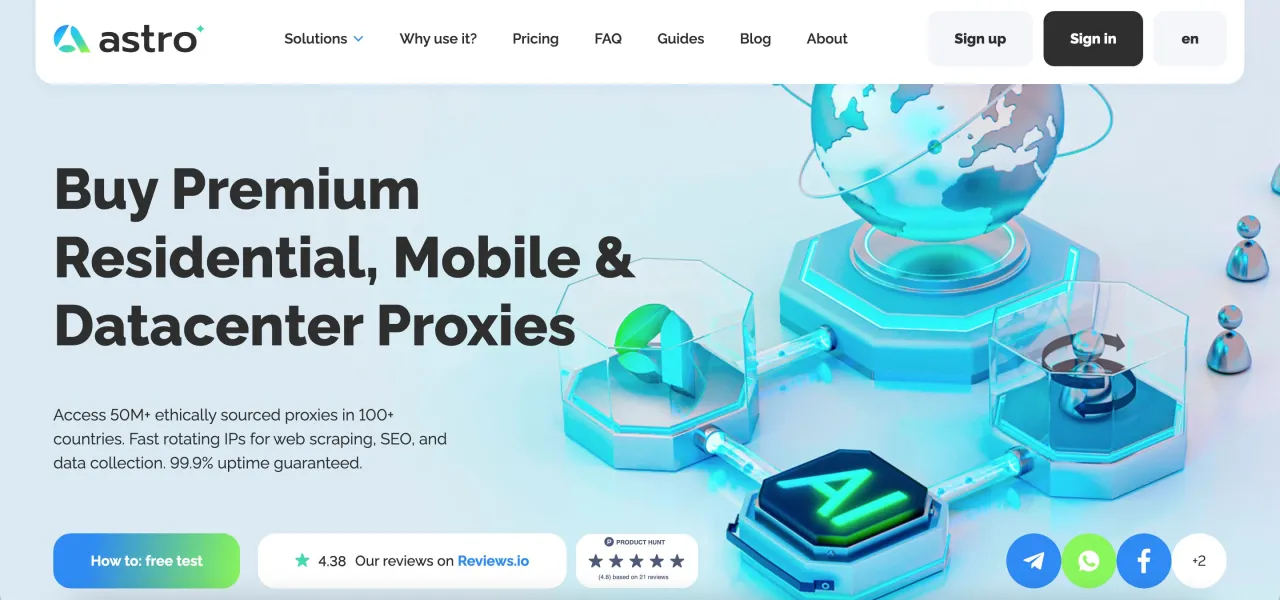
AstroProxy runs three proxy types, and the distinctions between them affect which tasks they are actually suited for. The underlying logic is the same for all three: traffic exits through a real or server-side IP, the destination site sees that IP instead of yours, and you pick up rotation either automatically or on demand. What differs is the IP origin, the trust level those IPs carry, and the price.
Residential Proxies
These are IP addresses registered under consumer internet service providers, meaning they belong to home broadband and public Wi-Fi connections rather than data centers. When a target site checks the reputation of the IP making a request, it sees what looks like a real person browsing from their home network. That is why residential IPs handle bot-detection systems better than datacenter IPs do on sites like sneaker stores, travel aggregators, or social platforms. AstroProxy's residential pool comes to 50 million addresses. Both HTTP(S) and SOCKS5 protocols are supported. Rotation can be set by timer or triggered on each new connection. Pricing starts at $7.30 per GB, with the smallest available purchase being 100 MB at $0.73.
Mobile Proxies
Mobile IPs come from real devices on 4G and 5G carrier networks. Websites and apps treat mobile IP ranges as high-trust traffic because genuine consumer devices generate them in large volumes every day, so these addresses almost never appear on reputation blocklists. AstroProxy lets you target mobile proxies by country, city, region, or specific carrier, which is useful when you need to verify how a mobile ad looks on a particular network or test a geo-locked app. Rotation works on demand or by API call. The port fee is $0.30, and bandwidth starts at $13.14 per GB, with 100 MB available at $1.31. Mobile proxies are the most expensive type on the platform, which is standard across the industry given the sourcing cost.
Datacenter Proxies
Datacenter IPs originate from server infrastructure rather than consumer devices. They are faster and cheaper than residential or mobile IPs, but they carry lower trust scores on sophisticated anti-bot systems. That said, for high-volume tasks on targets with lighter protection, such as public data collection from marketplaces, price monitoring, or internal testing, datacenter proxies are perfectly adequate. AstroProxy's datacenter offering comes with unlimited bandwidth, instant IP rotation via API or timer, and targeting by country and city.
Performance
Response time averages around 2.15 seconds for residential proxies across a broad sample of targets. That number breaks down geographically in a predictable way: European endpoints come in around 1 second, while requests routed from US exit nodes run closer to 3.4 seconds. This is not unusual for rotating residential proxies, where the IP may sit anywhere in the pool regardless of where the exit geography is nominally set. Success rates on residential proxies land around 95% across popular commercial websites, and closer to 99% against a straightforward test server. The gap between those two figures reflects the reality that high-protection retail and social sites impose additional verification layers beyond simple IP checks.
The 99.9% uptime claim on the website aligns with what you see in practice for normal operations. Downtime does occur during more serious technical incidents, but the support team responds through Telegram and other messengers rather than a ticketing system, which shortens resolution time in practice. Whether that informal support model works for your team depends on your size and how much you need a paper trail.
Free Trial
AstroProxy offers a $3 balance credit as a free trial. You contact support to claim it, there is no time limit attached, and it works across all proxy types and geos. Three dollars does not buy you a lot of bandwidth at residential rates, but it is enough to run a real test on a target you actually care about rather than a synthetic benchmark. The absence of a time limit is the genuinely useful part, since most trials in this category expire before you have finished integrating the proxy into your stack.
KYC and Logging
AstroProxy requires KYC verification before you can use the service without restrictions. The process involves submitting contact and company details along with your intended use cases. AstroProxy uses Sumsub for identity validation, runs real-time AI and ML-based network monitoring, conducts regular manual checks, and examines all third-party abuse reports. All traffic is logged according to their KYC and AML policies.
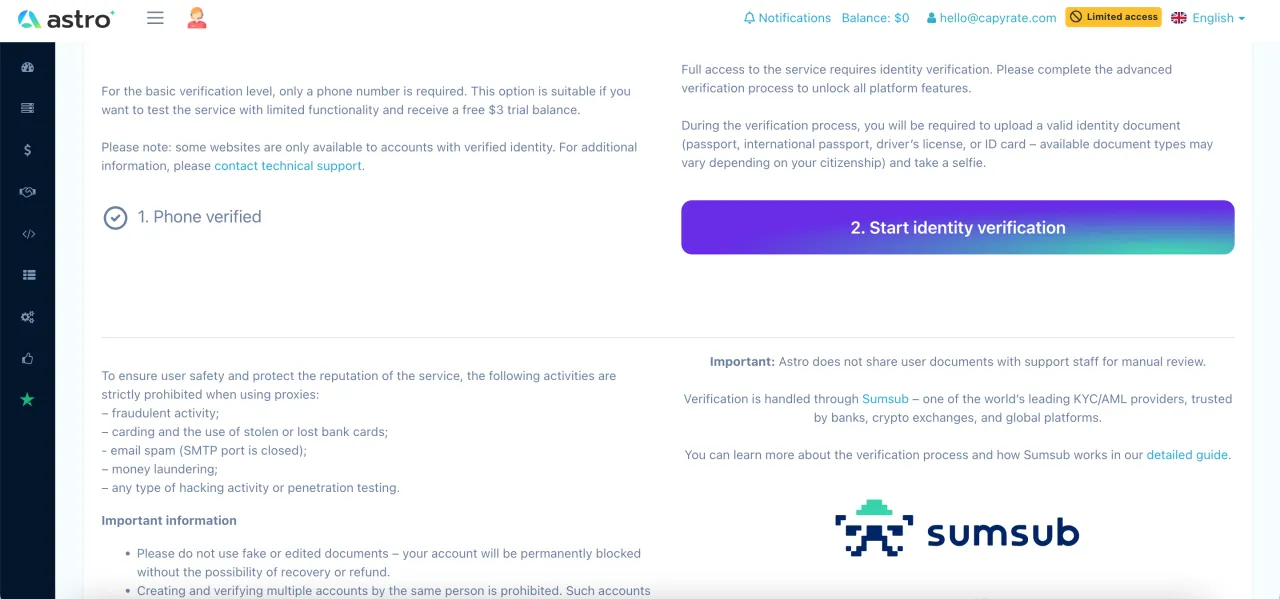
The logging policy is the most significant thing to understand before signing up. AstroProxy does record traffic data. For the majority of commercial use cases, such as web scraping, price monitoring, SEO tools, and ad verification, this is not a problem. For use cases where traffic confidentiality is a hard requirement, you should read the privacy policy carefully before committing any volume.
The ethical sourcing angle, on the other hand, is a genuine differentiator in a market where many providers acquire residential IPs through SDK bundling practices that the device owner may not fully understand. AstroProxy's stated framework covers user validation, AI-based monitoring for abuse, and examination of third-party complaints. This matters for businesses in regulated industries or those running KYC-sensitive workflows of their own.
Dashboard and Setup
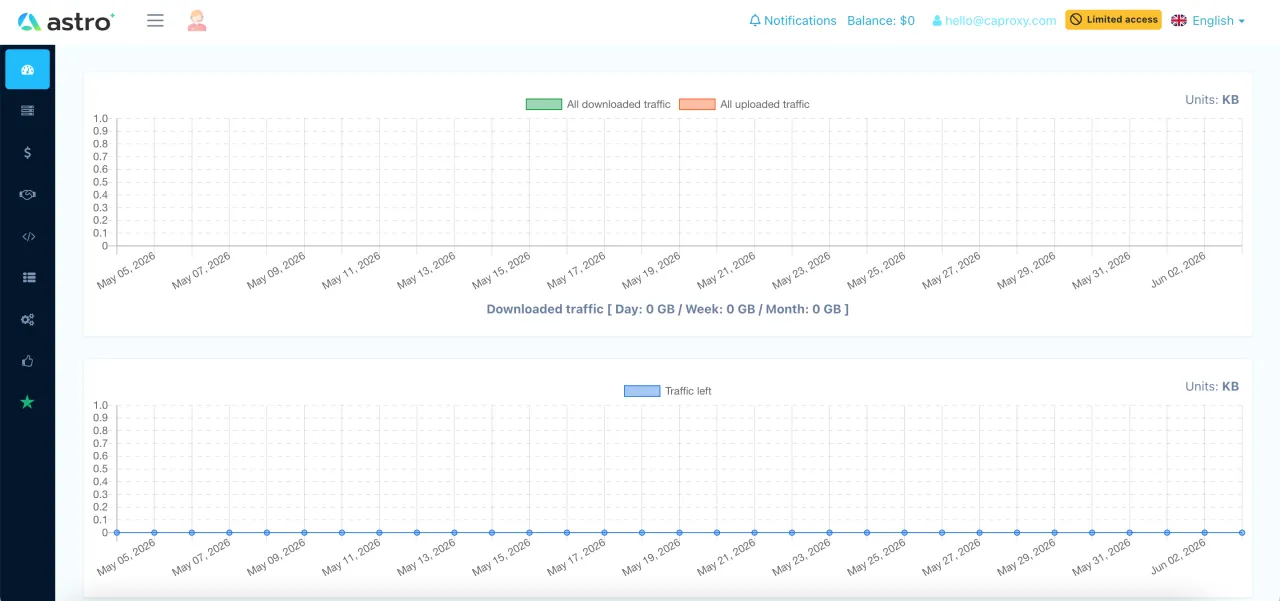
The dashboard is a single-page interface. You log in, top up your balance, click "Add port," and select your proxy type, location, and rotation settings. Targeting goes down to city, region, carrier, and ISP level depending on the proxy type. Real-time statistics and detailed logs are visible from the same screen without navigating between sections.

One notable feature is VPN-ready proxy connections. AstroProxy supports OpenVPN configuration files for Windows, macOS, iOS, Android, and MikroTik. This means you can route a whole device or router through an AstroProxy exit node without per-application configuration, which is useful for mobile device testing or network-level ad verification setups.
IP rotation can be triggered three ways: automatically by timer, on each new connection, or manually via API call. The API rotation option is the one that matters most for scraping pipelines, since it lets your code request a new IP at exactly the moment a session block or CAPTCHA appears rather than waiting for a timer to expire.
Use Cases
AstroProxy covers a fairly wide set of use cases on its website, and it is worth being direct about which ones the product actually suits well and which ones are more of a stretch.
- Web scraping and data collection: This is the strongest fit. Rotating residential and mobile IPs with 95% to 99% success rates, city-level targeting, and API-based rotation work well for product feeds, SERP data, and public marketplace pricing.
- SEO monitoring: Checking search result rankings from specific cities or countries is a natural fit for residential proxies with accurate geo-targeting. The latency on US nodes is on the higher side for real-time SERP tools but acceptable for scheduled crawls.
- Social media management and multi-accounting: Mobile proxies are the right tool here. Mobile carrier IPs are treated as high-trust traffic by platforms, which reduces the risk of session flags when managing multiple accounts. You still need an anti-detect browser alongside the proxy to handle fingerprinting.
- Ad verification: The combination of mobile proxies, carrier targeting, and VPN-ready connections via OpenVPN makes it straightforward to check how a mobile ad renders for a user on a specific carrier in a specific city.
- AI training data collection: AstroProxy explicitly targets this use case, and high-volume residential rotation with broad geographic distribution is a reasonable match for gathering diverse, geo-representative datasets.
Honest Assessment
AstroProxy is a solid mid-market option for teams that need rotating residential and mobile proxies with genuine geo-targeting depth and do not want to go through enterprise procurement to get started. The $3 free trial with no time limit is a genuinely good way to validate the network against your actual targets before spending anything meaningful. The whitelisted IP pool and ethical sourcing practices are meaningful differentiators compared to lower-cost providers where pool quality is harder to verify.
The pricing is not the cheapest available, particularly at low volumes. Residential bandwidth at $7.30/GB at entry level is above what some competitors charge at similar tiers, though the volume discounts bring it closer to market rate. The logging policy and mandatory KYC will rule the service out for privacy-sensitive applications, and that is worth being clear about upfront rather than discovering after integration. For straightforward commercial data collection and account management work, though, neither of those things should be a blocker.