Pricing
- Individual IPv6 Proxies
- Dedicated Datacenter Proxies
- Shared Datacenter Proxies
Specifications


ProxyLine in our rankings
Proxy Type
- Individual IPv6 Proxies
- Datacenter Proxies
- Dedicated Datacenter Proxies
- Shared Datacenter Proxies
Available Countries
- United States
- Russia
- United States
- United Kingdom
- Germany
- France
- Canada
- Netherlands
- Japan
- Brazil
- India
- Poland
- Spain
- Italy
- Australia
- Ukraine
- Turkey
- Singapore
- United States
- United Kingdom
- Germany
- France
- Canada
- Netherlands
- Japan
- Brazil
- India
- Poland
- Spain
- Italy
- Australia
- Ukraine
- Turkey
- Singapore
- United States
- Germany
- Netherlands
- Spain
- Italy
- Turkey
- Sweden
- Argentina
- Austria
- Czech Republic
- Malaysia
- Moldova
- Russia
- Slovakia
- Switzerland
Interface Language
- English
- Русский
Payment Methods
 Crypto
 WebMoney
- YooMoney
 Card (EUR)
- Card (UAH)
- Card (RUB)
- Card (AZN)
- Card (BRL)
Other Features
- Free proxy
- Online proxy checker
- IP check for blacklists and spam databases
- Checking your anonymity
- Speedtest
Top 9 alternatives for ProxyLine







→ Top 9 SpaceProxy & ProxyLine Alternatives in 2026
Our Review

Last updated: 2026-05-13
ProxyLine has been running since 2017, which puts it in a relatively small category of proxy providers that have survived long enough to build a real track record. The service focuses exclusively on static datacenter proxies — individual IPv4, shared IPv4, and IPv6 — and makes no pretense of being something it isn't. There's no residential pool, no mobile proxies, no rotating gateway dressed up with marketing buzzwords. You get static IPs on datacenter infrastructure, and that's the honest pitch.
The pool sits at over 490,000 addresses across 100-plus countries. Speeds are advertised at up to 100 Mbps per proxy, and from what multiple users have consistently reported, that number is close to reality — real-world speeds tend to hover around 85-95 Mbps for dedicated IPv4 connections. That's solid for datacenter infrastructure.
The use case fit is straightforward: web scraping, SEO analytics, ad verification, social media account management, traffic arbitrage, trading automation, and price monitoring. If your target sites require residential-looking IPs to get past bot detection, ProxyLine will struggle. For everything else at this price tier, it performs well above its weight.
Proxy Types and What You're Actually Buying
ProxyLine offers three distinct proxy types, and the differences matter depending on what you're building.
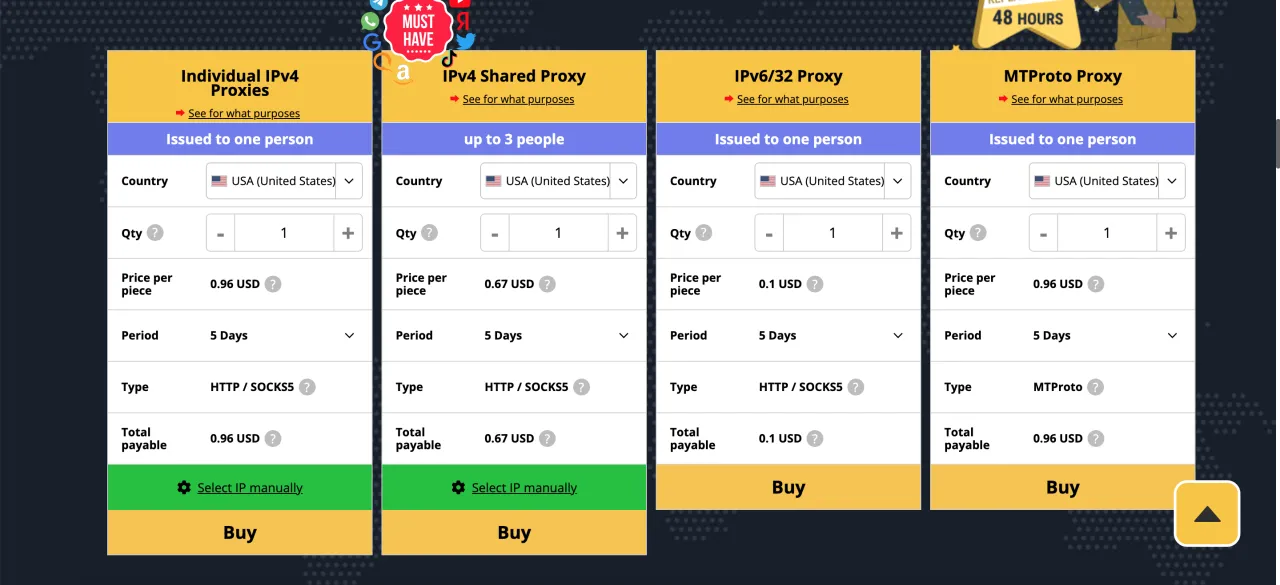
Individual (Dedicated) IPv4
These are private datacenter IPs assigned exclusively to you for the duration of your rental. No other ProxyLine customer shares your subnet activity. This is the right choice for social media account management, trading bots, and any workflow where a shared IP history would cause immediate flag triggers. Pricing starts around $1.56-1.77 per IP per month for longer rental terms, scaling down with volume.
Shared IPv4
Multiple users share the same IPs. The tradeoff is price — shared IPv4 starts from roughly $0.99 per month — but you accept the risk that another tenant's behavior has already flagged that IP on certain targets. For bulk scraping of non-sensitive sites, price monitoring, or SEO checks where IP reputation matters less, shared is a reasonable budget option. For anything involving account-level access, avoid it.
IPv6
IPv6 proxies are the cheapest tier ProxyLine offers, and they're genuinely useful for specific tasks. Bulk SERP scraping, form submissions, lightweight data collection — IPv6 works fine. The catch is that a meaningful percentage of older or misconfigured web infrastructure still doesn't support IPv6 properly. Expect some target failures that have nothing to do with detection, just protocol compatibility. Test your specific targets before ordering at scale.
Protocol Support
All proxy types support both HTTP(S) and SOCKS5. Additionally, ProxyLine has recently started offering MTProto proxies for Telegram. Authentication is IP-whitelist based — you bind your IP address(es) to the proxy order rather than using username/password. You can bind multiple IPs in a single order, which is convenient for teams or setups that rotate outbound addresses.
Geographic Coverage
ProxyLine covers Europe, North America, Asia, and the CIS region with city-level selection available in most major markets. The ability to pick specific cities rather than just countries is important for geo-targeted SEO work, ad verification, and localized price monitoring. Not every provider at this price point offers that level of granularity.
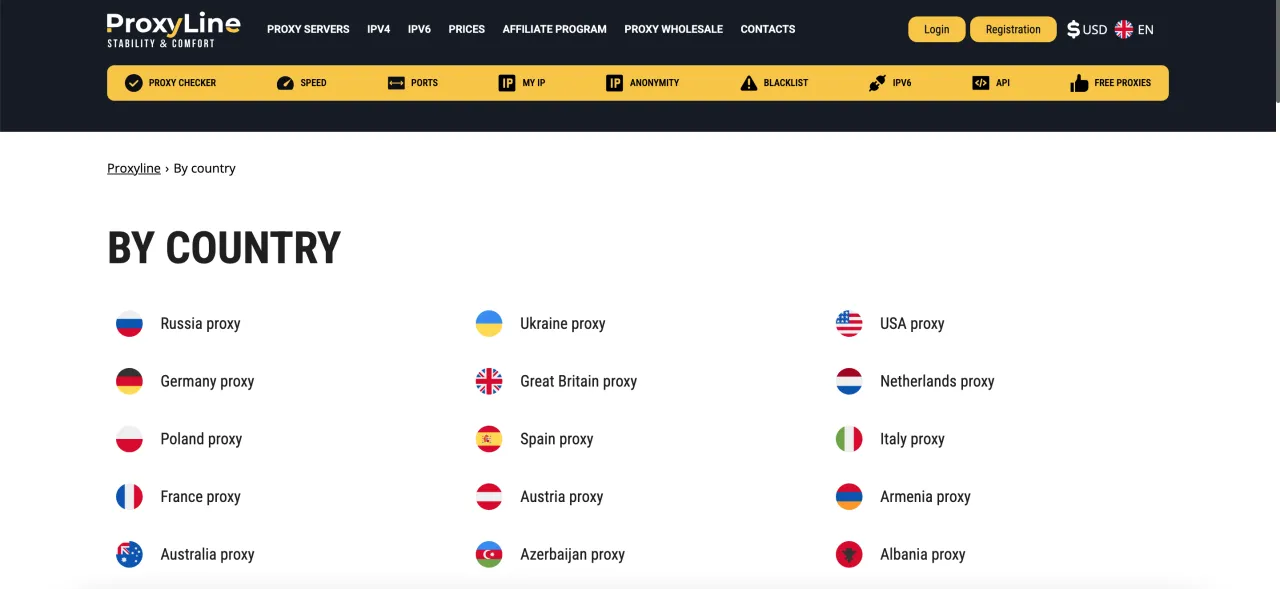
The subnet diversity within each country is one of the more frequently praised aspects in real user feedback. When you're buying a large pool of IPs, subnet variety matters more than raw IP count — 500 IPs from five /24 subnets will get you flagged faster on pattern-aware targets than 100 IPs spread across 40 different subnets. ProxyLine's selection interface lets you browse by subnet, which is a practical feature that saves you the manual work of cross-referencing WHOIS data.
Dashboard and Management
The control panel is functional and clean. Proxy activation is near-instant after purchase — no waiting for manual provisioning. You can monitor your active proxies, replace IPs that aren't performing, manage rental renewals, and handle bulk operations without digging through nested menus.
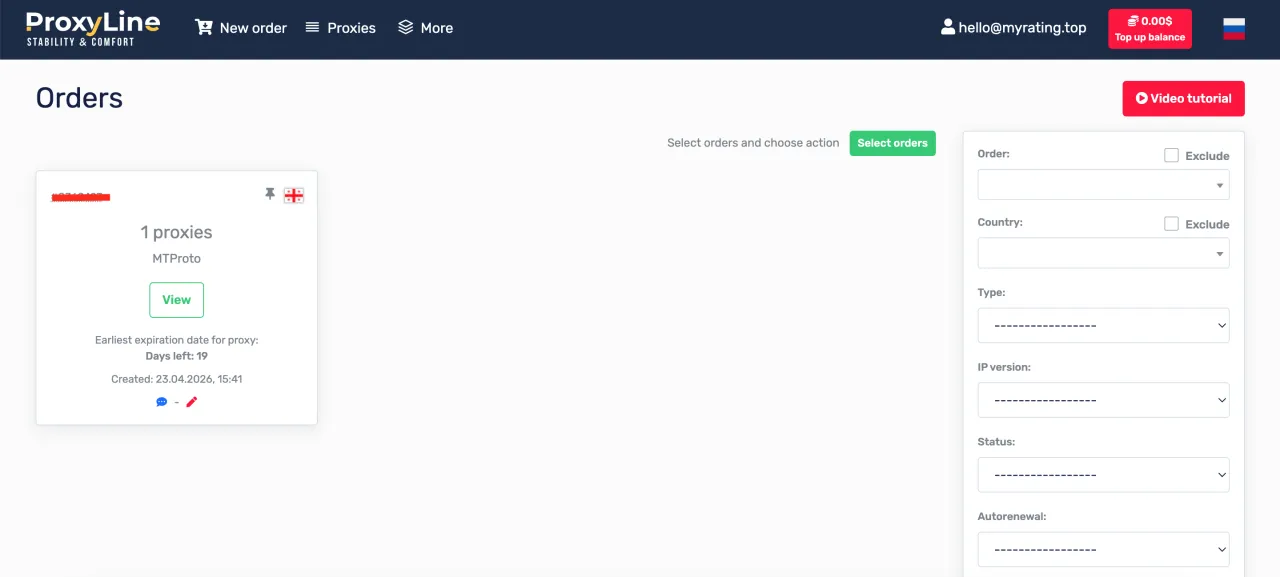
The API access is a notable feature for automation-heavy users. If you're managing dozens or hundreds of proxies programmatically — spinning up new IPs, checking status, integrating proxy assignment into your scraping pipeline — the API saves meaningful time over manual dashboard work. The documentation is serviceable, not exceptional.
One honest note from user feedback: the interface isn't winning any design awards. It's practical, gets the job done, but feels like it was designed for utility rather than aesthetics. For most developers and operators, that's a reasonable tradeoff.
Pricing Breakdown
ProxyLine's rental model is flexible. You can rent for as short as 5 days or as long as a full year. Longer terms drop the per-IP cost meaningfully, and bulk volume orders qualify for additional discounts. The minimum commitment of 5 days is useful for testing specific use cases before locking in a longer term.
| Proxy Type | Starting Price (monthly equiv.) | Best For | Notes |
|---|---|---|---|
| Dedicated IPv4 | ~$1.56–$1.77/IP/month | Social accounts, trading, ad verification | Exclusive use, clean history |
| Shared IPv4 | ~$0.99/IP/month | Bulk scraping, SEO, price monitoring | Shared reputation risk |
| IPv6 | Cheaper than IPv4 | High-volume SERP, lightweight data collection | Protocol compatibility varies by target |
Payment options include cards, e-wallets, and cryptocurrency. The crypto payment option matters for operators who prefer to keep their tooling costs off corporate cards or in regions with payment friction.
The 48-hour refund policy is a genuine safety net, not just marketing copy. If IPs don't work for your specific target or the geo coverage isn't what you expected, you have a real window to raise the issue and get a replacement or refund. That's a meaningful commitment at this price tier — plenty of budget providers make refunds a bureaucratic nightmare.
Performance: Where It Holds Up and Where It Doesn't
For scraping tasks that don't involve the toughest anti-bot targets, ProxyLine's dedicated IPv4 proxies perform consistently. Session stability is strong — users running multi-hour automation workflows report clean connections without unexpected drops or IP rotation. That matters a lot for trading bots and social media automation where mid-session disconnects cause real operational problems, not just a failed request.
Speed is genuinely close to the advertised ceiling. Multiple users have clocked around 85-90 Mbps in real conditions, and the connection doesn't throttle over long sessions. That makes ProxyLine viable for streaming-related use cases and parallel scraping where bandwidth-per-IP affects throughput.
Targets That Work Well
- Search engines (Google, Bing) for SERP tracking at moderate scale
- E-commerce price monitoring on sites without aggressive residential checks
- Social media platforms with account-level access (dedicated IPs only)
- Ad verification across regional markets
- Internal QA and testing environments
- Trading and financial platform automation
Targets Where You'll Hit Walls
- Amazon, Cloudflare-protected sites, or anything that specifically fingerprints datacenter ASNs for block decisions
- Sneaker sites with aggressive bot protection (Nike, Adidas, Supreme)
- Streaming services that geo-block datacenter IP ranges
- Sites using residential-check logic at the infrastructure level
The last point is where the "no residential pool" gap becomes relevant. ProxyLine's team isn't trying to hide this — the service is positioned for datacenter use cases. When users report occasional IP overload on shared pools, that's a real concern for scraping at scale. Dedicated IPv4 avoids the overload issue but costs more. At this price point, that's the right tradeoff.
Real-World Configuration Example
Here's a basic Python setup using ProxyLine's IP-authenticated proxies with the requests library. Since ProxyLine uses IP whitelist auth rather than user:pass, you whitelist your machine's outbound IP in the dashboard and connect directly:
import requests
from itertools import cycle

# List of ProxyLine dedicated IPv4 proxies (already whitelisted)
proxy_list = [
    "http://185.x.x.1:8080",
    "http://185.x.x.2:8080",
    "http://185.x.x.3:8080",
    "http://185.x.x.4:8080",
]

proxy_pool = cycle(proxy_list)

def scrape_url(url):
    proxy = next(proxy_pool)
    proxies = {
        "http": proxy,
        "https": proxy,
    }
    try:
        response = requests.get(url, proxies=proxies, timeout=15)
        print(f"[{proxy}] Status: {response.status_code}")
        return response.text
    except requests.exceptions.RequestException as e:
        print(f"[{proxy}] Failed: {e}")
        return None

# Example: scrape 10 SERP pages from different geo IPs
targets = [f"https://www.google.com/search?q=proxy+service&hl=en&start={i*10}" for i in range(10)]
for url in targets:
    result = scrape_url(url)
For SOCKS5 connections, swap the proxy prefix and install requests[socks]:
pip install requests[socks]

# Then use:
proxies = {
    "http": "socks5://185.x.x.1:1080",
    "https": "socks5://185.x.x.1:1080",
}
Support Quality
24/7 support is available and, based on user reports, actually responds within a reasonable timeframe. The feedback pattern across multiple review sources is consistent: support helps with product selection and technical issues without making you wait in a queue for days. That's not universal at this price tier — plenty of budget providers have "24/7 support" in their marketing and a 48-hour response time in practice.
Fast IP replacement when you hit a bad proxy is another specific point that comes up in real reviews. If a dedicated IP is flagged by your target or showing unexpected behavior, you can swap it out without a prolonged support ticket process. That operational flexibility matters when you're running time-sensitive campaigns.
What's Missing
Being direct about the gaps saves you time:
- No residential proxies. This is the biggest limitation. If your targets require residential IP routing to avoid datacenter detection, ProxyLine can't help you.
- No mobile proxies. Multiple users in 2026 reviews specifically call this out. For social media automation requiring "native" mobile behavior or targeting mobile-specific detection systems, this is a real gap.
- No ISP proxies. The hybrid datacenter/residential ASN sweet spot that's become increasingly important for mid-tier bot detection doesn't exist in ProxyLine's offering.
- Shared pool overload. Some users report occasional IP congestion on shared IPv4 tiers, particularly for high-traffic periods. Dedicated IPv4 solves this but at a higher cost.
- Interface age. The dashboard works, but it hasn't kept pace visually with providers that have invested in UX recently. Not a functional problem, but worth noting if you're comparing onboarding experiences.
Who Should Use ProxyLine
ProxyLine fits a specific operator profile well. If you're a developer or growth engineer who needs a reliable pool of static datacenter IPs for SEO tracking, price intelligence, ad verification, or social account management, and you're not trying to break through Cloudflare Enterprise or Amazon's bot mitigation — ProxyLine is a genuinely rational choice at its price point.
Traffic arbitrage teams running offer testing across regional geos, agencies managing large social media account portfolios on dedicated IPs, and developers building scraping pipelines against moderately protected targets will all find the service performs as advertised.
If you need residential coverage, mobile proxies, or ISP-tier IPs, look elsewhere for those specific needs. ProxyLine doesn't pretend to offer what it doesn't have, which is actually a point in its favor compared to providers that market residential pools padded with datacenter IPs and hope you don't check.
The Bottom Line
ProxyLine is a mature, no-frills datacenter proxy provider that does what it says at a price that makes economic sense for medium-to-large IP deployments. The dedicated IPv4 tier is where it shines — stable sessions, real subnet diversity, city-level geo selection, and a support team that actually responds. The shared tier is viable for cost-sensitive bulk scraping with appropriate expectations about IP reputation.
The absence of residential, mobile, and ISP proxy types is a genuine limitation that will disqualify ProxyLine for certain workflows. But for the use cases it targets, it's one of the more reliable options in the budget-to-mid-tier datacenter space, and the 48-hour refund window makes it low-risk to test on your specific targets before committing at volume.
The service has been around since 2017. That kind of longevity in this industry usually means the infrastructure is stable and the business model isn't built on burning through customers. For static datacenter proxies, that consistency is worth something.
The CAPYRATE promo code gives a 10% discount on your first order.Visit Website ProxyLine
FAQ
- What types of proxies does ProxyLine sell?
- ProxyLine sells datacenter IPv4 and IPv6 proxies.
- What use cases are ProxyLine proxies suitable for?
- Datacenter proxies are ideal for testing, automation, gaming, personal use, and infrastructure protection. They can also be used for other tasks, but in such cases, other proxy types are usually preferred.
- Is there a free trial available?
- No, ProxyLine does not offer a free trial.
- Does ProxyLine offer SOCKS5 proxies?
- Yes. SOCKS5 is a traffic delivery protocol, and after purchasing proxies, you can choose between HTTPS and SOCKS5 endpoints.
- Is ProxyLine a reliable proxy provider?
- Yes. They have been operating since 2017, and overall, users give positive feedback on the quality of their services.
- Does ProxyLine offer rotating proxies?
- No, they offer static datacenter proxies. If you need rotating proxies, you should use rotating residential proxies.
- Do they have an API?
- Yes, they do.
- Are there any discounts available?
- Yes, ProxyLine offers volume-based discounts. You can also get a 10% discount by using the promo code CAPROXY.